
Navigation
Install the app
How to install the app on iOS
Follow along with the video below to see how to install our site as a web app on your home screen.
Note: This feature may not be available in some browsers.
More options
You are using an out of date browser. It may not display this or other websites correctly.
You should upgrade or use an alternative browser.
You should upgrade or use an alternative browser.
4 bladed props
- Thread starter richardc7
- Start date
Ad: This forum contains affiliate links to products on Amazon and eBay. More information in Terms and rules
More options
Who Replied?
FLYBOYJ
"THE GREAT GAZOO"
Based on higher HP engines, engineers determined that on some aircraft hey were able to get the maximum thrust efficency from a 4 blade propeller.Many WW2 birds were sporting 4 bladed props at the end of the war. Anyone know why?

SoD Stitch
Banned
The late Marks of Spitfire (those with the larger Griffon engines, in particular) even had five-bladers by the end of the War.

ccheese
Member In Perpetuity
I've got a pic of a bf-109 [actually a HA-1009] with a RR Merlin in it
sporting a four bladed prop !!
Charles
sporting a four bladed prop !!
Charles

a three blade prop has a higher efficency but the diameter of the prop to accept the greater HP would exceed the length of the landing gear so the only way around was to add more prop blades. However, there are some sources that claim that a four blade is more efficent at high altitude.
Hope that helped
Hope that helped
Burmese Bandit
Senior Airman
- 474
- Dec 5, 2008
Tip speed plus landing gear length is the short answer. If an engine has a high output you need either more prop area or a higher prop rpm to use that power efficiently. Higher prop rpms will make the prop tips exceed the speed of sound, causing tip vortex problems. Longer props with more area are more efficient, and they solve the problem of lower rpms, but you need a longer landing gear to get ground clearance for the props (hence the highly problematic and expensive telescopic landing gear of the P-47). Another solution is to add more blades to the props. This solves the problem, with the exception of propeller torque - but that could be solved with contrarotating props on the same axis, which is dicussed in another thread on this forum.

Airframes
Benevolens Magister
Charles mentioned a 'Buchon' with a four-bladed prop, which was not uncommon after the BoB movie. I've got some pics (slides, unfortunately) of one of the BBMF's Hurricanes, in the early '80's, with a four-bladed prop. Didn't look at all right, but apparently, according to the BBMF pilots at the time, it made a heck of a difference to overall performance. BTW, this difference is allowing for the fact that the Merlin fitted, I think a 66, but not sure, was a later model with more output than the engines originally fitted to the various Marks of Hurricane.

109ROAMING
2nd Lieutenant
Me too Terry I've seen both the Hurricane and Buchon with 4 bladed props
my opinion -They look absolutely horible
maybe just because I'm not use to it but they do look hedius
my opinion -They look absolutely horible
maybe just because I'm not use to it but they do look hedius

I think this is more complicated than any of us realise, with many more factors to be taken into account.
There was one version (Mark) of the Mosquito which was intended for carrier use and which was fitted with 4 blade props. I have seen one version of the "why" for that which suggested that smaller diameter gave better deck clearance and faster engine response (in a wave-off situation). All other Mossies had 3 bladers.
One of the late great WW2 high altitude fighters, the Ta 152H with LOTS of power got by with a 3 blade prop ("so called "paddle blade").
There was one version (Mark) of the Mosquito which was intended for carrier use and which was fitted with 4 blade props. I have seen one version of the "why" for that which suggested that smaller diameter gave better deck clearance and faster engine response (in a wave-off situation). All other Mossies had 3 bladers.
One of the late great WW2 high altitude fighters, the Ta 152H with LOTS of power got by with a 3 blade prop ("so called "paddle blade").

I'm working from helicopter aerodynamics here (and from memory), but the principle should be the same.
More blades (higher disc solidity) gives better low-speed, low altitude performance (i.e. acceleration)
Fewer, longer blades give better high-speed perfmorance, presumably because the tip speed is in a better operating speed range for the higher speed.
I know that they cannot be directly compared (helicopter and prop), but the principles must be similar?
I've been trying to find some simple references, but no luck. The closest I have is this NACA report: http://hdl.handle.net/2060/19930084064
More blades (higher disc solidity) gives better low-speed, low altitude performance (i.e. acceleration)
Fewer, longer blades give better high-speed perfmorance, presumably because the tip speed is in a better operating speed range for the higher speed.
I know that they cannot be directly compared (helicopter and prop), but the principles must be similar?
I've been trying to find some simple references, but no luck. The closest I have is this NACA report: http://hdl.handle.net/2060/19930084064
Last edited:
Just remembered something which puzzled me some time back, and the answer to which may well be found in gumbyk's link - I'm just starting on it (wow!)
The Texan/SNJ and CAC Wirraway: same engine (P W 1340) .. Texan direct drive 2 blade prop, Wirraway geared, 3 blade prop.
The Texan/SNJ and CAC Wirraway: same engine (P W 1340) .. Texan direct drive 2 blade prop, Wirraway geared, 3 blade prop.

drgondog
Major
I'm working from helicopter aerodynamics here (and from memory), but the principle should be the same.
More blades (higher disc solidity) gives better low-speed, low altitude performance (i.e. acceleration)
Fewer, longer blades give better high-speed perfmorance, presumably because the tip speed is in a better operating speed range for the higher speed.
I know that they cannot be directly compared (helicopter and prop), but the principles must be similar?
I've been trying to find some simple references, but no luck. The closest I have is this NACA report: http://hdl.handle.net/2060/19930084064
The clasiic rule of thumb is keep the rpm at a level that eliminates Mcr on the blades. That is achieved at higher tip speeds the same way an airfoil works, namely reduce thickness to chord ratio, expand chord quickly (rather than taper) from hub..
Hallo all,
I have got some thoughts to add here:
the best efficiency in terms of thrust per horsepower you've got with few as possible blades - the best is a single bladed prop. I know this sounds strange but there are some NACA test done on this one.
Each additional blade will reduce efficiency by about 1% to 2%.
But there are additional constraints.
The blade tip speed shall not be higher than let's say Mach .8 (0.8*local speed of sound)
An other constraint is the the bending of the blades by the aerodynamic forces.
Mustangs and Corsairs and the like will produce more than 1000kg (2000lb) of thrust along the centerline.
So let's imagine pulling with this force at the prop blades in forward direction. Sure non rotating blades will bend!!!
The rotating blades will have an additional centrifugal force which tries to pull the blades out of the hub.
This force is even higher than the trust (let's say the prop is rotating at 2000rpm).
giving these two forces (a bit simplified) are the main forces on the blade.
OK. Now there comes two other constraints. the cross section shape -which has to be aerodynamically so that that you got thrust at all - a wing cross section therefore.
And not to forget the material. Aluminum and steel can withstand only a certain amount of force per cross section unit(stress) before get damaged or break.
So with all these limitations you have to devide all the power to more blades when you got from 1000hp to 2000hp.
I hope this explanation was good enough - although a bit simplified
Best regards
I have got some thoughts to add here:
the best efficiency in terms of thrust per horsepower you've got with few as possible blades - the best is a single bladed prop. I know this sounds strange but there are some NACA test done on this one.
Each additional blade will reduce efficiency by about 1% to 2%.
But there are additional constraints.
The blade tip speed shall not be higher than let's say Mach .8 (0.8*local speed of sound)
An other constraint is the the bending of the blades by the aerodynamic forces.
Mustangs and Corsairs and the like will produce more than 1000kg (2000lb) of thrust along the centerline.
So let's imagine pulling with this force at the prop blades in forward direction. Sure non rotating blades will bend!!!
The rotating blades will have an additional centrifugal force which tries to pull the blades out of the hub.
This force is even higher than the trust (let's say the prop is rotating at 2000rpm).
giving these two forces (a bit simplified) are the main forces on the blade.
OK. Now there comes two other constraints. the cross section shape -which has to be aerodynamically so that that you got thrust at all - a wing cross section therefore.
And not to forget the material. Aluminum and steel can withstand only a certain amount of force per cross section unit(stress) before get damaged or break.
So with all these limitations you have to devide all the power to more blades when you got from 1000hp to 2000hp.
I hope this explanation was good enough - although a bit simplified
Best regards

GregP
Major
The Hurrican V had a 4-bladed propeller.

Very good propeller salesmen?

Sagittario64
Airman 1st Class
The japanese a7m reppu sported a 4 bladed prop. and the J7W, along with the Ki-93, sported 6-bladed propellers
Kyushu J7W Shinden

Rikugun Ki-93

Kyushu J7W Shinden
Rikugun Ki-93
Last edited:
GregP
Major
Hi ccheese,
Regarding post #4, the Ha.1109 was called the Tripala and had a Hispano Suiza engie with a 3 bladed prop. The Ha.1112 Buchon has a Merlin with a 4-bladed prop. The Spanish also addressed the Bf 109 canopy issue, at least in the 2-seat Ha.1109:

The one shown is an Hispao Ha.1109K with HS engine and 3-blade prop.
Regarding post #4, the Ha.1109 was called the Tripala and had a Hispano Suiza engie with a 3 bladed prop. The Ha.1112 Buchon has a Merlin with a 4-bladed prop. The Spanish also addressed the Bf 109 canopy issue, at least in the 2-seat Ha.1109:
The one shown is an Hispao Ha.1109K with HS engine and 3-blade prop.
Last edited:
GregP
Major
There is another point of diminishing returns and that is fewer blades. They found out in the 1930's about aeroelasticity of the prop and discovered that high-powered 2-bladed props were prone to shed blades after too much flexing during takeoff and high-power runs.
You may remember that Jim Wright made a replica of the Howard Huges H-1 racer, complete with the same engine and prop. He was warned by several people that the 2-blade with the Hornet engine was a dangerous combination but, while flying back to Oregon from Oshkosh, he shed a prop blade and crashed.
I think the Germans stuck with 3-blades and added propeller chord for more powerful engines because they also favored fuselage armament and going to 4 blades would cut way down on the rate of fire though the synchronizers.
The USA experimented a bit. We went with longer 3-bladed props (13+ feet diameter!) as well as 4-bladed props for the R-2800 radial. The P-51 started out with a 3-blade Curtiss-Electric prop and would up with a 4-blade Hamilton or Aeroproducts unit ... and we did NOT need synchornizer gear since the guns were in the wings. In that case, it was the ground clearance taht determine more blades rather than a longer prop.
There are some rules of thumb out there for number of blades, blade area, and diameter ... but the Russians just love to confound the world.
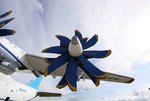
Their Bear turboprop bomber of the last 50 or so years is the world's fastest propeller-driven aircraft at 575 mph and those giant props are supersonic for almost 1/3 of their blade length. Go figure. So the rest of us are avoiding supersonic props blades and tips and the Russians are going faster WITH supersonic props ... at the cost of incredible noise.
You may remember that Jim Wright made a replica of the Howard Huges H-1 racer, complete with the same engine and prop. He was warned by several people that the 2-blade with the Hornet engine was a dangerous combination but, while flying back to Oregon from Oshkosh, he shed a prop blade and crashed.
I think the Germans stuck with 3-blades and added propeller chord for more powerful engines because they also favored fuselage armament and going to 4 blades would cut way down on the rate of fire though the synchronizers.
The USA experimented a bit. We went with longer 3-bladed props (13+ feet diameter!) as well as 4-bladed props for the R-2800 radial. The P-51 started out with a 3-blade Curtiss-Electric prop and would up with a 4-blade Hamilton or Aeroproducts unit ... and we did NOT need synchornizer gear since the guns were in the wings. In that case, it was the ground clearance taht determine more blades rather than a longer prop.
There are some rules of thumb out there for number of blades, blade area, and diameter ... but the Russians just love to confound the world.
Their Bear turboprop bomber of the last 50 or so years is the world's fastest propeller-driven aircraft at 575 mph and those giant props are supersonic for almost 1/3 of their blade length. Go figure. So the rest of us are avoiding supersonic props blades and tips and the Russians are going faster WITH supersonic props ... at the cost of incredible noise.
Last edited:
Users who are viewing this thread
Total: 1 (members: 0, guests: 1)

