![]() |
| |||||||
| Aircraft Pictures Pictures of aircraft of WWII. Discuss the pictures in the album here. |
![]() |
| | LinkBack | Thread Tools | Display Modes |
| | #1 |
| Senior Member Join Date: Jan 2009 Location: United Kingdom
Posts: 1,766
| A Curtiss P-40 Pictorial History Designer Donovan Berlin's fame was based nearly 100 per cent on the single, basic fighter design - the Hawk 75 - that he managed as Project Engineer for the Curtiss Aeroplane Div, Curtiss-Wright Corp from 1934 until he left its employ in December 1941. It isn't entirely clear why he terminated his service there, but it most likely concurred with his employment by General Motors (Fisher) at Cleveland, Ohio, a mere 190 road miles from Buffalo, NY. Guy Vaughn was the wartime president of Curtiss Aeroplane, his VP was Burdette S Wright. Walter Tydon moved into the project engineer's position vacated by Berlin and was responsible for the best-looking, best-performing P-40 aeroplane in the entire series: the XP-40Q. According to Mr Tydon, it did not go into production because of the combination of vacillation and reticence in top management, plus a powerful financial control over C-W's fate that was vested in Wall Street. The operation was a 'cash cow'. Burdette Wright held top-level management positions at both Curtiss Aeroplane & Engine Co and Curtiss-Wright Corp after an 11-year career in the US Army Air Service/Air Corps (1917 - 28 ). C-W was less than successful in designing technological leaders during Wright's watch, right through to the king-sze XP-87 night fighter in the late 1940s. Winning outsize contracts for the Curtiss P-36, P-40, SB2C and SO3C airplanes was tied to 'favoured' status with the War Department for years and many failed airplanes salted the tail of the corporation for almost two decades. While the XP-40Q was the fastest and best-performing of all P-40s, it still trailed North American Aviation's fighter designs as well as those from Germany, Britain, Japan and probably Russia. C-W's top management didn't want to contend with the XP-40Q major redesign and tooling changes, not to mention lost production time, that were required for production contracts of that type. By the middle of the last century, the American aircraft industry giant that had been created from the two greatest pioneers in aircraft manufacturing in the USA , and perhaps the world, was a fading shadow. This pictorial history chronicles the fighter aircraft that directly evolved from the Model 75 pursuit design created by Berlin and his staff for the 1935 Army Air Corps Pursuit Plane competition. This is not intended to be a pretty story, nor is it an indictment of the airplane. The P-40 gave yeoman service in many venues, but it wasn't the type of weapon that could ever be dominant in any war against a determined, tough and technically brilliant enemy. At best, it was a spear-thrower in a war dominated by archers and swordsmen. Last edited by Colin1; 06-24-2009 at 04:29 AM. |
| | |
| | #2 |
| Senior Member Join Date: Jan 2009 Location: United Kingdom
Posts: 1,766
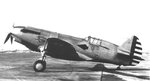
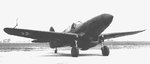
| XP-37 Some top-notch writers have noted that the Curtiss XP-40 was designed around the Allison V-1710C-series engine. Actually, in a desperate effort to catch up with dominant opponents before an oncoming war, Curtiss adapted a 5-year old standard pursuit plane to be powered by an inline V-12 Allison. In every sense, it was (as the H571 was, too) the hot-rodding of an already obsolescent airframe. ATSC via Warren Bodie Last edited by Colin1; 06-08-2009 at 04:49 AM. |
| | |
| | #3 |
| Senior Member Join Date: Jan 2009 Location: United Kingdom
Posts: 1,766
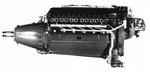
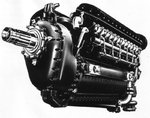
| Allison V-1710C engine When the Allison V-1710C-series engine was installed in the original prototype Model 75, the XP-37 became the Model 75I. Its length grew from 28 feet 2 inches (8.5m) to 31 feet (9.4m) and the rated power was 50hp less than the standard P-36C airplanes. The XP-37's speed was only marginally faster than that of the P-36G - 29mph (47km/h) faster and of the Hawker Hurricane prototype that flew about 18 months earlier. The XP-37 was unsuitable for production. Allison 77075 via Warren Bodie Last edited by Colin1; 06-07-2009 at 08:34 PM. |
| | |
| | #4 |
| Senior Member Join Date: Jan 2009 Location: United Kingdom
Posts: 1,766
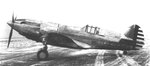
| YP-37 Despite the problems encountered with the XP-37 'Mule' and its GE turbo supercharger installation, the Air Corps (ie Gen Arnold) was determined to invest heavily in the Allison/GE combination. Consequently, an order was placed for 13 service-test YP-37 airplanes. These had V-1710-21 engines with newer, type B-2 superchargers. Design improvements made the new aft fuselage 25 inches (0.65m) longer and the horizontal tailplane was raised several inches. The first one appeared in January 1939. The prototype Spitfire's maiden flight had been nearly three years earlier. Curtiss 11640 via Warren Bodie Last edited by Colin1; 06-07-2009 at 08:35 PM. |
| | |
| | #5 |
| Senior Member Join Date: Jan 2009 Location: United Kingdom
Posts: 1,766
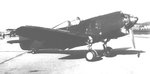
| XP-42 Special Hawk Probably panicked by the P-37 failures and the drag penalty of existing radial engines, the Army and NACA experimented with low-drag cowls for radial engines. Beginning in March 1939, the fourth P-36A was fitted with a series of new cowls in an attempt to solve the drag problem; this was exactly three years after the Spitfire first flew. Shortly thereafter, the Spitfire demonstrated a speed of 349.5mph (562.5km/h) - only 4mph (6.5km/h) better than the standard P-36C. USAAC via Warren Bodie Last edited by Colin1; 06-07-2009 at 03:35 PM. |
| | |
| | #6 |
| Senior Member Join Date: Jan 2009 Location: United Kingdom
Posts: 1,766
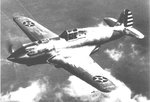
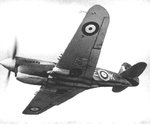
| First XP-40 in flight (Type H-75P) with aft radiator scoop When this picture (or a nearly identical picture) was published in Popular Aviation Magazine in 1939, the caption said it was 'America's new 400mph fighter' and it is likely that most readers believed that nonsense. Actually, it was most unfortunate in that it was essentially a Curtiss P-36A with a V-1710 Allison engine installed in place of the P&W R-1830. According to Air Corps data, it was capable of 342mph (550.4km/h). USAAC via Warren Bodie Last edited by Colin1; 06-07-2009 at 04:15 PM. |
| | |
| | #7 |
| Senior Member Join Date: Jan 2009 Location: United Kingdom
Posts: 1,766
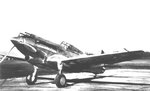
| XP-40 Second version With the coolant radiator relocated to the nose as per the corporate sales insistence of 'for appearance reasons' the wing fillets and inboard leading edges of the wing were revised with additional air-inlet slots. With these changes, Berlin increased the plane's 'guaranteed high speed' to 360mph (580km/h); that was a NACA wind-tunnel speed with 5mph (8km/h) added to cinch the contract. At the same time, Fighter Project Officer Lt Ben Kelsey was in California flight-testing the new XP-38. Gen Arnold bought Berlin's worthless guarantee and placed an order. Wright Field via Warren Bodie Last edited by Colin1; 06-07-2009 at 04:26 PM. |
| | |
| | #8 |
| Senior Member Join Date: Jan 2009 Location: United Kingdom
Posts: 1,766
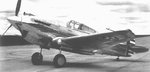
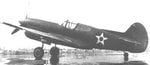
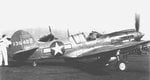
| P-40 Production model One of the first three production P-40s (identical to a third prototype) was assigned to the Service Test Division; all three remained unpainted while the rest of the 524-unit production order featured a newly-specified camouflage scheme. Ready for its delivery to Wright Field, this P-40 had a production spinner and the final exhaust stack configuration. The familiar P-36-style wheel fairing plates had been eliminated. Photo is dated 22Apr40 at Buffalo, NY. Curtiss 12950 via Warren Bodie Last edited by Colin1; 06-07-2009 at 03:39 PM. |
| | |
| | #9 |
| Senior Member Join Date: Jan 2009 Location: United Kingdom
Posts: 1,766
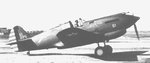
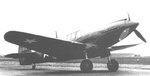
| Standard AAC service P-40 Under the circumstances that existed in America in the summer of 1940, most citizens who saw a camouflaged first-line Curtiss P-40 (no suffix letter) assigned to the 31st Pursuit Group, probably felt that pride was well founded. But the USAAC was still mired in the obsolete thinking that was centred on the Two-Ocean defence line, medium bombers, observation aircraft and in an ignorance of German, Russian and Japanese military aircraft and existing threats. These Curtiss P-40 fighters were obsolete on the day they were delivered. Warren Bodie Last edited by Colin1; 06-07-2009 at 03:04 PM. |
| | |
| | #10 |
| Senior Member Join Date: Jan 2009 Location: United Kingdom
Posts: 1,766
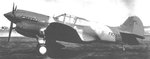
| An early export Curtiss Historical records inform us that Churchill and Stalin pleaded with and cajoled Roosevelt during the late summer of 1940 for support in any form, esp for fighter and bomber aircraft, to combat the Nazis. Britain needed fighters in the UK for the all-important Battle of Britain and also wanted them in Egypt to prevent a major defeat in North Africa. Roosevelt diverted large numbers of P-40s like this H81-A2 model in November 1940. Most H81-A1s and -A2s were used for training, not combat. Curtiss 13925 via Warren Bodie Last edited by Colin1; 06-08-2009 at 04:10 AM. |
| | |
| | #11 |
| Senior Member Join Date: Jan 2009 Location: United Kingdom
Posts: 1,766
| A major Allison engine: the F-series Beginning with the P-40D series (new model no H87-A2) Allison provided F-series engines with new reduction gearbox drives that could handle a greater horsepower limit than the 1,100hp limit of the previously installed C-series engines in all P-40s (H81-A). The thrust line was raised considerably with the F2 engines. This also caused fuselage changes, a redesigned windshield and canopy/aft vision panel setup. Warren Bodie |
| | |
| | #12 |
| Senior Member Join Date: Jan 2009 Location: United Kingdom
Posts: 1,766
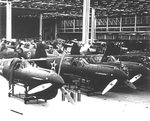
| Organised production chaos at Curtiss This view of a non-mechanised assembly area of the newest Curtiss Buffalo, NY plant (pre-Pearl Harbour) depicts a pre-wing mate; this was probably late at night before a three-shift schedule was adopted in 1942. In the background, P-40D and H87-A2 Kittyhawk I fuselages and components are in close quarters with O-52 fuselages. The P-40D was a significant departure from the P-40C/H81 Tomahawk version. Curtiss via Warren Bodie Last edited by Colin1; 06-07-2009 at 02:57 PM. |
| | |
| | #13 |
| Senior Member Join Date: Jan 2009 Location: United Kingdom
Posts: 1,766
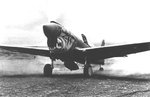
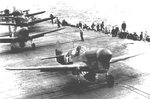
| Aleutian Tiger P-40E Maj John Chennault taxis in a somewhat unusual dust storm created by his own propeller at Adak in the Aleutians. His P-40E was named Aleutian Tiger. This 11th AF base was usually rife with B-24s, P-40s and P-38s. He was the eldest son of Gen Claire Chennault. Ten of the P-40Es assigned to the 11th AF were moved to Umnak Island in May 1942. The 18th FS, 54th FS and 11 RCAF Kittyhawks eventually joined them. USAAF via Warren Bodie Last edited by Colin1; 06-07-2009 at 03:02 PM. |
| | |
| | #14 |
| Senior Member Join Date: Jan 2009 Location: United Kingdom
Posts: 1,766
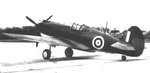
| RAF Kittyhawk Ia In deserts and jungles the P-40Es and Kittyhawk Is, like this RAF Kittyhawk Ia (H87-A3) performed well enough in combat to be accepted as frontline troopers. If kept away from Macchi MC 202 and 205s or Bf109Fs, they could more than hold their own. Tactics, toughness and their batteries of .50 machine guns coupled with good pilots at the controls gave them an edge, but not in the skies of Northern Europe. GH Curtiss Museum via Warren Bodie Last edited by Colin1; 06-07-2009 at 03:00 PM. |
| | |
| | #15 |
| Senior Member Join Date: Jan 2009 Location: United Kingdom
Posts: 1,766
| XP-40F With Packard Motors accelerating into the production of the RR Merlin, a decision was made to mate a 1,300hp Merlin with a P-40E (AC40-360). With minimal external changes, one XP-40F (Model H87-B3) was created. An order was soon placed for no less than 1,311 of these new fighters that were designated P-40F. Soon, the aircraft sprouted a dorsal fin, it was the first of several changes that were incorporated as problems were encountered. Curtiss via Warren Bodie Last edited by Colin1; 06-07-2009 at 02:58 PM. |
| | |
![]() |
| Thread Tools | |
| Display Modes | |
| |