| Hawker Hurricane Mk. IIB vs. Grumman F4F-4 Wildcat| Aviation Discuss Hawker Hurricane Mk. IIB vs. Grumman F4F-4 Wildcat in the World War II - Aviation forums; Originally Posted by pbfoot
Wake Island would be comparable to the Glads in Malta, but did not the F4F usually ... |
|
11-14-2007, 06:10 PM
|
#121 | | Senior Member
Join Date: Nov 2006
Posts: 315
Country: | Quote:
Originally Posted by pbfoot Wake Island would be comparable to the Glads in Malta, but did not the F4F usually have the advantage of height in Guadaulcanal when facing the Zeros as opposed to the Hurricanes which were surprised to find the Japanese over Ceylon and were attacking from below. | Again let's not focus entirely on Ceylon for Hurricanes, because there are a fair number of other examples. In Jan-April '42, when fighting greatly died down on British fronts v Japanese, the Hurricane results, as given in Bloody Shambles combat by combat as I count, fighter to fighter:
Zeroes: 2 combats over Ceylon, 27 Hurricanes lost for 3 Zeroes
Zeroes: 3 other combats with both sides known: 8 Hurricanes 3 Zeroes
Type 1's: 12 combats, 20 Hurricanes, 4 Type 1's
Type 97's: 9 combats, 8 Hurricanes, 5-6 Type 97's
1 Hurricane was lost in a combat with either Type 1's or Zeroes w/ no J loss, and 7 in combats where the Japanese side is not given. A few were Dutch Hurricanes, and a few combats were along with the AVG but only one has a real claim overlap, that's 5 v 6 Type 97's.
So the Hurricane combat effectiveness problem v the Japanese in the early campaigns was not a fluke of one situation. The Hurricanes were not outnumbered and surprised in every one of the 26 two-side documented combats, not nearly, but came out on the short end of all of them, except 2 combats v. Type 97's.
In the set piece interceptions over G'canal by F4F's, of Type 1 Land Attack Planes ('Betty') escorted by Zeroes, F4F's often had altitude advantage, but sometimes didn't. Plus, not all combats over G'canal involving land based planes in 1942 were those set pieces. Some were battles over convoys or carrier based planes of one side v landbased ones of the other, which occured at lower altitude. And a significant % were carrier fighters on both sides. At Coral Sea and Midway as already mentioned Lundstrom found the score between carrier based fighters was 14 (Zeroes, plus 2 Type 96's) v 10 carrier based F4F's. The numbers for Eastern Solomons and Santa Cruz are included above in Frank's numbers for all G'canal thru Nov 15 1942, but the carrier Zeroes did a bit better in the second two carrier battles. But overall the exchange in actions between carrier fighters was also around 1:1, where there was no tendency for altitude advantage on either side, and a general numerical advantage for the Japanese.
I suggest reading the references given above, count up and consider in their totality all the combats, and then see if a plausible case can be made that the Hurricane v F4F effectiveness difference can easily be explained by one factor like tactical situation. I don't see how.
Joe |
| |
11-14-2007, 06:43 PM
|
#122 | | Senior Member
Join Date: Apr 2005 Location: NIAGARA
Posts: 4,762
Country: | Most of these losses occured early on in the conflict during the first 4 months what were the losses like later in the conflict . Every allied aircraft was taking a beating including the Spitfire over Darwin are we to assume because the Spit was clobbered by Zeros the Wildcat was better then it or can we assume tactics changed to focus on the strong points of the aircraft.
__________________ |
| |
11-14-2007, 08:20 PM
|
#123 | | Senior Member
Join Date: Oct 2006
Posts: 1,033
Country: | Hi Joe,
>The Hurricanes were not outnumbered and surprised in every one of the 26 two-side documented combats, not nearly, but came out on the short end of all of them, except 2 combats v. Type 97's.
Thanks for the great summary!
>I suggest reading the references given above, count up and consider in their totality all the combats, and then see if a plausible case can be made that the Hurricane v F4F effectiveness difference can easily be explained by one factor like tactical situation. I don't see how.
I believe the decisive factor is not the tactical situation, but rather the tactical doctrine.
I believe one might add that the tactical properties of a fighter aircraft include one important aspect easily forgotten in hindsight, it's "mystery factor" - the degree to which its tactical abilities are unknown to the enemy.
If a fighter pilot is not aware of the strength and weaknesses of the enemy aircraft compared to those of his own, he might fail to use the strengths of his own aircraft properly. In my opinion, that's why the Hurricanes lost against the Zeros though technically, the British fighter might well have been superior.
"Hurricane over the Jungle" by Terence Kelly contains an interesting account of Hurricane operations from Tjillitan on Java with 605 Squadron. On receiving a radio warning of an impeding attack, they usually scrambled a handful of fighters that climbed to 34000 ft, where the Hurricane would barely fly but where they never encountered a Zero. When they spotted the enemy formation below, each pilot would make a diving pass when he judged he was in a good position, diving at one enemy aircraft, then through the enemy formation and on to escape. Apparently, it was very hard to hit, and to find out whether one had hit, and according to Kelly 605 squadron didn't file any claims (partially because there was no-one to accept the claims anyway).
However, I consider this account interesting because it illustrates that even the Hurricane did have strengths that could be employed tactically, even when badly outnumered.
Regards,
Henning (HoHun) |
| |
11-14-2007, 08:37 PM
|
#124 | | Senior Member
Join Date: Nov 2006
Posts: 315
Country: | Quote:
Originally Posted by pbfoot Every allied aircraft was taking a beating including the Spitfire over Darwin are we to assume because the Spit was clobbered by Zeros the Wildcat was better then it or can we assume tactics changed to focus on the strong points of the aircraft. | The F4F never took a sustained beating in fighter combat. It did in some particular combats of course, but not in any period of months as Hurricanes did in 1942, and yes as Spitfire V's did defending Darwin in 1943. They did about as poorly as Hurricanes did v Zeroes and Type 1's in 1942, worse in fact than P-40's had done in 1942 performing the same mission in the same place v the same Japanese Navy fighter unit, not even just the same type of plane (the 3rd Air Group had been renamed 202nd Air Group by 1943); the P-40 result had been about 1:2 in favor of the Zeroes. Also we can note that AVG P-40's cumulatively to end June '42 had a ratio of ~3:1 in their favor against both Type 97's and Type 1's; to compare to the Hurricane results.
Tactics would certainly be *one thing* to look at, but if possible in a substantive way, not just as some fudge factor along the lines of: "results don't jibe with our preconceptions, must be 'tactics'". And then preconceptions about the airplanes should also be reconsidered; as well as general preconception about how to measure them, for example that stuff like max speed and climb rate strongly dictated fighter v fighter combat success; did they actually? An F4F could turn better than either of the British planes (or the P-40) and an F4F pilot could track a target in deflection a lot better looking down the plane's stubby nose. Perhaps those were more important plane performance factors than we assume, against such opponents as Zero and Type 1. I don't know that the F4F was really inferior to the Spit V as fighter v fighter combat machine against a plane like the Zero or Type 1. The actual 1943 would seem to undercut any clear certainty about that.
But I don't believe 'plane' and 'pilot' and 'other' factors can necessarily be neatly separated. I started responding to a flat statement that the Hurricane did well v Japanese fighters 'early', and better 'it was thought' than the F4F; that at least is clearly not so.
Joe |
| |
11-14-2007, 09:17 PM
|
#125 | | Senior Member
Join Date: Apr 2005 Location: NIAGARA
Posts: 4,762
Country: | What I was trying to infer was the tactics in early 42 were probably changed a great deal in a few months . the learning curve was steep and by the time Guadaulcanal rolled around a consensus on how to use the tools at hand was formed . It was a different type of flying from the ETO where the RAF learned its craft also the hard way. How would of the F4F done in Malta I'll wager not well
__________________ |
| |
11-14-2007, 09:52 PM
|
#126 | | Senior Member
Join Date: Nov 2006
Posts: 315
Country: | Quote:
Originally Posted by pbfoot What I was trying to infer was the tactics in early 42 were probably changed a great deal in a few months . the learning curve was steep and by the time Guadaulcanal rolled around a consensus on how to use the tools at hand was formed . It was a different type of flying from the ETO where the RAF learned its craft also the hard way. How would of the F4F done in Malta I'll wager not well | That's what I was also trying to imply, you simply assume that because the results don't meet your preconceptions and/or simple paper stats comparison.
But was there in fact a lot of inter-air arm consultation about tactics among say between RAF, KNIL air corps, USAAF and the USN between early and mid 1942? no. What the USN knew from the early battles from the other air arms was this was a tough opponent, that's about it. James Thach invented his 'weave' (aka Beam Defence Manuever, unique USN tactic) in part based on reports about the Zero from China in 1941. He used it in his division (of 4 a/c) at Midway (with success confirmed in J accounts), but it wasn't std in this period. And specific anti-Zero tactics also were influenced by tests of the Zero recovered in the Aleutians in July, but restoring it, testing it and issuing reports also wasn't done until the end of the period (stats for F4F's were to Nov 15 '42).
So that's my point, if we look at tactics development substantively and historically, not as a fudge factor where we just assume stuff, a combined-Allied tactics learning curve explanation over a few months in 1942 becomes a less than compelling explanation. Less so still considering the Spit debacle in 1943.
I don't know about F4F's at Malta, I wonder if you're considering actual Hurricane/Spit results there or claimed ones, the Hurricane in particular was no stranger to being on the short end of exchange ratio's in fighter combat, but that's too much of a tangent. For the Pacific we have actual comparisons against the same opponents in the same general time period suggesting at least a reasonable possiblity that intangible performance factors rendered the Hurricane (and perhaps Spitfire V) considerably less formidable than it looked on paper, as compared to the F4F, against those kind of opponents.
Joe
Last edited by JoeB : 11-14-2007 at 10:01 PM.
|
| |
02-25-2008, 12:20 AM
|
#127 | | Member
Join Date: Feb 2008
Posts: 77
Country: | Hurricane performance A quick flip through Ospreys "Hurricane Aces 1941-45" would seem to indicate that the Hurri did far better than the stats posted above. Jack Storey and Frank Carey shot down 7 nates just by themselves in that time period.
The initial deployment of Hurricanes in January 1942 to Burma amounted to 30 hurricanes MK IIa s and some Mk Is, split between 3 squadrons. Not much of a force really. In almost all of these combats the Hurricanes being on the defensive ,without radar were consistantly outnumbered and still climbing when combat occurred. They never stood a chance in Ceylon. In Burma though they did much better giving as good as they got, though still heavily outnumbered.
If you take look at one of their few offensive actions such as the raid on the Japanese airbase at Magwe on March 23 1942, a force of 9 Blenheims and 10 Hurricanes destroyed 16 Sallys on the ground and 11 Oscars in the air, 9 by Hurricanes. This for the loss of 2 hurris and 2 blens.
In many of the accounts I have read , the RAF pilots consider the Hurricane an even match for the oscar or the zero. Terence Kellys books , Hurricanes over the Jungle, Hurricane and Spitfire Pilots at War and The 9 Lives of a Fighter Pilot are all good reads on this subject.
Slaterat |
| |
02-25-2008, 02:05 AM
|
#128 | | Senior Member
Join Date: Oct 2006
Posts: 1,033
Country: | Hi Slaterat,
>In many of the accounts I have read , the RAF pilots consider the Hurricane an even match for the oscar or the zero. Terence Kellys books , Hurricanes over the Jungle, Hurricane and Spitfire Pilots at War and The 9 Lives of a Fighter Pilot are all good reads on this subject.
I liked Kelly's books quite well, too
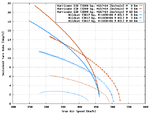
With regard to the Hurricane, a performance comparison below ... no reason for the Hurricane pilot not to be confident!
Regards,
Henning (HoHun) |
| |
02-25-2008, 07:04 AM
|
#129 | | Senior Member
Join Date: Nov 2007
Posts: 391
Country: | I didn't read through the entire thread, but I gotta wonder about this one.
In a slow speed turning battle, I wonder if the Hurricane wouldn't have an advantage, if for no other reason than its very thick wing.
I remember receiving an issue of Popular Mechaincs as a kid and there was an article in there about a guy who built his own Hurricane (1/2 or 3/8 scale, I believe).
When asked why a Hurricane over the more popular Spitfire, he stated that the thick wing was easier to build in the scaled down mode he was working in.
I'm thinking that, although the wing does taper down quite a bit as you go out from root to tip, there may be enough of the "thick area" to improve low speed handling, over a more common wing that would've been fitted to any a/c of the day.
Also, is it just me or does the top speed listed for the Hurricane seem a little high?
342mph?
Seems I see speeds in the 325-335 mph range more common for the Hurricane.
Maybe it's just that particular version.
...so which one would I pick?
1/2 metal - 1/2 wood & cloth  ... or ... A Flying Tank?
I'll take the tank, in "dash 3" varient, please.
If I can't outmanuver him, I will at least be in a more robust machine.
Elvis
Last edited by Elvis : 02-25-2008 at 07:18 AM.
|
| |
02-25-2008, 03:58 PM
|
#130 | | Senior Member
Join Date: Oct 2006
Posts: 1,033
Country: | Hi Elvis,
>In a slow speed turning battle, I wonder if the Hurricane wouldn't have an advantage, if for no other reason than its very thick wing.
I had a short look at the numbers, and while I don't have exact data on either type's wing, my guess is that the Hurricane was too heavy to compete with the much lighter A6M2 when it came to turning (despite the Hurricane II's greater power).
>When asked why a Hurricane over the more popular Spitfire, he stated that the thick wing was easier to build in the scaled down mode he was working in.
It probably flies better, too - aerodynamics don't scale well
>Also, is it just me or does the top speed listed for the Hurricane seem a little high?
>342mph?
>Seems I see speeds in the 325-335 mph range more common for the Hurricane.
Quite possible - note that the Hurricane II in my diagram uses fairly high boost pressures that weren't cleared yet when the type first came out.
Additionally, the RAF first selected one set of figures as representative for the Hurricane, then revised these figures to read somewhat higher later. If you rely on the earlier version of the test documents, you'll end up with slightly lower figures.
Regards,
Henning (HoHun) |
| |
02-25-2008, 05:17 PM
|
#131 | | Member
Join Date: Oct 2007
Posts: 35
Country: | Hurricane II speeds Quote:
Originally Posted by Elvis I didn't read through the entire thread, but I gotta wonder about this one.
In a slow speed turning battle, I wonder if the Hurricane wouldn't have an advantage, if for no other reason than its very thick wing.
I remember receiving an issue of Popular Mechaincs as a kid and there was an article in there about a guy who built his own Hurricane (1/2 or 3/8 scale, I believe).
When asked why a Hurricane over the more popular Spitfire, he stated that the thick wing was easier to build in the scaled down mode he was working in.
I'm thinking that, although the wing does taper down quite a bit as you go out from root to tip, there may be enough of the "thick area" to improve low speed handling, over a more common wing that would've been fitted to any a/c of the day.
Also, is it just me or does the top speed listed for the Hurricane seem a little high?
342mph?
Seems I see speeds in the 325-335 mph range more common for the Hurricane.
Maybe it's just that particular version.
...so which one would I pick?
1/2 metal - 1/2 wood & cloth  ... or ... A Flying Tank?
I'll take the tank, in "dash 3" varient, please.
If I can't outmanuver him, I will at least be in a more robust machine.
Elvis | I'm at work and away from my books, but I'm pretty sure the max speeds I've seen listed for the Hurricane II are:
Hurricane II prototype - 348 mph
IIa - 342 mph (armament 8 x .303-cal.)
IIb - 339 mph (armament 12 x .303-cal.)
IIc - 336 mph (armament 4 x 20-mm.)
IId - 286 mph (of course the big drop is because of the 40-mm armament)
P.S. The very fastest speed I've ever seen listed for a Hurricane is an estimated 350 mph for photo-recon Hurricanes in North Africa that were stripped of armament. |
| |
02-25-2008, 07:31 PM
|
#132 | | Senior Member
Join Date: Jan 2007 Location: Montrose, Colorado
Posts: 2,274
Country: | JoeB, I am a fan of Lundstrom also. Don't believe I have ever seen any books as well researched and authoritative as his are. In the discussion youall are having about the records of the F4F and Hurricane against the Japanese I believe one edge the Wildcat would have would be the ruggedness of the AC versus the Hurricane, especially the radial engine. You also might recall the Lundstrom mention of the "pin cushion' tactics of the Wildcat pilots. The other factor I would not discount is that of the skill and training of the USN and USMC pilots. In a word, on average, I think they were better trained, particularly in aerial gunnery than the Commonwealth pilots and for that matter the AAF pilots in the early days of the Pacific campaign. One last comment, to get in a slow turning fight with a Zero, in any Allied plane was a poor idea. |
| |
02-25-2008, 08:25 PM
|
#133 | | Senior Member
Join Date: Apr 2005 Location: NIAGARA
Posts: 4,762
Country: | Quote:
Originally Posted by renrich , I think they were better trained, particularly in aerial gunnery than the Commonwealth pilots and for that matter the AAF pilots in the early days of the Pacific campaign. . | I don't know what your basing this on . Are they smarter , did the US have a better training syllabus . I have a tough time swallowing this
__________________ |
| |
02-26-2008, 02:23 AM
|
#134 | | Senior Member
Join Date: Oct 2006
Posts: 1,033
Country: | Hi Jerry,
>I'm at work and away from my books, but I'm pretty sure the max speeds I've seen listed for the Hurricane II are:
>Hurricane II prototype - 348 mph
Are the boost pressures listed in your books? I don't think the prototype would be using the +14 lbs/sqin boost setting that was only cleared later in the war. The boost pressure uncertainty makes it difficult to learn something from the figures you posted ...
Regards,
Henning (HoHun) |
| |
02-26-2008, 02:25 AM
|
#135 | | Senior Member
Join Date: Oct 2006
Posts: 1,033
Country: | Hi Renrich,
>You also might recall the Lundstrom mention of the "pin cushion' tactics of the Wildcat pilots.
Hm, what are the "pin cushion" tactics? I believe I haven't heard of that move before ...
Regards,
Henning (HoHun) |
| | | Thread Tools | Search this Thread | | | | | Display Modes | Linear Mode |
Posting Rules
| You may not post new threads You may not post replies You may not post attachments You may not edit your posts HTML code is Off | | | All times are GMT -5. The time now is 10:35 AM. |  | |