
Navigation
Install the app
How to install the app on iOS
Follow along with the video below to see how to install our site as a web app on your home screen.
Note: This feature may not be available in some browsers.
More options
You are using an out of date browser. It may not display this or other websites correctly.
You should upgrade or use an alternative browser.
You should upgrade or use an alternative browser.
Italy v. England - Air to air
- Thread starter DAVIDICUS
- Start date
Ad: This forum contains affiliate links to products on Amazon and eBay. More information in Terms and rules
More options
Who Replied?

cheddar cheese
Major General
Short Answer: NO
Long Answer: NO WAY

Long Answer: NO WAY

mosquitoman
Master Sergeant
The fighters were probably a good match for each other except there weren't too many of the 5 Series around compared to Spits and Tiffies. The Italian bomber force was puny in comparison and all the Italian cities (with the factories in) would have been flattened
cheddar cheese
Major General
I think the Italian fighters could have easily dealt with the bombers.
- Thread starter
- #5

the lancaster kicks ass
Major General
- 19,931
- Dec 20, 2003
before the italian surrender?? the spitfire, hurricane, gloster gladiator, mosquito, and yes, the Skua and the Roc were all better fighters than anything the italians had................
- Thread starter
- #7
trackend
Chief Master Sergeant
I thing we had an experimental Halitosis cannon on trial but the barrel kept melting . 
At least none of the British aircraft had reverse gear for pronto pronto escape
At least none of the British aircraft had reverse gear for pronto pronto escape
the lancaster kicks ass
Major General
- 19,931
- Dec 20, 2003
it was only a metter of time............
trackend
Chief Master Sergeant
Well. I just had to say it first as I want to be a trend setter Lanc
- Thread starter
- #11
I was merely poking fun at Lanc for the audacious statemant that the Hurricane, Goster Gladiator, Skua, etc. were better than the Series 5 fighters.
Halitosis Cannon? Isn't that a cigar?
I thought the Brits had a patent on reverse gear mechanisms that they perfected during their run ins with Rommel.
Seriously though, did the Brits field anything by September of '43 that was a better air to air machine than the Series 5's?
Halitosis Cannon? Isn't that a cigar?
I thought the Brits had a patent on reverse gear mechanisms that they perfected during their run ins with Rommel.
Seriously though, did the Brits field anything by September of '43 that was a better air to air machine than the Series 5's?
the lancaster kicks ass
Major General
- 19,931
- Dec 20, 2003
yes, pretty much everything............

kiwimac
Staff Sergeant
Nope the english did not.
The Fiat G.55, Reggiane 2005 and the Macchi 202 / 205 we far superior to anything the brits had. As for the old Italians and reverse gear gag, you need to be reminded that that was a piece of propaganda designed for the British Home Front.
Where they were adequately supplied, the Italians were the match for anyone.


All photos and infromation from http://www.comandosupremo.com/Air.html
The Fiat G.55, Reggiane 2005 and the Macchi 202 / 205 we far superior to anything the brits had. As for the old Italians and reverse gear gag, you need to be reminded that that was a piece of propaganda designed for the British Home Front.
Where they were adequately supplied, the Italians were the match for anyone.
The final Macchi fighter was the ultimate development of this line, the MC.205 Veltro (greyhound). It first flew in April 1942 using the MC.202 airframe with a more powerful Daimler-Benz DB605 engine and also used the 1,475hp Fiat inline engine. Maximum speed was 399 mph, a range of 646 miles and a service ceiling of 37,090 ft. It was armed with 2 12.7mm Breda machine guns in the cowling and 2 wing mounted 7.7mm machine guns which were soon supplanted by 20mm cannon, with additional cannon or 12.7mm machine guns later added.
The MC.205 reached Italian squadrons in June 1943 and was used over North Africa, Pantelleria, Sicily and Italy. On their first sortie, 25 MC.205s faced a larger number of P-40's and Spitfires. Over Sicily, the MC.205 was used to try and stop the American bombers. The first Stormo to get the MC.205 was the 1st Stormo. The 51st Stormo received their MC. 205 in April 1943 and on 8/2/43, 6 MC.205 attacked 20 P-38 and P-40s destroying 6 of the Allied fighters for the loss of only 1 MC.205.
After the armistice, the majority of the MC.205 were with the pro-Axis forces with 112 new MC.205's built for that air force, along with the 29 that came over after the armistice. The MC.205 was capable of meeting on equal terms the Mustang and the latest German fighters. The MC.205 was produced until 1948, representing the best aeronautical engineering during the war
Specifications
Crew 1
Length 8.9m
Wingspan 10.6m
Height 3.0m
Engine Fiat RA 1050 R.C.58
Max Speed 650 Km/h
Armament Serie I /Breda SAFAT 7.7mm Machine gun X2 Serie III: M.G. 151 20mm Cannons X2
Article by JDG
Sources:
Enzo Angelucci Paolo Matricardi, World War II Airplanes (2 vol.), Rand McNally, 1978.
Hans Werner Neulen, In the Skies of Europe: Air Forces Allied to the Luftwaffe, 1939-45, Crowood Press, 2000.
Jane's Fighting Aircraft of WWII, Military Press, 1989.
Chris Bishop (Ed.), Encyclopedia of Weapons of World War II, Barnes Noble, 1998.
Bill Gunston, Illustrated Directory of Fighting Aircraft of World War II, Motorbooks, 2000.
K. G. Munson, Enemy Aircraft (German and Italian) of World War II, Ian Allen, 1960.
Jonathon Thompson, Italian Civil and Military Aircraft 1930-45, Aero, 1960.
William Green, Warplanes of the Second World War (10 vol.), Doubleday, 1960-68.
Nico Sgarlato, Italian Aircraft of World War II, Squadron/Signal Publications, 1979.
Roberto Gentilli, Macchi MC.202 In Action, Squadron/Signal Publications, 1970.
Giorgio Apostola, Aer. Macchi C.202, La Bancarella Aeronautica, 1995.
Brian Cull, Spitfires Over Sicily, Grub Street, 2000.
Brian Cull, Hurricanes Over Tobruk, Grub Street, 2000.
The MC.202 Folgore (lightning) was a direct descendant of the MC.200 that retained the same wing and controls, along with parts of the fuselage, but being powered by the inline Daimler Benz DB601 (later license built by Alfa Romeo). The MC.202 was delivered to operation groups in 1941, after the prototype flew in 1940 and had an enclosed cockpit. The MC.202 was armed with 2 12.7mm Breda machine guns in the cowling and 2 7.7mm machine guns in the wings. Some later versions had the 7.7mm machine guns replaced by 20mm cannon. The MC.202's top speed was 372 mph, range of 475 miles and had a service ceiling of 37,730ft.
The MC.202 clearly proved superior to the P-40 and Hurricane and met its match with the Spitfire and Mustang. By late 1942, MC.202s outnumbered other fighters in the Regia Aeronautica. The MC.202 saw service in the North Africa campaign, Malta, Sicily, and over Italy. There were 2 main subversions, the AS for tropical service and the CB fighter-bomber. After the armistice in 1943, MC.202s flew with both Italian air forces. This was arguably the best Italian fighter to see large-scale service during the war.
There are only a few restored examples of the MC.202 left, one being in the National Air Space Museum in Washington DC and is a late model MC.202 painted in the markings of the 90th Squadriglia, 10th Gruppo, 4th Stormo in Libya in 1942.
Specifications
Wingspan 34 ft, 8 1/2 inches
Length 29 ft, 11 1/2 inches
Range 475 miles at 267 mph at 21,320 ft
Height 9 ft, 11 1/2 inches
Engine Alfa Romeo R.A. 1000, 12 cyclinder inline, 1075 hp
Max Speed 372 mph at 18,370 ft
Armament Breda SAFAT .50' MG, optional (2) 7.7mm Breda-SAFAT wing MG
Article by JDG
Sources:
Photo courtesy regiamarina.net
Enzo Angelucci Paolo Matricardi, World War II Airplanes (2 vol.), Rand McNally, 1978.
Hans Werner Neulen, In the Skies of Europe: Air Forces Allied to the Luftwaffe, 1939-45, Crowood Press, 2000.
Jane's Fighting Aircraft of WWII, Military Press, 1989.
Chris Bishop (Ed.), Encyclopedia of Weapons of World War II, Barnes Noble, 1998.
Bill Gunston, Illustrated Directory of Fighting Aircraft of World War II, Motorbooks, 2000.
K. G. Munson, Enemy Aircraft (German and Italian) of World War II, Ian Allen, 1960.
Jonathon Thompson, Italian Civil and Military Aircraft 1930-45, Aero, 1960.
William Green, Warplanes of the Second World War (10 vol.), Doubleday, 1960-68.
Nico Sgarlato, Italian Aircraft of World War II, Squadron/Signal Publications, 1979.
Roberto Gentilli, Macchi MC.202 In Action, Squadron/Signal Publications, 1970.
Giorgio Apostola, Aer. Macchi C.202, La Bancarella Aeronautica, 1995.
Brian Cull, Spitfires Over Sicily, Grub Street, 2000.
Brian Cull, Hurricanes Over Tobruk, Grub Street, 2000.
The last model in the series was the excellent Re.2005 Sagittario (Archer). The wings were improved and enlarged, with new landing gear and heavy armament of 3 20mm cannon and 2 12.7mm machine guns. The first prototype was ready in December 1941, but lacked the engine for 4 months from Germany (the Daimler Benz inline). The first flight was on 5/9/42 , after the MC.205 and G.55 had both flown. The Re.2005 was fast and maneuverable and used the Fiat 1,475 hp inline license built version of the Daimler-Benz DB 605 engine. Maximum speed was 391 mph, a service ceiling of 40,000 ft and a range of 786 miles. However, only 29 were built.
The Re.2005's operational career began in May 1943 with the 362nd Squadriglia and used to defend Sicily and Italy against Allied bombers until 8/26/43. After the armistice, the Germans seized 13 and used them to defend the Romanian oil fields.
Specifications
Model Reggiane Re 2005 Sagittario
Max Speed 678 Km/h
Ceiling 12,000 m
Range 1,250 km
Horsepower 1,475 hp
Wingspan 11 m
Crew 1
Length 8.73m
Height 3.15m
Weight 2,600 Kg
Max Weight 3,610 Kg
Engine Fiat RA.1050 RC 58 Tifone (license-built Daimler-Benz DB 605A-1) V-12 inline liquid-cooled piston
Armament Two 12.7 mm Breda-SAFAT machine guns with 350 rounds each in upper engine cowling. One 20 mm Mauser MG 151 cannon with 150 rounds firing through propellor hub. Two 20 mm Mauser MG 151 cannon with 200 rounds each in wings. Up to 2,200 lb / 1,000 kg bomb or fuel tank under fuselage. Two wing hardpoints for 353 lb / 160 kg of bombs or fuel tanks.
Article by JDG
Sources:
Enzo Angelucci Paolo Matricardi, World War II Airplanes (2 vol.), Rand McNally, 1978.
Hans Werner Neulen, In the Skies of Europe: Air Forces Allied to the Luftwaffe, 1939-45, Crowood Press, 2000.
Jane's Fighting Aircraft of WWII, Military Press, 1989.
Chris Bishop (Ed.), Encyclopedia of Weapons of World War II, Barnes Noble, 1998.
Bill Gunston, Illustrated Directory of Fighting Aircraft of World War II, Motorbooks, 2000.
K. G. Munson, Enemy Aircraft (German and Italian) of World War II, Ian Allen, 1960.
Jonathon Thompson, Italian Civil and Military Aircraft 1930-45, Aero, 1960.
William Green, Warplanes of the Second World War (10 vol.), Doubleday, 1960-68.
Giorgio Apostolo, Reggiane Re 2001, La Bancarella Aeronautica, 1996.
John Brindley, Caproni Regianne Re 2001 Falco II, Re 2002 Ariete Re 2005 Sagittaro, Squadron/Signal Publications, 1973.
Nico Sgarlato, Italian Aircraft of World War II, Squadron/Signal Publications, 1979.
Gianni Cattaneo, The Regianne 2000, Doubleday, 1970
The next in the Reggiane series was the Re.2002 Ariete II (Ram II) fighter-bomber. This went back to a radial engine of 1,175 hp built by Piaggio and had a top speed of 329 mph and a range of 685 miles. The Re.2002 was an agile and sturdy plane and was the best fighter and attack bomber in the Italian Air Force. The Luftwaffe liked the aircraft so much, they decided in 1943 to develop a version with the FW190 radial engine, but the plan was never carried out. A total of 255 planes were built, 149 for the Regia Aeronautica and the rest for the Luftwaffe.
The Re.2002 was developed in 1940 and used the wing system of the Re.2001 with a remodeled fuselage to accommodate the radial engine. Armament consisted of 2 12.7 mm machine guns in the cowling and 2 7.7mm machine guns in the wings and up to a 1,102lb bomb attached to the belly and 2 352 lb bombs under the wings. The prototype flew in October 1940, but did not reach squadrons until March 1942. The 5th Dive Bomber Group became operational in July 1943 and were used in the defense of Sicily and Italy. 40 Re.2002 continued the war after the armistice on the allied side until the summer of 1944. Germany seized the rest and new production and used them against the French resistance fighters.
Article by JDG
Sources:
Enzo Angelucci Paolo Matricardi, World War II Airplanes (2 vol.), Rand McNally, 1978.
Hans Werner Neulen, In the Skies of Europe: Air Forces Allied to the Luftwaffe, 1939-45, Crowood Press, 2000.
Jane's Fighting Aircraft of WWII, Military Press, 1989.
Chris Bishop (Ed.), Encyclopedia of Weapons of World War II, Barnes Noble, 1998.
Bill Gunston, Illustrated Directory of Fighting Aircraft of World War II, Motorbooks, 2000.
K. G. Munson, Enemy Aircraft (German and Italian) of World War II, Ian Allen, 1960.
Jonathon Thompson, Italian Civil and Military Aircraft 1930-45, Aero, 1960.
William Green, Warplanes of the Second World War (10 vol.), Doubleday, 1960-68.
Giorgio Apostolo, Reggiane Re 2001, La Bancarella Aeronautica, 1996.
John Brindley, Caproni Regianne Re 2001 Falco II, Re 2002 Ariete Re 2005 Sagittaro, Squadron/Signal Publications, 1973.
Nico Sgarlato, Italian Aircraft of World War II, Squadron/Signal Publications, 1979.
Gianni Cattaneo, The Regianne 2000, Doubleday, 1970.
Between 10/38 and 4/39, Sergio Stefanutti designed the SAI.7 as a high-performance touring plane for the civil market. Undoubtedly one of the best looking aircraft ever designed, the SAI.7 possessed exceptionally clean lines, was of wooden construction with plywood skin. The SAI.7 was the first Ambrosini airplane with retractable landing gear, in this instance of the fully-retractable tailwheel type with wide-track main units that swung inward and upward into the roots of the cantilever low-set wing. The first two aircraft were completed in 7/39 with a windscreen design that extended right to the nose for a very clean entry, and were entered in the Avio Raduno del Littorio competition that started a few days after the machines made their maiden flights. The aircraft were too under developed to win the competition, but nonetheless put in a very credible performance that included a maximum speed of 251 mph with a 280 hp air-cooled Hirth HM 508D inverted-Vee engine. One aircraft took a class closed-circuit speed record over 61.2 miles with a speed of 244 mph.
The high speed/power ratio of the SAI.7 caught the imagination of the Italian air force which saw considerable possibilities in the concept of a lightweight interceptor that could be built in large numbers without drawing on the country's strategic stockpile of aluminum alloys. Little was done about the military potential of the SAI.7 in the short- term, however, and it was 1941 before Stefanutti began work on a fighter trainer derived from the SAI.7 with the Hirth engine being replaced by a 280 hp Isotta-Fraschini Beta RC.10 inverted-Vee engine. The fuselage and wingspan were increased and the faired racing windscreen was replaced by a conventional stepped windscreen at the front of a more heavily framed cockpit enclosure with two rearward sliding sections for access, and the landing gear was modified with a fixed tailwheel. These changes increased the maximum take-off weight, but the maximum speed was reduced only slightly to 248.5 mph. By the time the first of an eventual 10 SAI.7 fighter trainers appeared, the increasingly difficult military position in which Italy found itself was reflected in the emphasis on combat aircraft rather than trainers; and so further work on the fighter trainer variant was abandoned until after the war when it was revived and led to the S.7 and Supersette trainers.
Throughout this process Stefanutti and the Italian air ministry had not lost sight of the SAI.7's potential for development into a lightweight fighter. In 1942 Ambrosini evolved the SAI.107 as an experimental fighter for full evaluation of this potential. The new type was essentially a single-seat derivative of the fighter trainer was a considerably more powerful engine in the form of a 540 hp Isotta-Frashini Gamma RC.35 IS inverted-Vee engine driving a two bladed propeller. This prototype recorded a maximum speed of 348 mph and confirmed that a viable interceptor was possible. Stefanutti then proceeded to the design of a fighter with full operational equipment including armament. This was the SAI.207 that otherwise differed from the SAI.107 only in its more powerful engine driving a three-bladed propeller. Flight trials began in 1942, and in the course of these, the first SAI.207 recorded a dive speed of 596 mph at 9,845 ft, corresponding to Mach .86.
The Italian air ministry ordered Ambrosini to begin work on a pre-production batch and placed an order for 2,000 production aircraft. In the event only 13 of the pre-production aircraft were completed, three of them being allocated to the 3rd Stormo Caccia Terrestre during 7/43 for operational trials. Italy secured an armistice with the Allies just two months later. Production of the SAI.207 had meanwhile been cancelled in favor of its SAI.403 Dardo (dart) derivative. This essentially was a more sophisticated version of the SAI.207 with the same type of stressed-skin wooden construction, but which had fully retractable landing gear rather than the 207's combination of retractable main gear and fixed tailwheel. In addition, changes included a revised tail unit with a variable-incidence tailplane, greater ammunition capacities, and an upgraded powerplant in the form of the 750 hp Isotta-Fraschini Delta RC.21/60 Serie I-IV driving a three-bladed Piaggio constant-speed propeller.
The three variants of the SAI.403 planned were the Dardo-A lightweight interceptor with armament restricted to two 12.7mm machine guns, the Dardo-B general-purpose fighter with two 20mm cannon and two 12.7mm machine guns, and the Dardo-C long-range fighter with 2 20mm cannon and provision for two 39.6 US gallon drop tanks supplementing the internal fuel capacity from the 79.25 US gallon of the Dardo A/B to 108.3 US gallon. The first SAI.403 flew late in 1942 and revealed exceptional performance, including a maximum speed of 404 mph at 23,620 ft. This resulted in the termination of the SAI.207 in favor of 3,000 of the SAI.403 to be produced. None of these fighters had been delivered before the Italian armistice with the Allies and the closing of the program.
Specifications
Powerplant One Isotta-Fraschini Delta RC.40 inverted-Vee engine
Horsepower 750
Range 528 miles
Cruising Speed 304 mph
Max Speed 398 mph at 14,765 ft
Max Ceiling 39,370 ft
Armament (2) 20mm cannon and (2)12.7mm machine guns
Article by JDG
Sources:
Wings: Midway to Hiroshima cd-rom
Elke Weale, Combat Aircraft of World War Two, Bracken Books, 1985.
Enzo Angelucci, Rand McNally Encyclopedia of Military Aircraft 1914-1980, Military Press, 1983.
Some aviation experts consider the FIAT G55 Centauro the best single seat fighter produced for the Italian air force in World War Two. The Fiat G55 Centauro was a redesigned version of the G50 Freccia. Differences included a DB 605 A-1 engine, an improved fineness ratio of the fuselage and a redesigned wing, built in 2 sections ,bolted together at the centerline for greater efficiency. Metal stressed skin was used and the metal framed airlerone was fabric covered.
The first prototype was flown on April 30, 1942 and production started in the beginning of 1943. The initial model was the G55/0 which held a 20mm MG 151 cannon and (4) 12.7mm Breda SAFAT machine guns. The "O" model was succeeded by the "I" model which held three 20mm MG151's and two Breda SAFAT machine guns. Deliveries of the G55 to the 53rd Stormo and the 353rd Squadriglia of the 20th Gruppo just started when Italy surrendered to the Allies on September 8, 1943. Because of Italy's surrender, the G55 did not see combat with the Regia Aeronautica. However, factories which were building the G55's were still under the control of the Republica Sociale Italiana (Salo Republic) in northern Italy, and several thousand were ordered. The G55 became the RSI's standard aircraft for their air force. Shortages began to develope as the DB 605 A-1 engines became scarce and only 105 FIAT G55's were produced by the time the Allies overran all of Italy.
Other models developed based on the G55 which were the G55/II with 5 20mm cannons and the G55/S Torpedo Fighter, which carried one 2,176 lb Whitehead fiume torpedo beneath the fuselage. Both of these variations of the G55 flew in 1944.
After the war, production of the G55 resumed for foreign export and the newer G55/A's and G55/B's were built. Fiat reinstalled the production lines to produce the G.55A armed with either 2 wing-mounted 12.7mm machine guns or 2 20mm canon plus the 2 12.7mm machine guns in the cowling. 19 went to the Italian air force and 30 were supplied to Argentina. Argentina returned 17 that were then sold to Egypt in 1948, being armed with 4 12.7mm machine guns. A 2-seat trainer version, the G.55B was built in 1946 with 10 going to the Italian air force and 15 to Argentina in 1948.
Specifications
Model Fiat G55 single seat interceptor
Max Speed 385 mph
Ceiling 42,650 Ft
Range 746 miles
Horsepower 1,475 hp Fiat R.A 1050 (DB605 A-1)
Length 30' 10 1/2"
Height 10' 3 1/4"
Weight 8,179 lbs (Loaded)
Engine Fiat RA.1050 RC 58 Tifone (license-built Daimler-Benz DB 605A-1) V-12 inline liquid-cooled piston
Armament 20mm MG151 (250 rounds), 12.7mm Breda-SAFAT machine gun
Article by Adam Savery
Sources:
Special thanks to Adam Savery for contributing the G50 and G55 information through War Planes of the Second World War. Fighters; Volume Two: Author William Green. Hanover House: Garden City, New York. 1961
All photos and infromation from http://www.comandosupremo.com/Air.html
- Thread starter
- #14
Sal Monella
Airman 1st Class
LOL I swear you crack me up.trackend
Chief Master Sergeant
I don't need reminding Kiwimac
The British did'nt actually believe the propaganda and thought that of the Italians. (it was tanks anyway 3 forward and 10 reverse), what did become apparent was that large numbers of Italian troops did not favour Mussolini and so where selective in their application of force against the enemy however the Italian mountain troops and their naval divers where amongst the elite units of WW2.
As for the teeth thing Dave that is not propaganda
Imagine the scenario two units one British army commandos one United States Rangers.
Night attack. creepy creepy towards the enemy.
Suddenly a search light scans the area commandos black and manky teeth blend effortlessly into the night while US gleaming gnashers light up like cats eyes. Bingo position compromised Ranges wiped out all because of dental hygiene 
The British did'nt actually believe the propaganda and thought that of the Italians. (it was tanks anyway 3 forward and 10 reverse), what did become apparent was that large numbers of Italian troops did not favour Mussolini and so where selective in their application of force against the enemy however the Italian mountain troops and their naval divers where amongst the elite units of WW2.
As for the teeth thing Dave that is not propaganda
Imagine the scenario two units one British army commandos one United States Rangers.
Night attack. creepy creepy towards the enemy.
Suddenly
a search light scans the area commandos black and manky teeth blend effortlessly into the night while US gleaming gnashers light up like cats eyes. Bingo position compromised Ranges wiped out all because of dental hygiene 
evangilder
"Shooter"

FLYBOYJ
"THE GREAT GAZOO"
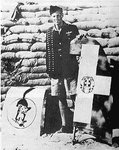
I don't know about you guys, but I think given the chance, this guy would of wiped out the whole Italian AF in 30 days!
SCREWBALL GEORGE - WHAT A CHARACTER
Buzz Beurling, Canada's leading WWII ace. His skill in a cockpit was, however, matched with a streak of rebelliousness and disrespect for authority. He had two nicknames: "Buzz" for his habit of unauthorized low-level flying and "Screwball" for his erratic behavior. At one point he even designed his own uniform!
32 total kills, In 14 days of combat on Malta against the Italians, he destroyed 27 enemy planes, damaged eight, and probably destroyed three more.
SCREWBALL GEORGE - WHAT A CHARACTER
Buzz Beurling, Canada's leading WWII ace. His skill in a cockpit was, however, matched with a streak of rebelliousness and disrespect for authority. He had two nicknames: "Buzz" for his habit of unauthorized low-level flying and "Screwball" for his erratic behavior. At one point he even designed his own uniform!
32 total kills, In 14 days of combat on Malta against the Italians, he destroyed 27 enemy planes, damaged eight, and probably destroyed three more.
Attachments
- Thread starter
- #19
The Italians fielded many really poor, obsolete aircraft like the Fiat CR-42's (a biplane) and Re-2000's.
The "Falcon of Malta" flew a Spitfire. Definitely no contest there. Not that he didn't also shoot down his share of MC-202's. He was a confident and daring pilot.
From: http://www.constable.ca/beurling.htm
"Beurling waxed hot and cold on his Italian opponents. In a 1943 interview he referred to the Italians as 'ice-cream merchants', saying
'The Eyeties are comparatively easy to shoot down. Oh, they're brave enough. In fact, I think the Eyeties have more courage than the Germans, but their tactics aren't so good. They are very good gliders, but they try to do clever acrobatics and looping. But they will stick it even if things are going against them, whereas the Jerries will run.'"
He shot down Italy's top ace who was flying a Macchi Mc-202 Veltro depicted below.

The "Falcon of Malta" flew a Spitfire. Definitely no contest there. Not that he didn't also shoot down his share of MC-202's. He was a confident and daring pilot.
From: http://www.constable.ca/beurling.htm
"Beurling waxed hot and cold on his Italian opponents. In a 1943 interview he referred to the Italians as 'ice-cream merchants', saying
'The Eyeties are comparatively easy to shoot down. Oh, they're brave enough. In fact, I think the Eyeties have more courage than the Germans, but their tactics aren't so good. They are very good gliders, but they try to do clever acrobatics and looping. But they will stick it even if things are going against them, whereas the Jerries will run.'"
He shot down Italy's top ace who was flying a Macchi Mc-202 Veltro depicted below.

Nonskimmer
Captain
Shot his head right off with a cannon shell, I read somewhere.
Users who are viewing this thread
Total: 1 (members: 0, guests: 1)


