Aircraft of World War II - Warbird Forums


Go Back   Aircraft of World War II - Warbird Forums > World War II - Aviation > Aviation

Aviation Discussion on the aircraft of WWII.

Reply
 
LinkBack Thread Tools Display Modes
Old 07-19-2008, 08:59 PM   #1
Senior Member
 
Join Date: Oct 2006
Posts: 1,765
P-40 Performance - Allison versus Merlin

Hi everyone,

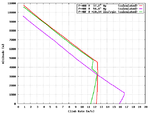
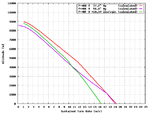
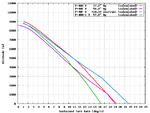
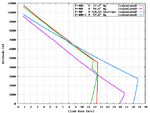
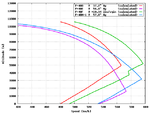
Here some graphs on the performance of the Allison- versus the Merlin-engined Curtiss P-40 fighters.

That the P-40F was not as good as one might have expected has two main reasons: It was using an early Packard-built V-1650-1 that was similar to the two-speed, single-stage 20-series Rolls-Royce Merlin and not as powerful as the later V-1650 engines fitted to the Mustang that were based on the 60-series Merlins. Additionally, the P-40F was 160 kg heavier than the P-40E, and an amazing 750 kg heavier than the P-40B, which of course had considerable impact on its performance.

(The Allison-vs-Merlin issue was raised in this thread:

http://www.ww2aircraft.net/forum/avi...mal-13759.html (P-38 with Merlin Engines? Any such animal?)

However, since that was a P-38 thread I decided to start a new one for the P-40 here.)

Regards,

Henning (HoHun)
Attached Images
File Type: png P-40_Speed_Comparison.png (7.5 KB, 118 views)
File Type: png P-40_Climb_Comparison.png (7.4 KB, 113 views)
File Type: png P-40_Turn_Comparison.png (7.5 KB, 115 views)
HoHun is offline  
Digg this Post!Add Post to del.icio.usBookmark Post in TechnoratiFurl this Post!Spurl this Post!Reddit! Wong this Post!
Reply With Quote
Old 07-19-2008, 09:18 PM   #2
Senior Member
 
claidemore's Avatar
 
Join Date: Jan 2008
Location: British Columbia, Canada
Posts: 497
Turn rates are in degrees per second?
__________________
claidemore is offline  
Digg this Post!Add Post to del.icio.usBookmark Post in TechnoratiFurl this Post!Spurl this Post!Reddit! Wong this Post!
Reply With Quote
Old 07-19-2008, 09:22 PM   #3
Senior Member
 
Join Date: Oct 2006
Posts: 1,765
Hi Claidemore,

>Turn rates are in degrees per second?

Oops - yes, they are!

Regards,

Henning (HoHun)
HoHun is offline  
Digg this Post!Add Post to del.icio.usBookmark Post in TechnoratiFurl this Post!Spurl this Post!Reddit! Wong this Post!
Reply With Quote
Old 07-21-2008, 01:46 AM   #4
Senior Member
 
kool kitty89's Avatar
 
Join Date: Aug 2007
Location: San Jose, CA
Posts: 2,412
How about adding in the P-40M?
(I think the P-40N is less comparable as there were many other changes to that model and many changes in that model its-self) And the P-40K is roughly the same as the P-40E (at normal loaded weight) except it has more power below 5,000 ft due to increased boost limit to 60" HG. (1,570 hp at ~3,000 ft)

The P-40M was basicly the P-40K with the V-1710-81 (as P-51A and P-40N) instead of the -73. The -81 having much better altitude performance due to the 9.6:1 blower (opposed to the 8.8:1 of the -36 and -73), as has been discussed before. This also had the disadvantage of lower max boost rating (than the -73) and lower max power available below ~5,100 ft.

So:

P-40M

Gross weight: 8,400 lbs

powered by one V-1710-81 with 1,200 hp takeoff,
1,125 hp at 17,500 ft millitary rating, and
1,480 hp at 10,400 ft at 57" Hg WEP rating. (1,360 hp at SL -although using 57" WEP at SL was not recomented-) These are with ram in high speed level flight.

Without ram (for climb) mil was at ~14,600 ft and
WEP at ~7,500 ft. (crit alt effectively drops by ~2,900 ft)

There's a graph for the P-51A-1 with power curves (climb and level flight) on WWII Aircraft Performance too:


Last edited by kool kitty89; 07-21-2008 at 01:57 AM.
kool kitty89 is offline  
Digg this Post!Add Post to del.icio.usBookmark Post in TechnoratiFurl this Post!Spurl this Post!Reddit! Wong this Post!
Reply With Quote
Old 07-21-2008, 07:35 PM   #5
Senior Member
 
Join Date: Oct 2006
Posts: 1,765
Hi Koolkitty,

>(I think the P-40N is less comparable as there were many other changes to that model and many changes in that model its-self)

Hm, I believe the P-40N-1 at 7800 lbs, 57" Hg is quite comparable and have included it in the comparison :-)

Note that the graphs for the P-40N decay a bit quicker with altitude than those of the other types. I suspect that is because the underlying engine graph is more accurate than those for the earlier models - during the war, a better understanding of high-altitude power developed. (And the engine graphs up high were calculated anyway.)

It was Sir Stanely Hooker who came up with an improved method of calculating high-altitude power, but unfortunately an important part of it consists of running the supercharger on a test stand to measure its performance parameters in isolation, so it's difficult to try it at home :-(

Regards,

Henning (HoHun)
Attached Images
File Type: png P-40_Speed_Comparison.png (8.4 KB, 64 views)
File Type: png P-40_Climb_Comparison.png (8.5 KB, 63 views)
File Type: png P-40_Turn_Comparison.png (8.0 KB, 64 views)
HoHun is offline  
Digg this Post!Add Post to del.icio.usBookmark Post in TechnoratiFurl this Post!Spurl this Post!Reddit! Wong this Post!
Reply With Quote
Old 12-21-2008, 06:50 AM   #6
Junior Member
 
Join Date: Dec 2008
Posts: 9
What suorce of these data did you use? Could you show it. Im interesting expecially about speed pefromance at sea level of P-40. I cant find any data.
Kwiatek is offline  
Digg this Post!Add Post to del.icio.usBookmark Post in TechnoratiFurl this Post!Spurl this Post!Reddit! Wong this Post!
Reply With Quote
Old 12-21-2008, 07:07 AM   #7
Senior Member
 
Join Date: Oct 2006
Posts: 1,765
Hi Kwiatek,

>What suorce of these data did you use? Could you show it. Im interesting expecially about speed pefromance at sea level of P-40. I cant find any data.

The data was kindly provided by my friend Peril, who is the real P-40 expert here. You can find the data I had (and more) on Peril's site:

Perils P40 Archive Data

As always, the data can be somewhat self-contradicting due to differences in equipment states, sub-standard engine performance and the like. A good part of my analysis consisted of making sense of these differences and find out what "standard" performance actually means.

Have fun with the data! :-)

Regards,

Henning (HoHun)
HoHun is offline  
Digg this Post!Add Post to del.icio.usBookmark Post in TechnoratiFurl this Post!Spurl this Post!Reddit! Wong this Post!
Reply With Quote
Old 12-21-2008, 04:03 PM   #8
Junior Member
 
Join Date: Dec 2008
Posts: 9
Thx i check these site and its very helpfull! I wonder from which test, data you got speed numbers for P-40 E? I cant find such fast speed at the deck in any charts?

BTW i also tried to find any reliable data for maximum speed expecially at the deck about Bf 109 E famliy - expecially BF 109 E-3, E-4 and E-7. I know Kurfust site about 109 but still i need more info about these. I really want to know how fast was Bf 109 E-4 during BoB time .

Last edited by Kwiatek; 12-21-2008 at 04:05 PM.
Kwiatek is offline  
Digg this Post!Add Post to del.icio.usBookmark Post in TechnoratiFurl this Post!Spurl this Post!Reddit! Wong this Post!
Reply With Quote
Old 12-21-2008, 05:31 PM   #9
Senior Member
 
Join Date: Oct 2006
Posts: 1,765
Hi Kwiatek,

>I wonder from which test, data you got speed numbers for P-40 E? I cant find such fast speed at the deck in any charts?

Note that the P-40E speed in my chart is for the engine boosted to 56" Hg - early on, it seems to have been limited to 44.5" Hg or 45.5" Hg depending on the type of boost control used, which would obviously result in lower speeds.

I'm not quite sure any more what the original data source for the P-40E was, but from comparison to the P-40N I concluded that the P-40E had the same coefficient of drag as the P-40N and calculated the P-40E speeds from there.

>BTW i also tried to find any reliable data for maximum speed expecially at the deck about Bf 109 E famliy - expecially BF 109 E-3, E-4 and E-7. I know Kurfust site about 109 but still i need more info about these. I really want to know how fast was Bf 109 E-4 during BoB time .

The Me 109E is tricky because it had five different engines types (and the prototype had yet another). The DB601A-1 and the DB601Aa were both used on the Emil, and at some time before the Battle of Britain, the supercharger on the DB601A engine was replaced by another one that gave 500 m higher full throttle heights, so after the change both of the above engines had different characteristics. Additionally, the DB601N was used during the battle of Britain by one Gruppe of JG 26.

(A Me 109E captured during the Battle of France was equipped with the "old" supercharger, but other aircraft that came down on British soil during the Battle of Britain had the "new" supercharger. I don't know the proportions of each type in service during the Battle of Britain.)

Here is a site created by my friend Mike Williams that has a good discussion of the topic:

Spitfire Mk I versus Me 109 E

You have to be aware that the Messerschmitt speed graph he gives are for climb and combat power (though are not explicitely designated as such in the original graph, this is evident from the implicit conventions of German performance diagrams). The power setting corresponding to the Spitfire's +12 lbs/sqin would be take-off and emergency power.

As his article was written when the full complexity of the engine question was not yet clear to us, the article is somewhat outdated, but still a good start. As mentioned at the very bottom of the article, at that time it was believed that the DB601Aa was an export engine only, but since then a Luftwaffe Emil has been retrieved from a Russian lake with a DB601Aa engine, and Olivier Lefebvre who's quoted in that footnote has done some additional research, indicating that a certain proportion of the DB601A production was of the Aa variant and that these engines went into Luftwaffe service aircraft.

As the DB601Aa seems to have been a DB601A-1 with raised boost level and thus improved power output, this would actually affect your question for top speed at sea level, too. The supercharger type on the other hand would only influence speed at altitude.

Regards,

Henning (HoHun)
HoHun is offline  
Digg this Post!Add Post to del.icio.usBookmark Post in TechnoratiFurl this Post!Spurl this Post!Reddit! Wong this Post!
Reply With Quote
Old 12-22-2008, 12:57 PM   #10
Senior Member
 
Marshall_Stack's Avatar
 
Join Date: Sep 2005
Location: Missouri
Posts: 379
Does anyone know anything about the engine for the XP-40Q? All I have read is that it had a two-stage supercharger and a higher rated Allison. Was this the same arrangement as the P-63?
Marshall_Stack is offline  
Digg this Post!Add Post to del.icio.usBookmark Post in TechnoratiFurl this Post!Spurl this Post!Reddit! Wong this Post!
Reply With Quote
Old 12-22-2008, 03:09 PM   #11
Junior Member
 
Join Date: Dec 2008
Posts: 9
Quote:
Originally Posted by HoHun View Post
Hi Kwiatek,

>I wonder from which test, data you got speed numbers for P-40 E? I cant find such fast speed at the deck in any charts?

Note that the P-40E speed in my chart is for the engine boosted to 56" Hg - early on, it seems to have been limited to 44.5" Hg or 45.5" Hg depending on the type of boost control used, which would obviously result in lower speeds.

I'm not quite sure any more what the original data source for the P-40E was, but from comparison to the P-40N I concluded that the P-40E had the same coefficient of drag as the P-40N and calculated the P-40E speeds from there.

>BTW i also tried to find any reliable data for maximum speed expecially at the deck about Bf 109 E famliy - expecially BF 109 E-3, E-4 and E-7. I know Kurfust site about 109 but still i need more info about these. I really want to know how fast was Bf 109 E-4 during BoB time .

The Me 109E is tricky because it had five different engines types (and the prototype had yet another). The DB601A-1 and the DB601Aa were both used on the Emil, and at some time before the Battle of Britain, the supercharger on the DB601A engine was replaced by another one that gave 500 m higher full throttle heights, so after the change both of the above engines had different characteristics. Additionally, the DB601N was used during the battle of Britain by one Gruppe of JG 26.

(A Me 109E captured during the Battle of France was equipped with the "old" supercharger, but other aircraft that came down on British soil during the Battle of Britain had the "new" supercharger. I don't know the proportions of each type in service during the Battle of Britain.)

Here is a site created by my friend Mike Williams that has a good discussion of the topic:

Spitfire Mk I versus Me 109 E

You have to be aware that the Messerschmitt speed graph he gives are for climb and combat power (though are not explicitely designated as such in the original graph, this is evident from the implicit conventions of German performance diagrams). The power setting corresponding to the Spitfire's +12 lbs/sqin would be take-off and emergency power.

As his article was written when the full complexity of the engine question was not yet clear to us, the article is somewhat outdated, but still a good start. As mentioned at the very bottom of the article, at that time it was believed that the DB601Aa was an export engine only, but since then a Luftwaffe Emil has been retrieved from a Russian lake with a DB601Aa engine, and Olivier Lefebvre who's quoted in that footnote has done some additional research, indicating that a certain proportion of the DB601A production was of the Aa variant and that these engines went into Luftwaffe service aircraft.

As the DB601Aa seems to have been a DB601A-1 with raised boost level and thus improved power output, this would actually affect your question for top speed at sea level, too. The supercharger type on the other hand would only influence speed at altitude.

Regards,

Henning (HoHun)
Thx Henning for replay

I made some reserch about Bf 109 E perfomance but its hard to find really how fast was E model at the deck. At the Kurfurst site about 109 i find that according to some test speed at sea level was from 467-500 km/h:

109 E-1 manual : ( with DB 601 Aa - 1175 hp)
sea level - 500 km/h
5 km - 570 km/h
7,5km - 550 km/h

Kurfrst - Baubeschreibung fr das Flugzeugmuster Messerschmitt Me 109 mit DB 601.

109 V15 prototype: near the same as above

http://www.kurfurst.org/Performance_...15a_blatt6.jpg

Swiss test:
sea level - 465 km/h-472 km/h
5km - 565 km/h

Kurfrst - Swiss level speed results for Bf 109E-3, WNr. 2404, J-347 with Escher-Wyss and original VDM propellers.

France test:
sea level - ~480 km/h
5 km - 570 km/h ( radiator closed)

Kurfrst - CEMA : Performance trials with the captured Messerschmitt Bf 109E-3 WNr.1304

German test 109 E-3 - with MG FF and without

sea level - 467 km/h (dont know at which power)

Kurfrst - Meprotokoll vom 16.2.39, Geschwindigkeitsunterschied mit und ohne Flgelwaffen Bf 109 E3

It must be noted that these test was done with pre BoB 109 E which didnt have armour plate behind the pilot and armoured windscreen.

Its really hard to find how fast was Bf109 E-3 or E-4 from BOB time - with armour plate and armoured windsreen.

Also i have problem with climb rates.

At the site which you gave the link i found climb rate for Bf 109 E - ~2800 ft/min ( 14 m/s) also according to these:

http://www.wwiiaircraftperformance.o...dbookcurve.jpg

Emil have 14,5 m/s initial climb rate and climb to 4 km in 4 min , 6 km in 7 min

If really Emil have 14,5 m/s initial climb rate so must climb to 4 km in 4,6 min not in 4 min so must be some error here.

In manual for E-1 there is climb times:
1 km - 1 min
2 km - 1,9 min
3 km - 3 min
4 km - 3,8 min
5 km - 4,9 min
6 km - 6,3 min

So E-1 must have initial climb rate ~ 16,7 m/s - 17 m/s - but there is no info about setting power - if it is 5 minut power or climb and combat power ( 30 min). If these climb times are for climb and combar power (30 min) so at 5 minut emergency power E-1 should climb even better ~ 18,7 m/s (1122 m/min) and climb time would be:

1 km - 53 sec
2 km - 1,8 min
3 km - 2,6 min
4 km - 3,5 min
5 km - 4,45 min

These would be climb times and rates equal for Bf 109 F model rather.
Kwiatek is offline  
Digg this Post!Add Post to del.icio.usBookmark Post in TechnoratiFurl this Post!Spurl this Post!Reddit! Wong this Post!
Reply With Quote
Old 12-22-2008, 04:06 PM   #12
Senior Member
 
Join Date: Oct 2006
Posts: 1,765
Hi Kwiatek,

You're quite right that the data is hard to consolidate and sometimes even contradictory in itself.

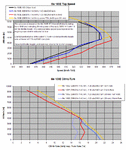
Here is an (somewhat older) analysis I prepared from the Me 109 handbook data for the DB601A-1 with the early supercharger (designated as "DB601A-1 4.0 km" for its full throttle height). If I'd do that analysis again, I'd probably arrive at slightly different figures due to some improved methods, but it should still be good enough to gave an idea of how to read the handbook graph.

(This is for the condition of the handbook Me 109E, which I presume is without armour glass windscreen.)

Regards,

Henning (HoHun)
Attached Images
File Type: gif Me109E_DB601A-1_early.gif (37.5 KB, 29 views)
HoHun is offline  
Digg this Post!Add Post to del.icio.usBookmark Post in TechnoratiFurl this Post!Spurl this Post!Reddit! Wong this Post!
Reply With Quote
Old 12-22-2008, 06:59 PM   #13
Senior Member
 
kool kitty89's Avatar
 
Join Date: Aug 2007
Location: San Jose, CA
Posts: 2,412
Interesting, those turn rates are fairly similar to the Spitfire Mk.I's, correct HoHun. (not to get too off topic, but this has been the subject a continuing argument betwwen the Spitfires and 109's performance)

Last edited by kool kitty89; 12-22-2008 at 07:02 PM.
kool kitty89 is offline  
Digg this Post!Add Post to del.icio.usBookmark Post in TechnoratiFurl this Post!Spurl this Post!Reddit! Wong this Post!
Reply With Quote
Reply


Thread Tools
Display Modes

Posting Rules
You may not post new threads
You may not post replies
You may not post attachments
You may not edit your posts

BB code is On
Smilies are On
[IMG] code is On
HTML code is Off
Trackbacks are On
Pingbacks are On
Refbacks are On


All times are GMT -4. The time now is 12:47 AM.
Powered by vBulletin
Copyright ©2000 - 2009, Jelsoft Enterprises Ltd.
Content Relevant URLs by vBSEO 3.3.0
Ad Management plugin by RedTyger
Design by HTWoRKS


1 2 3 4 5 6 7 8 9 10 11 12 13 14 15 16 17 18 19 20 21 22 23 24 25 26 27 28 29 30 31 32 33 34 35 36 37 38 39 40 41 42 43 44 45 46 47 48 49 50 51 52 53 54 55 56 57 58 59 60 61 62 63 64 65 66 67 68 69 70 71 72 73 74 75 76 77 78 79 80 81 82 83 84 85 86 87 88 89 90 91 92 93 94 95 96 97 98 99 100 101 102 103 104 105 106 107 108 109 110 111 112 113 114 115 116 117 118