| Paddle blade P-47 and P-38J| Aviation Discuss Paddle blade P-47 and P-38J in the World War II - Aviation forums; Trying to compare the P-47 padle blade and the P-38J but don't know about the climb rates. ... |
|
03-08-2006, 10:23 PM
|
#1 | | Senior Member
Join Date: Mar 2005
Posts: 681
| Paddle blade P-47 and P-38J Trying to compare the P-47 padle blade and the P-38J but don't know about the climb rates. The paddle blade P-47D that came out in 1944 had a climb rate of 3,120fpm at 5,000 feet.
The P-38J coulod reach 20,000 feet in 7 minutes flat.
Does anyone have any data for each aircraft at the same altitude? |
| |
03-09-2006, 10:26 AM
|
#2 | | Senior Member
Join Date: Feb 2006 Location: City of the Angels California
Posts: 810
| P-47D-35-RA hit 20,000 feet in 8.5 minutes
__________________ |
| |
03-09-2006, 03:01 PM
|
#3 | | Senior Member
Join Date: Apr 2005 Location: Redwood City
Posts: 223
| Twitch, can you share where that data came from? I have some interesting data that I will post. |
| |
03-09-2006, 04:46 PM
|
#4 | | Senior Member
Join Date: Apr 2005 Location: Redwood City
Posts: 223
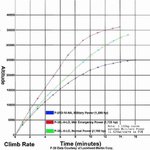
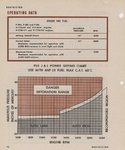
| As you can see, time to climb at combat power to 20,000 feet is right at 7 minutes. The P-47D with the paddle prop blade was a very different animal indeed. Francis Gabreski said that after the paddle blade was installed, the Germans found that they could no longer just climb away from the Thunderbolt.  |
| |
03-09-2006, 05:27 PM
|
#5 | | Senior Member
Join Date: Mar 2005
Posts: 681
| Wonderful chart Sal |
| |
03-09-2006, 11:49 PM
|
#6 | | Senior Member
Join Date: Dec 2005 Location: Cupertino, CA
Posts: 105
| Yes, as you say, the paddle bladed Thunderbolt was a different airplane. She she got a 400fpm boost in climb which is clearly borne out by the chart you have provided.
Very impressive climb for a 14,500lb airplane in 1944.
Thanks for the info!
__________________ MAGISTER |
| |
03-10-2006, 12:06 AM
|
#7 | | Senior Member
Join Date: Apr 2005 Location: Texas
Posts: 970
Country: | I've never heard of a paddle blade. Anyone have pictures?
__________________ "I had ten rockets on board, and as I wasn't particularly fond of head-on attacks, I salvoed the whole lot at him. The rockets didn't hit him but but they must have scared the bejesus out of him, for he did a steep turn to starboard... I let him have the full blast, all eight fifty-calibers. I had never seen an aircraft completely disintegrate in the air the way this Me-110 did..."
Bill Dunn, 406th Fighter Group
Matt |
| |
03-10-2006, 12:12 PM
|
#8 | | Senior Member
Join Date: Apr 2005 Location: Redwood City
Posts: 223
| I believe it was fitted on all the D-22 and later series starting early in 1944. It had a broader chord and more bite. It really helped out with the P-47's rather anemic low altitude performance.
I don't have side by side comparison pictures. |
| |
03-10-2006, 02:51 PM
|
#9 | | Senior Member
Join Date: Feb 2006 Location: City of the Angels California
Posts: 810
| Sal- the climb figure is typically found in about any aircraft stat book. Initial climb rate is about 3,200FPM. Time to altitude is more meaningful since initial climb rate can and does fall off by differing amounts depending on the plane.
The insight from Gabreski is dead similar to Bob Johnson's. While us little kiddies fart around with the magic of specification comparisons in the real world guys like Zemke, Gabreski, and Johnson capitalized on things like the new prop and the Jug's high roll and dive rate to dominate the battles they were in regardless of what any book says about performance.
__________________ |
| |
03-10-2006, 03:55 PM
|
#10 | | Senior Member
Join Date: Dec 2004 Location: Boise, Idaho
Posts: 1,178
| The Paddle blade props also had a more sensitive control mechanism that was more effective, the same type of system added a lot to the P-38K too.
The Paddle blade P-47D was also faster than the P-38J (421mph @ 25,800ft) but about the same as the L, I think.
The P-38J/L could get to 20,000ft in 5-5.4min in WEP here is data from AAF Flight test 47-1706-A, Randomly picked P-38J # 42-67869
Altitude - Cl Rate - Time
0 -------- 4,000 --- 0
5000 ---- 3960 ---- 1.25
10000 -- 3860 ----- 2.54
15000 -- 3550 ----- 3.89
20000 -- 3190 ----- 5.37
25000 -- 2665 ----- 7.o6
30000 -- 1830 ----- 9.32
35000 -- 985 ------ 12.99
40000 -- 100 ------ 25.14
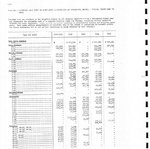
Heres a graph for an in house test of an L model
wmaxt |
| |
03-10-2006, 07:08 PM
|
#11 | | Senior Member
Join Date: Dec 2005 Location: Cupertino, CA
Posts: 105
| Whoa!
4.5 minutes to 20,000ft with a full load of ammo and internal fuel? That's an average of 4,444fpm over the entire climb. No way. Sorry. I don't buy it.
__________________ MAGISTER |
| |
03-10-2006, 10:21 PM
|
#12 | | Senior Member
Join Date: Jul 2005 Location: Japan
Posts: 451
| Its more like 5 minutes to 20,000 feet for an L in full War Emergency Power.
Tis really not that remarkable for a plane with 3,450 hp pulling it along.
Standard Spitfire L.F. Mk IXs were tested to 20,000 feet in 4 3/4 minutes at +18 lbs. That droped to about 4 1/2 minutes at +25lbs. Some A&AEE testing had them pulling upwards of 5,700 feet/minute for the first 1,000 feet or so and better than 5000 feet/minute until 10,000 feet. |
| |
03-10-2006, 10:36 PM
|
#13 | | Senior Member
Join Date: Dec 2005 Location: Cupertino, CA
Posts: 105
| Its more like 5 minutes to 20,000 feet for an L in full War Emergency Power.
Not according to that chart! Tis really not that remarkable for a plane with 3,450 hp pulling it along.
It is when you figure that it weighs in at 17,500 at combat load! (full ammo and internal fuel) Standard Spitfire L.F. Mk IXs were tested to 20,000 feet in 4 3/4 minutes at +18 lbs. That droped to about 4 1/2 minutes at +25lbs. Some A&AEE testing had them pulling upwards of 5,700 feet/minute for the first 1,000 feet or so and better than 5000 feet/minute until 10,000 feet.
Yeah well a P-38 at combat weight weighs in at over twice that of the Spitfire!
The P-38K model had a broad chord propeller. Not the J and L series.
__________________ MAGISTER |
| |
03-11-2006, 02:11 AM
|
#14 | | Master of Ewes
Join Date: Dec 2003
Posts: 19,959
Country: | Quote:
Standard Spitfire L.F. Mk IXs were tested to 20,000 feet in 4 3/4 minutes at +18 lbs. That droped to about 4 1/2 minutes at +25lbs. Some A&AEE testing had them pulling upwards of 5,700 feet/minute for the first 1,000 feet or so and better than 5000 feet/minute until 10,000 feet.
Yeah well a P-38 at combat weight weighs in at over twice that of the Spitfire!
| what's your point? does the spit's climb rate suddenly become void because the P-38's heavier? if the P-38 was the same weight as the spit would she climb the same? if the Queen had balls would she be the King?
__________________ 
"Reminds me of the time I sank the Tirpitz" comments a Spitfire pilot, "One pass of course, old boy." |
| |
03-11-2006, 09:45 AM
|
#15 | | IP/Mech THE GREAT GAZOO
Join Date: Apr 2005 Location: Colorado, USA
Posts: 12,511
Country: | Quote: |
Originally Posted by Twitch The insight from Gabreski is dead similar to Bob Johnson's. While us little kiddies fart around with the magic of specification comparisons in the real world guys like Zemke, Gabreski, and Johnson capitalized on things like the new prop and the Jug's high roll and dive rate to dominate the battles they were in regardless of what any book says about performance. | YEP!!!!
Folks - been reading this thread and observing interesting discussion, but I'm gonna throw my 2 cents in here...
I know its probably been said before but these tests were done under the best circumstances, maybe with "line" aircraft but never the less under somewhat controlled conditions flown by very experienced pilots. For my money stick with the POH - its probably the best representation of performance gathered based on factory and government tests designed for combat operations.
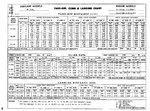
In my P-38 manual recommended climb performance is listed at 54"MP, 3000 rpm at a combat weight of 17, 400 you're going to get 7 minutes to 20,000 feet at best rate of climb (Vx) - period. Of course more boost and less weight may get you up there quicker but the charts are formulated for a reason with those numbers and be rest assured a WW2 combat pilot is going to go with those numbers posted, not data gathered from Wright Patterson or anywhere else that is not part of the "official document," that being the POH or in USAAF terms the -1.....
__________________ "IF ITS RED OR DUSTY, DON'T TOUCH IT" |
| | | Thread Tools | Search this Thread | | | | | Display Modes | Linear Mode |
Posting Rules
| You may not post new threads You may not post replies You may not post attachments You may not edit your posts HTML code is Off | | | All times are GMT -5. The time now is 05:59 AM. |  | |