| RCAF 409 nfs| Aviation Discuss RCAF 409 nfs in the World War II - Aviation forums; Night fighter may I ask what is above the radome and in front of the cockpit-colour ? or is it ... |
|
01-25-2007, 09:43 PM
|
#16 | | the old Sage
Join Date: May 2004 Location: Platonic Sphere
Posts: 9,511
Country: | Night fighter may I ask what is above the radome and in front of the cockpit-colour ? or is it another tarp ? also the motiff which must be a personal one on the left side / pilot/radar op names ?
great pic. Is your father still with us ?
Erich ~ |
| |
01-25-2007, 10:03 PM
|
#17 | | the old Sage
Join Date: May 2004 Location: Platonic Sphere
Posts: 9,511
Country: | I am going to have to dig but think Mark helped me with the combat reports from Britten and Fownes.
1 Ju 88G-6 was shot down by the 409sq crew near Kaldenkirchen. Ju 88G-6 from 3./NJG 2, werk nummer 620591. 3 man crew, two wounded the thrid bailed out. German report mentions it was from Flak.
1 Ju 88G-6 shot down by Flak hits through German reports but found it was from a Mossie Night fighter. Ju 88G-6 coded: 4R+OH from 1./NJG 2 shot down near Grathem. The pilot and rear gunner were KIA, the Radar operator bailed out and captured by the English.
27/28 of December was a bad night for the German night fighter force with some 9 losses, Bf 110G-4 and Ju 88G variants. Four of the losses are for missing a/c and crews. As most combat for the Germans in the Ardenne was night ground attack to aide the German advance or retreat on the ground. |
| |
01-25-2007, 10:08 PM
|
#18 | | Junior Member
Join Date: Jan 2007 Location: Coquitlam Canada
Posts: 6
Country: | Hi Eric , I think it is just another tarp , as the cockpit is tarpped.
I could never make out exactly what the figure / logo was but above it is 3 Kills and 2 Probables.
Sorry to say my father passed on 20 years ago ,but I still remember some of the stories he told !
Last edited by Nightfighter : 01-25-2007 at 10:11 PM.
Reason: more info
|
| |
01-25-2007, 10:14 PM
|
#19 | | the old Sage
Join Date: May 2004 Location: Platonic Sphere
Posts: 9,511
Country: | so sorry to hear of your father passing ! please if anything comes to mind on the squadron please post
seeing a copy or a listing of kills, probs and damages for the squadron would be choice. If dates are included we may be able to match up German losses to Squadron crews |
| |
01-25-2007, 10:23 PM
|
#20 | | Junior Member
Join Date: Jan 2007 Location: Coquitlam Canada
Posts: 6
Country: | I certainly will do Eric....just bear with me , I seem to have misplaced a bunch of material.
I have spent the last couple of years researching my grandfathers WW1 history ,so things got put away some where ?? |
| |
01-25-2007, 10:36 PM
|
#21 | | the old Sage
Join Date: May 2004 Location: Platonic Sphere
Posts: 9,511
Country: | I can be patient...........now to find the combat report(s) of the above RCAF crew that I first mentioned ......
417nfs crew shot down the Ju 290 mentioned on the December 44 date, but brick you probably have this info. Most likely the Ju 290A was on agent dropping mission(s) |
| |
01-28-2007, 06:55 PM
|
#22 | | Member
Join Date: Jan 2007
Posts: 77
Country: | A Keen 24 Year Old
Jack Roff became an aviation addict in 1927. The then 12 year old saw his first airplane when a yellow-painted floatplane conducting aerial surveys flew over his small town on the coast of British Columbia. From then on, he was hooked on anything related to flying.
As he grew up, however, the pressing needs of earning a living superseded his dream of flying. He worked at times as a lumberjack and in various factories for 15-30 cents per hour, glad frankly to have a job during the Depression. All that changed, however, in March 1939 when Jack spied an advertisement in the newspaper for young men to apply for RAF pilot training.
Taking the train to Ottawa, he was accepted for the program and was given a ticket to England. Jack and several other hopefuls were told that if they didn’t make it into the RAF as flyers, their trip home would also be paid for.
After 12 hours in an Anson Cadet bi-plane, Jack was deemed as “unlikely to become a proficient service pilot.” He was politely, but firmly, put out of the RAF’s care. Asking about the “free trip home” he had been promised, no one in authority seemed to know anything about it. So Jack was stuck.
Fortunately, his RAF screening had been conducted near Coventry. With war imminent, it was now June 1939; many industries were gearing up to produce military equipment so jobs were plentiful. Jack worked for eight months before be able to head back to Canada in April 1941.
He enlisted in the RCAF that same month, hoping to become an observer. Also sharing the common experiences concerning ITS and navigation school as did the other RCAF flyers in this article, Jack did his time in navigation, bombing, and air gunnery courses. After seven months, he won his navigator wings and by February 1942 found himself in a two-ship convoy attended by tow destroyers, one brand new, one an old ‘four stacker’ borrowed from WWI surplus American stocks, bound for England.
Two hours after leaving Halifax harbor, the new destroyer was torpedoed and blew up and sank near the stern of Jack’s transport. The other ‘four stacker’ soldiered on however, and the convoy proceeded. Jack says of this trip, “I was never so scared for the rest of my war!”
Obviously, Jack’s ship made it to England where he and the other fledgling aircrew were placed in one of several manning depots. There he waited and waited. As mentioned in Bill Vincent’s story of the massive buildup of heavy bomber squadrons, most of the airmen expected to go to Stirlings, Halifxes or Lancasters. Due to delays in new aircraft reaching squadrons, however, new aircrew languished for months sometimes waiting for a posting.
Jack escaped his purgatory by volunteering for a ‘secret job.’ He and several hundred other navigators were briefed of a need for volunteers for a “job with danger and full of action.” The incentive was that the posting would be almost immediate. Almost to a man, the group stepped forward. So it was that Jack found himself sent off to A.I school in Scotland. Considered so secret at the time, Jack says he still has trouble speaking about it today. The RAF was still responding to the vital need to bolster its night defenses.
It was in Scotland that Jack first flew in a Beaufighter and learned to operate the A.I. radar, in his case the first really operational version, the Mk IV A.I. The Mk IV had several eccentricities that made it challenging for its operators. The Mk IV displayed target information on two separate scopes, one for height and one for range. In addition to extrapolating target intentions from both scopes, the Mk IV was hindered by its inability to blank out ‘clutter’ or interference caused by the radar waves reflecting from the earth’s surface. The lower the Mk IV was to the surface, the more the two displays were swamped by interference. This problem was greatly reduced in later A.I. radars but for now, Jack just had to cope with the limitation.
Another early Beau quirk foisted on a navigator’s shoulders was the necessity to manually reload the four 20 mm cannons. The breeches of the cannons were located just aft of the pilot and were fed by ammunition drums. Imagine ack-ack guns being fed by a gunner’s assistant and one has a fair approximation of the job required. Now add in the fact that it is night and one’s pilot, having emptied the guns at a target, is having to follow an alert, maneuvering enemy by throwing the Beaufighter around the sky. Not a fun job for the navigator at all! Thankfully, later Beau marks had automated ammunition feeds.
Jack was also posted to 409 Squadron in July 1942. For the next 18 months, he flew dozens of patrols, guarding Britain’s skies from the Wash north to the Hebrides and over to Norway and the Skaggerat and chasing contacts over the North Sea. Too often, however, Jack’s crew had to abandon the chase as the quarry made the safety of occupied territory. The RAF had issued strict instructions that A.I aircraft were NOT to be risked over enemy territory.
Recalling one situation where he was unable to help, he tells of a sortie to escort a group of Norwegian fishing boats making a dash to freedom across the North Sea. “ We were at our limit for fuel when we found them and couldn’t stick around. We found out later that the Jerries really worked them over soon after we left.”
Jack really liked the strength of the Beaufighter. He recounted on experience of a crew returning from a sortie and losing its brakes. He says of the affected Beau, “It ran off the runway, through a stone wall and into a flock of sheep. It only required a couple of new props and it was back on operations.”
Jack’s first combat tour ended in May 1944. He went back to Canada for a rest and started another tour with No. 410 Squadron (RCAF) flying Mosquitoes in France.
He makes a comparison between the Beaufighter and De Havilland’s product thusly, “The Mossy was a pretty bird. A different craft than the Beau, light and maneuverable with a better radar but a difficult kite to get out of in a hurry. The Beau was much more rugged and heavily armored, but not nearly as much fun to fly.” |
| |
01-29-2007, 07:24 AM
|
#23 | | World Traveler
Join Date: Nov 2004 Location: Royal Deeside/St Andrews, Scotland, UK
Posts: 11,751
Country: | Interesting story, thanks for sharing.
__________________ "Success is not Final, Failure is not Fatal, it is the Courage to Continue that Counts"
Sir Winston Churchill "To him the People of the World Largely owe the Freedom and Liberties they Enjoy Today"
Enscription on Hugh Dowding's (AOC Fighter Command 1936-40) statue in London Moderator WW2 Talk: A WW2 Discussion Forum My Photo Collections on Flickr |
| |
10-05-2008, 09:36 AM
|
#24 | | Junior Member
Join Date: Oct 2008
Posts: 1
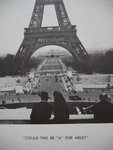
Country: | Mosquito "A" Able thru the Eiffel Tower Quote:
Originally Posted by Nightfighter I realize this is an old thread , but my father was an engine mechanic in 409 Sq. in WW2. I can't remember the exact model of Mossie the used but it had the " bulb" radar nose.
There exists a photo of "A" for Able flying through the arch of the Eiffel Tower with very little clearance. | I have a copy of a photo of "A" Able flying thru the Eiffel Tower. It is signed by the late Bill Bryant RAF, an old friend of mine, who was the navigator of that aircraft piloted by Bob Boorman RCAF. The caption reads as follows" This Stars & Stripes photograph was taken on 14 September 1944 and shows a Mosquito Mk XIII of 409 Squadron RCAF. Pilot - W/O Bob Boorman RCAF ,Navigator F/S Bill Bryant RAF Flying through the Eiffel Tower. How the picture came to be taken is another story told to me before Bill Bryant died!!!
Nic Shelley, Sqn Ldr RAF (Ret'd) |
| |
10-05-2008, 05:10 PM
|
#25 | | Junior Member
Join Date: Jan 2007 Location: Coquitlam Canada
Posts: 6
Country: | rafnav .... good to hear from you , please post the photo if you can , and do tell us the story please !!!
__________________
Midnight Is Our Noon |
| |
10-05-2008, 05:11 PM
|
#26 | | the old Sage
Join Date: May 2004 Location: Platonic Sphere
Posts: 9,511
Country: | yes please post the photo if you would sir when time permits
Erich ~ |
| |
10-06-2008, 06:35 AM
|
#27 | | Senior Member
Join Date: Jul 2004
Posts: 137
| Lordy, yes, post post post!  |
| |
10-06-2008, 03:28 PM
|
#28 | | Senior Member
Join Date: Aug 2008
Posts: 1,518
Country: | Agreed! That is one photo I'd DEFINITELY like to see! |
| | | Thread Tools | Search this Thread | | | | | Display Modes | Linear Mode |
Posting Rules
| You may not post new threads You may not post replies You may not post attachments You may not edit your posts HTML code is Off | | | All times are GMT -5. The time now is 11:13 PM. |  | |