| The sound barrier| Aviation Discuss The sound barrier in the World War II - Aviation forums; An interesting article...
Mach 1 - Who was really the first
According to this article, Hans Guido Mutke claims to have ... |
|
11-16-2007, 04:30 PM
|
#1 | | Senior Member
Join Date: Sep 2007
Posts: 203
Country: | The sound barrier An interesting article... Mach 1 - Who was really the first
According to this article, Hans Guido Mutke claims to have reached Mach 1 during a dive in his Me-262. I started to wonder if any other WWII plane might have been capable of meeting this speed in a dive, particularly the Me-163. I’ve even read an on-line article (which I can’t find at the moment) that the Bachem 349 might have inadvertently broke the sound barrier during it’s first manned flight. Could any propellor aircraft reach Mach 1 in a dive?
Any comments or thoughts about this? Thanks ya'll!  |
| |
11-16-2007, 05:28 PM
|
#2 | | Senior Member
Join Date: Jun 2006 Location: oregon
Posts: 2,256
Country: | Quote:
Originally Posted by Velius An interesting article... Mach 1 - Who was really the first
According to this article, Hans Guido Mutke claims to have reached Mach 1 during a dive in his Me-262. I started to wonder if any other WWII plane might have been capable of meeting this speed in a dive, particularly the Me-163. I’ve even read an on-line article (which I can’t find at the moment) that the Bachem 349 might have inadvertently broke the sound barrier during it’s first manned flight. Could any propellor aircraft reach Mach 1 in a dive?
Any comments or thoughts about this? Thanks ya'll!  | He didn't, none of them could with Mcrit way too low for all the types in WWII, all fooled by compressibility/calibration issues with airspeed indicators.
IIRC, The Me 262 in particular would start a pitch down at or near critical mach number and, if not corrected immediately would contine the tuck and fail pretty quickly. The horizontal stabilizer was 'blanked' by the ensuing flow separation as the airflow over the subsonic wing design approached transonic velocities (but not the a/c)
No propeller driven a/c was truly close to Mach 1 nor was any ship (jet or rocket or prop) a legitimate .9 Mcrit wing/body combo
Last edited by drgondog : 11-16-2007 at 05:33 PM.
|
| |
11-16-2007, 05:31 PM
|
#3 | | Senior Member
Join Date: Dec 2006 Location: Fresno, CA
Posts: 2,380
Country: | Even if he did, It doesn't take away from Yeager. Level flight is a lot different than a dive.
.
__________________ “Despite the threat of SAMs and increasing visibility on 31 January 1991, one gunship opted to stay and continue to protect the Marines. A SAM subsequently shot down this AC-130H, call sign Spirit 03. All 14 crew members of Spirit 03 perished." www.NewMediaPerspective.com |
| |
11-16-2007, 06:16 PM
|
#4 | | Senior Member
Join Date: Sep 2007
Posts: 203
Country: | Quote:
Originally Posted by drgondog He didn't, none of them could with Mcrit way too low for all the types in WWII, all fooled by compressibility/calibration issues with airspeed indicators.
IIRC, The Me 262 in particular would start a pitch down at or near critical mach number and, if not corrected immediately would contine the tuck and fail pretty quickly. The horizontal stabilizer was 'blanked' by the ensuing flow separation as the airflow over the subsonic wing design approached transonic velocities (but not the a/c)
No propeller driven a/c was truly close to Mach 1 nor was any ship (jet or rocket or prop) a legitimate .9 Mcrit wing/body combo |
Not even momentarily during a dive? I know well that no WWII aircraft was capable of supersonic level flight....and even if it did, I know it wasn't staying there for long. But it is not possible at all just to meet terminal Mach?? |
| |
11-16-2007, 06:31 PM
|
#5 | | Senior Member
Join Date: Jun 2006 Location: oregon
Posts: 2,256
Country: | Quote:
Originally Posted by Velius Not even momentarily during a dive? I know well that no WWII aircraft was capable of supersonic level flight....and even if it did, I know it wasn't staying there for long. But it is not possible at all just to meet terminal Mach?? | No.
None of the WWII designs coupled all the 'lessons learned' into one airframe - swept wings to delay transonic flow
- thin wings for same reason
- slab elevators to operate in high compressibility
- wing/body design to ensure that elevators were not blanked by wake turbulence
The engines weren't anywhere near powerful enough to brute force the airframe through compressibility and the aircraft were not designed well enough, given that kind of power, to prevent ugly stability and control issues from causing the aircraft to 'depart' and fail structurally in the process.
The F-100A, first supersonic fighter was the last of the US century series fighters designed before Whitcomb collected a lot of prior work into his theory of area rule to address better wing body performance in transonic regions. I'm trying to remember whether the F101 or F102 was designed to embody the area rule
The crafty Crumpp will soon swoop by to give you the 10 reasons I forgot
Last edited by drgondog : 11-16-2007 at 06:37 PM.
|
| |
11-16-2007, 07:36 PM
|
#6 | | Senior Member
Join Date: Sep 2007
Posts: 203
Country: | Thanks drgondog! |
| |
11-16-2007, 08:40 PM
|
#7 | | Senior Member
Join Date: May 2007
Posts: 1,448
Country: | |
| |
11-17-2007, 04:17 AM
|
#8 | | Senior Member
Join Date: Jul 2007 Location: Queensland- Australia
Posts: 897
Country: | I believe the fastest a prop plane got was 0.83 of the speed of sound, This was in a late model spitfire, apprantly when the plane was pulled out of the dive the engine disconnected itself from the airframe and apprantly the pilot only got out of the dive because he was a big 6 foot 4 inch bloke who had lots of muscle on him otherwise he would have made a coffin of himself 100 foot in the soil...
I'm not sure if this is true the author of the book was a test pilot during the war and after it.
__________________
98% Of teens surround their minds with rap. If you're part of the 2% that stayed with rock, put this on your signature
I am also one of the 2% who does not own a myspace account....
DEFY THE SYSTEM |
| |
11-17-2007, 05:44 AM
|
#9 | | Banned
Join Date: Oct 2007
Posts: 220
Country: | Not quite correct Aussie.
The Spitfire was a PR XI.
The pilot Martindale landed the Spitfire (EN409) but the reduction gearbox was missing as was the prop. The main engine bearer had buckled.
In PL827 during another test dive the CS unit failed and the SC exploded causing a fire, which went out. He attempted a crash landing but some power lines appeared and while avoiding the lines crashed into a copse of trees. He survived the crash, even retrieving the film despite a damaged spine. |
| |
11-17-2007, 05:57 PM
|
#10 | | Senior Member
Join Date: Mar 2005 Location: Berlin (Kreuzberg)
Posts: 1,527
| There is scientific evidence, proposed by the technical university of Munich in an study which covers structural integrity of the Me-262 at different dive conditions. It shows that it is theoretically possible to exceed Mach 1.0 under certain conditions in a certain altitude with a certain load (You guess it- everything has to fit to make it through, which in turn makes it unprobable). Something which surprised me.
This study so far was never disprooved. The results of the study were challenged but not on scientific grounds.
__________________ ---delcyros---
Last edited by delcyros : 11-17-2007 at 05:59 PM.
|
| |
11-17-2007, 06:08 PM
|
#11 | | Senior Member
Join Date: Oct 2006
Posts: 960
Country: | Hi Delcyros,
>There is scientific evidence, proposed by the technical university of Munich in an study which covers structural integrity of the Me-262 at different dive conditions.
Do you perhaps happen to have a link to that study?
Thanks in advance,
Henning (HoHun) |
| |
11-17-2007, 06:34 PM
|
#12 | | Senior Member
Join Date: Feb 2006 Location: Colorado, USA
Posts: 1,505
Country: | Aerospaceweb.org | Ask Us - First Supersonic Jet
Here's an article about another pilot George Welch who may have achieved breaking it before Yeager in an XP-86, the prototype of the future F-86 Saber. But if he broke it, it wasn't in level flight like Yeager, it was in a dive.
But I am biased!
__________________ 
"His motor's conked out!"
"What's the differance, they're all Nazis!"
"Luke, shut up!"
"Fear the hook!"
"Oh.....I wanna fly."
"You mean the kind that go under water and fly up the stairs?"
"What you doing? Oh Nooooo!"
Last edited by Soundbreaker Welch? : 11-17-2007 at 06:41 PM.
|
| |
11-18-2007, 02:43 AM
|
#13 | | Senior Member
Join Date: Jul 2007 Location: Queensland- Australia
Posts: 897
Country: | thanks Al wasn't sure, i did however read that the plane that de havilands son died in was supposed to have gone throung the sound barrier. This was in the same book.
The title is Wings on My Sleeve.
__________________
98% Of teens surround their minds with rap. If you're part of the 2% that stayed with rock, put this on your signature
I am also one of the 2% who does not own a myspace account....
DEFY THE SYSTEM |
| |
11-18-2007, 05:18 AM
|
#14 | | Banned
Join Date: Oct 2007
Posts: 220
Country: | Aussie, that would be the DH108. Sort looked like a Me163. The Swallow - DH108 crash at Bow Brickhill 1950 The de Havilland 108 was a swept wing high speed research aircraft built to explore the effects of high speed flight close to the speed of sound. Powered by a de Havilland Goblin jet engine, the aircraft was constructed using a standard de Havilland Vampire fuselage with a newly designed swept back wing at the de Havilland factory at Hatfield. Three aircraft were built for the programme: TG283, TG306 in 1946 and VW120 in 1947. TG306 crashed on 27th September 1946 killing the pilot Geoffrey de Havilland during a high speed dive. TG283 crashed on 1st May 1950 killing the pilot George Genders whilst carrying out stalling trails at Hartley Wintney. VW120 crashed on 15 February 1950 at Little Brickhill whilst involved in transonic dive research, killing the pilot Squadron Leader Stuart Muller-Rowland. |
| |
11-18-2007, 11:49 AM
|
#15 | | Senior Member
Join Date: Mar 2005 Location: Berlin (Kreuzberg)
Posts: 1,527
| Quote:
Originally Posted by HoHun Hi Delcyros,
>There is scientific evidence, proposed by the technical university of Munich in an study which covers structural integrity of the Me-262 at different dive conditions.
Do you perhaps happen to have a link to that study?
Thanks in advance,
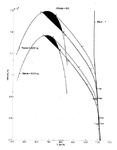
Henning (HoHun) | Unfortunately not my friend. The study isn´t avaibable online. You might use the KOBV-Fernleihe to see the 1999 paper in question. The below page is from appendix II and shows how narrow to frame for reaching Mach 1.0 is at a pure vertical dive.
__________________ ---delcyros---
Last edited by delcyros : 11-18-2007 at 11:56 AM.
|
| | | Thread Tools | Search this Thread | | | | | Display Modes | Linear Mode |
Posting Rules
| You may not post new threads You may not post replies You may not post attachments You may not edit your posts HTML code is Off | | | All times are GMT -5. The time now is 07:12 AM. |  | |