| Spitfire mk VB/Seafire vs Zero| Aviation Discuss Spitfire mk VB/Seafire vs Zero in the World War II - Aviation forums; Spitfire mk VB/Seafire mk IB/Seafire mk IIc/Seafire F mk IIIb vs Zero
Spitfire mk Vb/Seafire mk ... |
|
04-13-2008, 07:15 PM
|
#1 | | Junior Member
Join Date: Apr 2008
Posts: 17
Country: | Spitfire mk VB/Seafire vs Zero Spitfire mk VB/Seafire mk IB/Seafire mk IIc/Seafire F mk IIIb vs Zero
Spitfire mk Vb/Seafire mk IB
Crew: one pilot
Length: 29 ft 11 in (9.12 m)
Wingspan: 36 ft 10 in (11.23 m)
Height: 11 ft 5 in (3.86 m)
Wing area: 242.1 ft² (22.48 m²)
Empty weight: 5,090 lb (2,309 kg)
Loaded weight: 6,622 lb (3,000 kg)
Max takeoff weight: 6,770 lb (3,071 kg)
Powerplant: 1× Rolls-Royce Merlin 45, Merlin 46, Merlin 50 (spitfire only), or Merlin 55 (spitfire only)
Seafire mk IIIb:
Role: Single-seat Shipboard Fighter-bomber
Engine(s): 1x Rolls-Royce Merlin 50, Merlin 55, or Merlin 55M
Armament: 2x 20 mm Hispano cannon with 120 rpg and 4x .303 cal Browning machine guns with 350 rpg
Ordnance: 1x 500 lb or 2x 250 lb bombs
Maximum Speeds: Maximum speed 352 mph at 12,250 ft, maximum cruising speed 310 mph at 20,000 ft
Service Ceiling: 33,800 ft
Range: 725 miles
Empty Weight: 5,400 lb
Normal Weight: 7,100 lb
Wingspan: 36 ft 10 in
Length: 30 ft 3 in
Height: 11 ft 2 in at airscrew
Wing Area: 242 sq ft
Zero (A6M2)
Crew: 1
Length: 9.06 m (29 ft 9 in)
Wingspan: 12.0 m (39 ft 4 in)
Height: 3.05 m (10 ft 0 in)
Wing area: 22.44 m² (241.5 ft²)
Empty weight: 1,680 kg (3,704 lb)
Loaded weight: 2,410 kg (5,313 lb)
Max takeoff weight: kg (lb)
Powerplant: 1× Nakajima Sakae 12 radial engine, 709 kW (950 hp)
Sooo, who would win??
Note: The Seafire was tested against against the Zero, and it outmanuvered it at low speeds. |
| |
04-14-2008, 04:42 PM
|
#2 | | Senior Member
Join Date: Apr 2008
Posts: 912
Country: | The zero Mk 2 had the following statistics
Specification of A6M2 Navy Type 0 Carrier Fighter Model 21:
One Nakajima NK1C Sakae 12 fourteen cylinder air-cooled radial, rated at 940 hp for takeoff, 950 hp at 13,780 feet.
Performance: Maximum speed 331 mph at 14,930 feet. Cruising speed 207 mph. Initial climb rate 4517 feet per minute. Climb to 19,685 feet in 7 minutes 27 seconds. Service ceiling 32,810 feet. Normal range 1160 miles. Maximum range 1930 miles. Radius of turn with entry speed of 230 mph was 1118 feet. Entering a 180 degree steep turn with an entry speed of 230 mph, the fighter could complete the turn in 5.62 seconds, with an exit speed from the turn of 189 mph. At slower speeds, the turning radius was 612 feet. Normal positive g-load factor was 7g, with a safety factor of an additional 1.8g. Normal negative g-load factor was 3.5g, with a safety factor of an extra 1.8g.
Dimensions: Wingspan 39 feet 4 7/16 inches, length 29 feet 8 11/16 inches, height 10 feet 0 1/16 inches, wing area 241.5 square feet. Weights: 3704 pounds empty, 5313 pounds loaded, 6164 pounds maximum. Fuel capacity: Internal fuel capacity was 114 Imp gall. One 72.6 Imp. gall drop tank could be carried underneath the fuselage. Armament: Two 7.7-mm Type 97 machine guns in the fuselage decking and two 20-mm Type 99 cannon in the wings. Two 132-pound bombs could be carried on underwing racks
I dont have figures for the radious of turn for the either the Sppitfire, ir the Seafire. Do you have them,so that we can compare. I assume your claim "the Spit can outmanouvre the zero at low speeds is a claim that they can ou turn the zero....seems a bit unbelivable, but would like to see your figures first.
If you are referring to dive speeds, roll rate (above 300 knots) and combat after October 1942, when new tactics against the zero had been worked out, almost certainly you are correct. But difficult to accept if the combat is early 1942, using the tactics of the time
Before I make any conclusions, however, would like to see your source, and the figures you have
__________________ Do not judge on abilities, but on choices |
| |
04-14-2008, 04:59 PM
|
#4 | | Senior Member
Join Date: Oct 2006
Posts: 960
Country: | Hi Parsifal,
>I assume your claim "the Spit can outmanouvre the zero at low speeds is a claim that they can ou turn the zero....seems a bit unbelivable, but would like to see your figures first.
I wondered about this bit too, but I guess Major's "it outmanuvered it" can be read either way, and he probably meant that the Zero outmaneouvred the Spitfire like we expect.
Alfred Price's "Spitfire - A Complete Fighting History" quotes Patuxent River trials of a captured A6M5 against a Seafire LIIC, and the A6M5 was found to be superior in low-speed turns at all altitudes. Somewhat surprisingly, the A6M5 also held a speed advantage at high altitudes over the Seafire LIIC, owed to the former's two-speed supercharger providing better altitude power than the latter's single-speed, low-altitude optimized supercharger.
Regards,
Henning (HoHun) |
| |
04-14-2008, 05:02 PM
|
#5 | | Senior Member
Join Date: Apr 2008
Posts: 912
Country: | Characteristics for the Spit IX
Spit IX Performance
Turn Performance
300mph 1,000ft 5,000ft 10,000ft 15,000ft
One 360 12.5s 12.9s 14.0s 16.0s
Two 360s 27.7s 28.9s 32.3s 36.7s
250mph
One 360 12.5s 13.5s 15.5s 16.6s
Two 360s 28.9s 30.8s 34.1s 38.1s
Sustained
No Flaps 16.3s 18.1s 19.7s 23.2s
Full Flaps 16.9s 18.4s 20.4s 23.3s
Best Flap none none none full
Speed/best 150mph 145mph 140mph 105mph
Corner Speed and Radii (1,000ft):
Speed: 270mph
Radius: 531ft
Sustained Turn Speed: 160mph
Sustained Turn Radius: 609ft
Full Flaps Speed: 120mph
Full Flaps Radius: 473ft
Corner Times 1,000ft 5,000ft 10,000ft 15,000ft
180 degrees 6.2s 6.6s 7.2s 8.0s
360 degrees 13.8s 14.6s 16.2s 18.1s
Roll Rate:
150mph: 5.0s
200mph: 3.7s
250mph: 4.2s
300mph: 5.4s
350mph: 7.9s
400mph: 11.4s
Minimum Full-Flaps Full-Power Split-S altitude:
150mph: 900ft
200mph: 1000ft
250mph: 1500ft
300mph: 1800ft
The way I read those figures, the Spit IX could indeed turn inside a Zero, but its entry and exit speed, and time taken to complete the manaouvre were so slow, and so much time taken, that the zero would basically be behind the Spit IX in next to no time....remeber, this is for speeds below 300 knots. Would not apply for anything above that
Spit V was better in a turn, but I dont yet have the details
__________________ Do not judge on abilities, but on choices |
| |
04-14-2008, 09:24 PM
|
#6 | | Senior Member
Join Date: Apr 2008
Posts: 912
Country: | Hi HoHun & Major
I have posted the performance arcs for the Spit IX, which is all i could find at short notice. These figurres suggest to me that in order to ou-turn the Zero, the Spit would need to bleed an awful lot of speed to do it.. It appears to me that the Zero would have completed its turn a second or two faster, and have a lot more airspeed remaining at the completion of that manouvre, than its Spitfire opponent. The slightly smaller turn radius is only achieved, if the Spitfire is carrying out the manouever very slowly. Moreover the turn radii given for the zero are for what might be termed "normal dogfight speeds", ie around the 250-300 knot range, so it may in fact be thye case that the turn radius of the Spit is actually greater, at dogfight speed.
So my conclusion on this bit of information is that whilst the Spit may (and its only a "may") turn more tightly than a zero, it does it so slowly and awkwardly as to render itself a sitting duck in the air.
The Spit would be far better to dive or roll in which case it has the inherent advantage.
I wanted to know your opinions, however, about the so called Zeroes agility. I have seen this statement allover the place. I assume that by saying the zero was "agile" they meant it had good accelaration, ie recovery of airspeed in level flight. But is this necessarily a true statement....if you look at the power to weight, of say the A6M2, which had a 950 hp engine, to pull around 5300 lbs of weight. This gives a power to weight ratio of 0.18:1. Compare this to the Spit, which has a loaded weight of about 7000 lbs (depending on which mark, and for a Spit V about 1475 hp, this gives a power to weight ratio of 0.21:1. If I assume similar drag co-efficients for the two aircraft (very suspect, but i just dont know what they are) for the zero and Spit, does this mean the Spit will regain airspeed at the rate of 21/18 compared to the Zero??? I have not taken into account the performance arcs or altitude in this very crude comparison
__________________ Do not judge on abilities, but on choices |
| |
04-15-2008, 01:39 AM
|
#7 | | Senior Member
Join Date: Oct 2006
Posts: 960
Country: | Hi Parsifal,
>The slightly smaller turn radius is only achieved, if the Spitfire is carrying out the manouever very slowly.
From a look at weights and wing areas, I don't think the Spitfire would be able to match the smallest turning radius of the A6M.
However, it might be possible for a Spitfire to match the fastest turn rate of an A6M at a larger radius. This really depends on the exact flying weight of the Spitfire, the engine type it's using, and the boost pressure that can be used with the engine.
An early tropicalized Spitfire V at +9 lbs/sqin would be much inferior to the "temperate" Spitfire V at +16 lbs/sqin as it was later used against the Fw 190 menace. Likewise, the Seafire variants were pretty heavy due to the carrier equipment they carried, but if they had a low-altitude engine, that might have compensated for some of the extra weight in a sea level fight.
>I wanted to know your opinions, however, about the so called Zeroes agility. I have seen this statement allover the place. I assume that by saying the zero was "agile" they meant it had good accelaration, ie recovery of airspeed in level flight.
Something not often mentioned is that the A6M also had a good roll rate at low speed. This would enable it to change the direction of its turn quickly, which is an important aspect of agility, too.
Regards,
Henning (HoHun) |
| |
04-15-2008, 12:20 PM
|
#8 | | Senior Member
Join Date: Jan 2008 Location: British Columbia, Canada
Posts: 249
Country: | From the australian trials of Spit MkV vs "Hap" (A6M3 Model 32).
This report gives some very good suggestions for tactics of Spitfire vs Zekes and Haps (Zeros). Basically they recomendation was to use high speed tactics, loops, climbing turns etc against the Zero, and to avoid low speed fighting completely.
Claidemore
__________________ |
| |
04-15-2008, 03:53 PM
|
#9 | | Senior Member
Join Date: Oct 2006
Posts: 960
Country: | Hi Claidemore,
>From the australian trials of Spit MkV vs "Hap" (A6M3 Model 32).
Do you know the engine type used in that Spitfire (and ideally weight, boost and ejector type as well)?
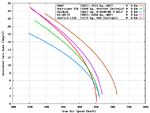
I've just prepared a comparison for a number of fighters including the Seafire LIIc with a Merlin 32 engine (because I found good data for that variant here: Seafire L Mk. IIC Trials ).
The result is interesting because it shows that the Seafire LIIc with the Merlin 32 running at +18 lbs/sqin can almost match the A6M2's turn rate at sea level. There is some uncertainty about the maximum lift coefficients, and that of the Seafire might be a little higher than shown but not high enough to reach the A6M2 turn rate as indicated in the graph.
However, this is at low altitude where the Merlin 32 is at its best. At 5 km and at 10 km, the Seafire really loses a lot of ground to the other types in that graph.
Regards,
Henning (HoHun)
Last edited by HoHun : 04-15-2008 at 04:02 PM.
Reason: Fixed graph
|
| |
04-15-2008, 04:38 PM
|
#10 | | Senior Member
Join Date: Jan 2008 Location: British Columbia, Canada
Posts: 249
Country: | HoHun,
Those trials were done in July and August of 1943, and the only info on the Spit is that it was a 'regular' Mark VC, normal combat weight without drop tanks.
One high altitude trial was done with a 'special' Spitfire, which I would guess would be a high alt version, possibly even a PR MKIV?
__________________ |
| |
04-15-2008, 09:27 PM
|
#11 | | Senior Member
Join Date: Apr 2008
Posts: 912
Country: | maybe there is some truth to the claim that the spit could out-turn the Zero in certain low speed situations???? I am not so sure now...
__________________ Do not judge on abilities, but on choices |
| |
04-15-2008, 10:57 PM
|
#12 | | Senior Member
Join Date: Mar 2008 Location: Las Vegas, Nevada
Posts: 262
Country: | I think we could look at the combat record. It is my understanding that the Spitfire pilots where ordered to dive in on a Zero and not engage in a turning engagement. As much as I love the Spit, the Zero was one of the most manuveurable planes in World War II and if anybody consults a variety of sources, they will come up with the same results. |
| |
04-15-2008, 11:35 PM
|
#13 | | Senior Member
Join Date: Aug 2007 Location: San Jose, CA
Posts: 2,006
Country: | Ki 43-II was even more maneuverable though, about equal at low speeds but it kept it better at high speeds. (demonstrated in HoHun's chart) |
| |
04-16-2008, 10:17 AM
|
#14 | | Senior Member
Join Date: Jan 2008 Location: British Columbia, Canada
Posts: 249
Country: | The big advantage of the Ki43 Hayabusa would be it's roll rate. It would get into the turn quicker than any of it's contemporaries, particularly at lower speeds. Concensus was that it was more manueverable than the Zero. Watching video of the 'nimble' Oscar, I'm always impressed by what an acrobatic little fighter it is.
__________________ |
| |
04-16-2008, 10:47 AM
|
#15 | | IP/Mech THE GREAT GAZOO
Join Date: Apr 2005 Location: Colorado, USA
Posts: 13,208
Country: | Quote:
Originally Posted by claidemore The big advantage of the Ki43 Hayabusa would be it's roll rate. It would get into the turn quicker than any of it's contemporaries, particularly at lower speeds. Concensus was that it was more manueverable than the Zero. Watching video of the 'nimble' Oscar, I'm always impressed by what an acrobatic little fighter it is. | Heard the same thing - it had a split butterfly flap that enabled it to turn on a dime.
__________________ "IF ITS RED OR DUSTY, DON'T TOUCH IT" |
| | | Thread Tools | Search this Thread | | | | | Display Modes | Linear Mode |
Posting Rules
| You may not post new threads You may not post replies You may not post attachments You may not edit your posts HTML code is Off | | | All times are GMT -5. The time now is 09:03 AM. |  | |