AviationDiscuss Village Inn in the World War II - Aviation forums; I've been trying to find out information on the Village Inn Airborne Gun laying system fitted to the Lancaster. ...
I've been trying to find out information on the Village Inn Airborne Gun laying system fitted to the Lancaster. I had never heard of this particular piece of equipment until just recently. It sounds pretty futuristic for the time. Does anyone have good information on this system?
Not much at present, but replacement turrets in B.Mk.III Lancasters to heavier calibre guns, late in the War, were the deletion of Fraser-Nash F.N.20 turrets for F.N.121 [still 7.7mm -.303in]; F.N.82 with two Browning 12.7mm [0.5 in] and also the Rose-Rice Type R No.2 Mk.I of the same calibre; - This turret was often combined with this other late-war development, the ''Village Inn'' Automatic Gun-laying Turret, incorporating a 'radar sight for automatic laying and firing of the turret's guns'.......Can't scare-up much else about it presently, but the Rose-Rice turrets were apparently ''big enough to house two gunners''.....
sorry about my late reply however i have not managed to get on for a while due to lack of time...........
Gemhorse is partially correct, the Automatic Gun Laying (Turrets) or AGL(T) as they were known were code named "Village Inn". The system was fitted only to Nash and Thompson FN121 rear turrets (the 121 was simply a FN120 with the AGL(T)), meaning the turrets were still armed to the teeth with four Browning .303 machine guns, each with 2,500 rpg, the system was never fitted to the Rose Rice turrets, and as a side note Gem where did you hear about the RR turrets being big enough for two people? many of the gunners that used it said there was barely enough for one! The system was designed with the FN82 in mind, however the 82 was fitted in too small numbers and as far as i'm aware the system was never fitted to the FN82s
The system first saw use in July 1944 when fitted to lancs of 49 and 460 Sqns, but 460 Sqn later had the system taken away. By the end of the war it was fitted in 35, 49, 582 and 635 Sqns in 5 and 8 (PFF) groups
The system itself was a small RADAR scanner housed inside a small black dome slightly below the turret, it moved in sync if with the guns (wherever the guns point the RADAR points), once an enemy was detected direction and range data was fed back to the navigator, and the gunner was given warning of the enemy and the crew decided a responce.
early on the turret was liked by the crews however eventually the Germans found a way of homing on to the RADAR transmissions and finding the bombers and so the point came where the system had to be used very selectively, however even if a fighter was tracking the bomber the RADAR would still pick up the fighter
This of course begs the question, how did the crews know if the aircraft they were tracking was an enemy fighter or a friendly bomber? that's easy, the friendly bombers were never picked up by the system? how can this be? were the lancs fitted with radar absorbant material and incredible stealth technology? no, not really, it's incredibly simple actually, so simple the jerries never figured out what it was, it was simply known as the "Z-system". the system consisted of two infra-red lamps placed in the nose blister of lancs, that's all it was, two infra-red lamps, because infra-red light would override the AGL(T) system
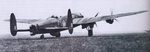
below is the only picture i have of the AGL(T) system (apart from some very nice ones in books), it can just be made out below the rear turret, and below that is the "Z-system", notice the two small rings above the clear vision pannel in the nose blister? that's them........
__________________
"Reminds me of the time I sank the Tirpitz" comments a Spitfire pilot, "One pass of course, old boy."
About the Luftwaffe IR thats impressive but now a question for Lanc what or where was the cooling system for the H2S located and how did it work did it use outside air temp or something else
In Mike Garbett & Brian Gouldings' book, ''Lancaster'' [ISBN 1 85648 055 0], P.55, shows 3 rear turrets indicating their progressive development through the War....that particular statement went on to say the RR turrets were used mainly by I Group, and the pic also shows a 'Monica' radar aerial beneath it....- It certainly 'looked' roomier, having a different layout altogether from the preceding ones, with even more 'open area' of perspex for the gunners view....
In ''Lancaster'' by Christopher Chant [ISBN 0 75258 769 2], P.48, is his statement about the RR turret and 'Village Inn'....
In regard to 'Type Z', I read mention of it in a book about 100 Group, when F/Sgt Honeyman & F/L 'Topsy' Turner of RAF 85 Sqn. shot down a Ju.188 on 4/5 April 1945.....
....''At 100 yds, there was no Type F response [an infra-red telescope which could pick-up a light source under the tail of RAF bombers, but invisible to the naked eye because the the light was covered by a black shield, known as 'Type Z']. Using night binoculars, the target aircraft was identified from underneath as a Ju.188....''
- It's the first I had ever heard about this system; I had though IFF was their main ID system, which was able to be homed on to by German NF's...
Unfortunately I don't have the advantage of checking these types of things out 'first-hand', as in museums, ex-aircrew etc., having to rely on what I've read about, which is also probably limited in what is available to me....But thanks for that Lanc, it was most informative - I'd heard of 'Village Inn', but that was all I could lay my hands on.........
well those tubes would be really hot because of the power consumption alot of them were even in oil baths but I read the h2s was water cooled but i was curious how they did it
The Magnetron and rotating reflector were housed in the "bump" under the fuselage, part of the electronics were inside the box structure supporting the radome and cooled by heat disipation from airflow as well.
The display unit was mounted at the navigators position.
H2X that replaced it was the same.
Village Inn did not have any form of IFF capability when first issued to active duty squadrons.
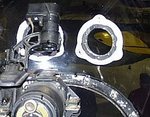
The two circles on the front windscreen were not used for IR lamps, they can be seen on any of hundreds of photos of MkI,MkII, and MkIII along with the Canadian manufactured planes that were fitted or refitted with the larger MkIII type bomb aimers blister.
All these photos were taken in the years before Village Inn was introduced.
Off the top of my head I can't remember the purpose but it was not as mentioned above.
German reciever units.
FUG 221-A “ROSENDAAL-HALBE”: Passive homing device by Siemens. This device was designed to recognize and intercept the signals of the “Monica”, “ASV” antiship, “Rosendaal,” and “Magic Box” tail-warning transmitters. It had a 100-km range and worked with 190 – 230 mHz frequencies. The “Rosendaal-Halbe” never entered mass production.
FUG 222 “PAUKE S”: Telefunken aiming device. It worked with frequencies from 3250-3330 mHz with a range of 300 – 10,000 m. Vision range of 100 degrees horizontally and 20 degrees vertically. The device was connected to an electrical ReVi device and monitor. Only 3 apparatus were build.
FUG 226 NEULING IFF experimental device by Lorenz. Me 262A Wrk.Nr. 170056 was equipped with this ground-to-air and air-to-air IFF device together with the FuG 218 Neptun. FUG 227 “FLENSBURG” It was a passive homing device developed by Siemens. The Flensburg could detect from a distance of 65 Kms (45 miles) the emissions of the “Monica” tail-warning radars of the RAF bombers. Production of this set began in Spring of 1944. The Flensburg antennas were installed in both the wings: at the top and bottom panels of the starboard wing tip and in the leading edge of the port wing. When on 13.7.44 the Ju 88 G-1 of 7./NJG 2 felt under Allied hands its FuG 220 and 227 sets were rapidly examined and countermeasures developed against them. Three different Ausführung with many improvements were delivered for a total of 250 apparatus.
FUG 280 “KIEL”: The Kiel was a passive IR vision detector developed by Zeiss. It operated using lead-sulphite photocells amplified in a vision screen. Its range was about 4000 m; the unit weighed only 42 kg. Only a few devices were built.
FuG 350 “NAXOS Z”: The Naxos was a Telefunken passive homing device similar to the FuG 227 ("Flensburg"). It was developed during the Summer of 1943. Production began in the early months of 1944 and the device entered service together with the Flensburg and remained in use until the end of the war. Unlike the Flensburg, the Naxos detected the H2S ground mapping radar (as well as the H2X, AN APS 15) instead of the Monica tail warning radar. Models I, II, and III used frequencies 82 – 84 MHz; IV, V, VI, and VII, 91 – 116 MHz. Its range was as far as 50,000 m in its best Ausführung, 10,000 in its very first versions. In whole 25 series were developed being the “Z” series the most successful with 700 apparatus built alone from “Z” to “ZR” series! The “Naxos Z” were used in Ju 88 G's in combination with the covered Morgenstern antennae because its elements could be easily installed inside the wooden nose cone or inside teardrop-shaped covers. Tests with Naxos were also carried in single-engined Me109G's (NH+VZ, for example) housed under a plexiglass dome on the second panel just behind the radio antenna mast behind the canopy.
Prior to Village Inn and Monica was Fishpond, which was used from the H@S to the radion operators position, basically a radar return with the gain tuned to within 1,000 feet of the aircraft that would show airborne targets coming in from underneath the aircraft. Not very effective.
__________________ 4 out of 5 voices in my head say I am normal. Majority rules.
You're just jealous because the voices only talk to me.
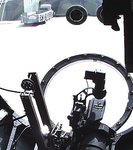
It wasn't to cool down the bombadier, it was to allow the inside temperature to equal the outside temp and reduce frosting on the inside.
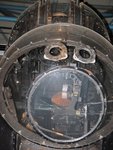
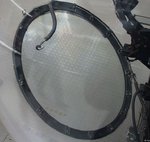
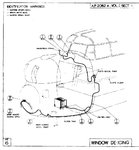
If you look in the photo below in the lower part of the flat sitting panel you will see a tube wrapping around from right to left heading towards the top of the flat panel. It has a small orange mark on it where it crosses the panel.
It leads to an outlet pipe top dead center of the flat panel and was connected to the glycol storage tank located by the entrance steps to the bombadiers position.
It sprayed glycol anti freeze over the flat panel ensuring it didn't freeze up.
__________________ 4 out of 5 voices in my head say I am normal. Majority rules.
You're just jealous because the voices only talk to me.
I don't think Glycol is what I'd want on a piece of glass it gotta be harder to see out of then just scrapping the frost off. Was it a standard mod or just a one of