

Hobilar
Airman
The Westland P.9 Whirlwind was designed in 1936 by W.E.W. Petters (see note 1) to the requirements of Air Ministry specification F.37/35 for a high-performance fighter, armed with four cannon. It would become the Royal Air Force's first twin-engined single-seat fighter and the first such aircraft to be used in numbers by any of the belligerent powers. Of orthodox all metal stressed-skin construction, the Whirlwind introduced several design innovations later to be widely adopted. It had an extremely slim fuselage (the cross section of which was less than that of the engine nacelles), and the four Hispano cannon were closely grouped in the fuselage nose to give a dense concentration of fire. The all-round vision cockpit was an advanced feature, and the coolant radiators were ducted within the centre section of the wing, In addition the Whirlwind incorporated Fowler-type flaps which extended from aileron to aileron.
A contract for two prototypes (L6844 and L6845) was placed in February 1937, with the first of these flying on the 11th October 1938. An initial production order for 200 machines was placed in January 1939 (followed by a second order for a similar number), with deliveries to fighter squadrons being scheduled to commence during the following September. Unfortunately deliveries the first Peregrine engines (in essence a modernised version of the classic Kestrel) did not reach Westland until January 1940, and, in consequence, the first Whirlwinds did not enter service until June, 1940.
Teething and delivery problems with the Peregrine engines (See Note 2) coupled with a number of flying accidents and a high landing-speed which restricted the number of airfields from which it could operate, resulted in production being terminated in January 1942 after the completion of just 112 production aircraft. These aircraft equipped just two squadrons of the RAF (No.263 Squadron from June 1940, and No.137 Squadron from November 1941. Both would re-equip with Typhoons in November 1943.
Notes:
Bibliography:
A contract for two prototypes (L6844 and L6845) was placed in February 1937, with the first of these flying on the 11th October 1938. An initial production order for 200 machines was placed in January 1939 (followed by a second order for a similar number), with deliveries to fighter squadrons being scheduled to commence during the following September. Unfortunately deliveries the first Peregrine engines (in essence a modernised version of the classic Kestrel) did not reach Westland until January 1940, and, in consequence, the first Whirlwinds did not enter service until June, 1940.
Teething and delivery problems with the Peregrine engines (See Note 2) coupled with a number of flying accidents and a high landing-speed which restricted the number of airfields from which it could operate, resulted in production being terminated in January 1942 after the completion of just 112 production aircraft. These aircraft equipped just two squadrons of the RAF (No.263 Squadron from June 1940, and No.137 Squadron from November 1941. Both would re-equip with Typhoons in November 1943.
Notes:
- W.E.W. Petters would later be the chief designer of the post-war English Electric Canberra.
- Rolls-Royce being, at that time, more concerned with improving and maximising production of the important Merlin engine.
Bibliography:
- Aircraft of World War II (Chris Chant, Dempsey-Parr, 1999)
- The Complete Book of Fighters (William Green and Gordan Swansborough, Salamandar, 1997).
- Warplanes of the Second World War-Fighters Volume 2 (William Green,MacDonald,1961).
- World Aircraft Information Files (Aerospace Publishing Periodical).


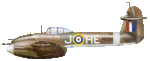

 The Whirlwind is one of my fav.ww2 a/c at all.


