| Why not a jet driven P-38?| Aviation Discuss Why not a jet driven P-38? in the World War II - Aviation forums; You are assuming that RAF test pilots only flew the P-59 after flying only piston fighters. Since the Brits ... |
|
08-10-2007, 11:27 AM
|
#16 | | Your ad here. ;)
Join Date: Sep 2004 Location: Moorpark, CA
Posts: 12,141
Country: | You are assuming that RAF test pilots only flew the P-59 after flying only piston fighters. Since the Brits were quite ahead of the US in jet aircraft development, I am sure that the comparisons were against the Meteor. I understand how acceleration and spool up time work. It doesn't change the fact that the P-59 was a big disappointment, period.
__________________ http://www.vg-photo.com Wherever their bones may lie, the courage of heroes is consecrated in the hearts and engraved in the history of the free. Lt Col Honner DSO MC, 39th Commander speaking of the dead from the battle of Kokoda. |
| |
08-10-2007, 12:59 PM
|
#17 | | Senior Member
Join Date: Jun 2007 Location: Pine Mountain Lake, California
Posts: 610
Country: | Good idea, but you used the wrong airframe . . . the XP-58 Chain Lightning would've been a better candidate for a jet engine installation. Basically an enlarged P-38 with more powerful engines (Allison V-3420's), more airframe room to work with, and a lot more fuel onboard (2,000 gals.+). Initial tests with the aircraft weren't exactly successful, mainly due to the tempermental engines (another Allison trademark), but the airframe had a lot of room for development, including room for installing a jet engine in the rear of the centrally-mounted fuselage.  |
| |
08-10-2007, 01:04 PM
|
#18 | | IP/Mech THE GREAT GAZOO
Join Date: Apr 2005 Location: Colorado, USA
Posts: 12,511
Country: | Agree.....
__________________ "IF ITS RED OR DUSTY, DON'T TOUCH IT" |
| |
08-10-2007, 05:32 PM
|
#19 | | Senior Member
Join Date: Jun 2006 Location: London Ontario Canada
Posts: 183
Country: | Or how about a pair of 3000shp turbine. |
| |
08-10-2007, 06:25 PM
|
#20 | | Senior Member
Join Date: Jun 2007 Location: Pine Mountain Lake, California
Posts: 610
Country: | Quote:
Originally Posted by johnbr Or how about a pair of 3000shp turbine. | Yeah, if they'd had turboprops in '45, which they didn't.
Jet turbine technology was in it's infancy as that time; as it was, it was difficult enough to get a jet turbine to operate reliably without trying to bolt on an output shaft to the compressor section, and add a bunch of other stuff (accessory drives, etc.) to an otherwise complicated (for 1945) piece of technology. They had enough trouble with just the engine by itself, let alone an output shaft, harmonic balancers, etc. |
| |
08-10-2007, 07:18 PM
|
#21 | | Senior Member
Join Date: May 2007
Posts: 1,318
Country: | Quote:
Originally Posted by delcyros It just has been an idea, nothing to upset us. | Good.
In that case, had you thought of eliminating the piston engines altogether?
I know the jet powerplant you envisage is 'small', so would two suffice? Arranged in a stacked position?
I guess you would have to redesign the tail to prevent scorching? I understand that Lockheed had experimented with this to reduce flutter (unsuccessfully).  |
| |
08-11-2007, 11:14 AM
|
#22 | | Senior Member
Join Date: Jun 2007 Location: Pine Mountain Lake, California
Posts: 610
Country: | Quote:
Originally Posted by Graeme Good.
In that case, had you thought of eliminating the piston engines altogether?
I know the jet powerplant you envisage is 'small', so would two suffice? Arranged in a stacked position?
I guess you would have to redesign the tail to prevent scorching? I understand that Lockheed had experimented with this to reduce flutter (unsuccessfully).  | Yes, they did; and the envisioned floatplane version of the P-38 would also have used the raised tail, if it had been built.
However, it turned out to be the wing-to-fuselage juncture that was causing the problem, so all subsequent versions of the -38 had a large fillet added to the wing/fuselage juncture at the leading edge of the wing.
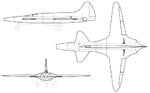
BTW, those line drawings look an awful lot like the Saab 21R, except the Saab only had one engine.  |
| |
08-11-2007, 02:51 PM
|
#23 | | Senior Member
Join Date: Mar 2005 Location: Berlin (Kreuzberg)
Posts: 1,479
| I too think that turboprops are no option due to technology and production avaiability issues.
I also tend to think that the XP-58 is no option due to similar reasons. While the plane offers enough space and fuel, it was a developmental airplane, not to get airborne before june 44. The P-38 is avaiable in numbers since 41 and production and assembly lines were working fully by mid 42 latest.
The proposed pure jet engine version is an interesting option. I now am a bit scared about the potential of the P-38 airframewise! Unbelievable but the plane could be kept in frontline service up to the early 50īs with these modifications:
P-38H - mass production started in may 43. As historical.
"P-38I" -mass production could start in nov. 43 (modifications as shown on top of page 1, mix plane. jet engine: I-16 mod 3)
"P-38P" -mass production could start in mid 44 (modifications: I 16 mod 5 engine + 2 Allisons with high speed props, higher set stabilizer and new nose section with fully pressurized cockpit and bubble type canopy = higher crit Mach figure, higher top speed, more range)
"XP-88A" - developmental plane to be ready in late 44. Both Allison engines are removed, the boom structure fully redesigned. The plane is driven either by two I-16 mod 5 (as suggested by Graeme) or by a single I-40. The Modifications are significant enough to justify the new number. Since the plane is both, lighter and aerodynamically cleaner, it will receive substantial advantages and become a true 500 mp/h class fighter. Basically a Vampire, just better.
"XP-88C" - the final version to be made in the late 40īs. Using an improved I-40 engine and swept back, thinner wings, which turn the plane into a true 600 mp/h class fighter.
Neither the Fw-190, the Bf-109, the Spitfire, the Thunderbolt nor the Mustang or any other high performance piston fighter had a comparable potential for further development -if only explored- than the P-38, impressive.
__________________ ---delcyros---
Last edited by delcyros : 08-11-2007 at 02:59 PM.
|
| |
08-11-2007, 07:51 PM
|
#24 | | Senior Member
Join Date: May 2007
Posts: 1,318
Country: | From SoD Stitch Quote: |
Yes, they did; and the envisioned floatplane version of the P-38 would also have used the raised tail, if it had been built.
| I have very little on Lockheed's P-38 floatplane, do you have more on it? Quote: |
BTW, those line drawings look an awful lot like the Saab 21R, except the Saab only had one engine.
| The montage of images was to simply try to portray what I had in mind. Yes, the first is the SAAB 21R. The second is the odd looking Yugoslav Government Factories Type 452-2 experimental aircraft. 
Last edited by Graeme : 08-11-2007 at 08:10 PM.
|
| |
08-11-2007, 09:19 PM
|
#25 | | Your ad here. ;)
Join Date: Sep 2004 Location: Moorpark, CA
Posts: 12,141
Country: | Graeme, there was a short-lived program for a float-plane P-38 for ferrying. From my P-38 presentation notes: Quote: |
One interesting E model was equipped with floats for ferrying across the Pacific, which would be later removed for combat operations. The challenge for using floats was that the tail needed to be out of the spray. One of these aircraft had the tail booms lengthened and raised 3 feet! An observer/engineer seat was added behind the pilot, replacing some of the radios. Developments in the Pacific proved that the Navy could deliver the aircraft to their locations and further floatplane development stopped.
|
__________________ http://www.vg-photo.com Wherever their bones may lie, the courage of heroes is consecrated in the hearts and engraved in the history of the free. Lt Col Honner DSO MC, 39th Commander speaking of the dead from the battle of Kokoda. |
| |
08-11-2007, 09:21 PM
|
#26 | | Your ad here. ;)
Join Date: Sep 2004 Location: Moorpark, CA
Posts: 12,141
Country: | Delcyros, by the time you have finished all of those modifications, you have a completely different ariplane anyway, so why spend all that engineering time re-engineering the Lightning when you can start with a fresh new design that won't take tooling away from production aircraft that are needed in the combat zones?
__________________ http://www.vg-photo.com Wherever their bones may lie, the courage of heroes is consecrated in the hearts and engraved in the history of the free. Lt Col Honner DSO MC, 39th Commander speaking of the dead from the battle of Kokoda. |
| |
08-12-2007, 08:27 AM
|
#27 | | Senior Member
Join Date: Mar 2005 Location: Berlin (Kreuzberg)
Posts: 1,479
| Quote: |
Delcyros, by the time you have finished all of those modifications, you have a completely different ariplane anyway, so why spend all that engineering time re-engineering the Lightning when you can start with a fresh new design that won't take tooling away from production aircraft that are needed in the combat zones?
| Itīs perhaps the tooling problem (a complete new plane not only needs to be engeneered in plane and the tooling devices but also requires more developmental time) which cancelled the P-38K. A new design anyway also needs new tooling processes, but uncomparably more. The effect is not a combat plane production reduction but a general delay until the new plane get accepted, the assembly lines get build up, the tooling avaiable and the production starts. A complete new airframe coupled with the new type of propulsion - as it was done in the P-59 - is not a favourable condition to start with. The pistonīs had advantages on their own, which were unsurpassed by jets until the late 40īs / early 50īs. The mix propulsion was perhaps the best way to deal with jet problems in between 1942 and 1947.
The key aspect is that while some fewer P-38H and probably no P-38L would have been build, the P-38I is a truly superior plane when it arrive on the continent, the increase in performance may justify the production delay and the USAAF in europe never experienced a P-38 shortage in replacement planes. You also donīt need to retrain all pilots extensively, as it was necessary with "pure" jets, experiencing poor low speed performances.
I had a controversy with a friend of mine, who insisted that the allies while having better jet engines in production, never could bring a jet airframe into combat during ww2: Quote:
The P-59 was disappointing, the P-80 was the better plane, hands down, but she never had a realistic chance to get deployed in action for ww2 and was on the edge to be obsolete in action over Korea.
The Meteor was a somehow inferior airframe up Mk-III and was to late to see extensive use in ww2 outside the V-1 hunting and ground attack role, the Vampire MK I would be to short legged to be of any use. All these jetīs required very long testing to work out teething problems, effectively preventing their effective deployment.
| Of course I disagreed! Since he was referring mostly to the airframes, I looked for something which could be done realistically and stumbled over the P-38.
__________________ ---delcyros--- |
| |
08-12-2007, 09:31 AM
|
#28 | | Senior Member
Join Date: Jun 2006 Location: oregon
Posts: 1,899
Country: | Quote:
Originally Posted by delcyros "XP-88A" - developmental plane to be ready in late 44. Both Allison engines are removed, the boom structure fully redesigned. The plane is driven either by two I-16 mod 5 (as suggested by Graeme) or by a single I-40. The Modifications are significant enough to justify the new number. Since the plane is both, lighter and aerodynamically cleaner, it will receive substantial advantages and become a true 500 mp/h class fighter. Basically a Vampire, just better.
"XP-88C" - the final version to be made in the late 40īs. Using an improved I-40 engine and swept back, thinner wings, which turn the plane into a true 600 mp/h class fighter.
Neither the Fw-190, the Bf-109, the Spitfire, the Thunderbolt nor the Mustang or any other high performance piston fighter had a comparable potential for further development -if only explored- than the P-38, impressive. | I haven't seen all the specs on the P-38 but recall that Mcr was lower than the 51 and Spit and Fw190D - so the redesign would have to be significant to improve stability at lesser speeds than 600mph as well as increased interference with elevator due to turbulent flow over the centerbody?
I would be suprised, absent a completely swept wing, that the 'late version' could do 600mph.
Just guessing, but the straight section of the wing inboard of the booms would be your first issue and probably define Mcr for the airframe, even with a redesign of centerbody.. moving the center of lift rearward at that moment combined with any flow separation masking the elevators would probably make this bird pitch nose down at that point.. |
| |
08-12-2007, 10:20 AM
|
#29 | | Senior Member
Join Date: Mar 2005 Location: Berlin (Kreuzberg)
Posts: 1,479
| Quote: |
Just guessing, but the straight section of the wing inboard of the booms would be your first issue and probably define Mcr for the airframe, even with a redesign of centerbody.. moving the center of lift rearward at that moment combined with any flow separation masking the elevators would probably make this bird pitch nose down at that point..
| It is. The modification of the centerwing part is necessarely the first redesign next to the rear fuselage. The tankage systems needs to be redesigned to suite the jet engineīs fuel requirements and the wingroots needs to be reshaped as well. Aerodynamic compressibility related issues were not fully understood at this point (say earliest design stage 1941-1942) and while we might be able -with 20/20 hindsight- to make it work, the Lockheed designers might eventually not have come to the same solution. Or it goes the other way -Skunk work people had a reputation for doing the unthinkable- who knows?
BTW- has anyone a detailed drawing of the sections in question (midwing section and more importantly the center fuselage gondola)? I have run up & down in the net and have been unable to find something barring a rather simple and unscaled cutaway drawing.
best regards,
delc
__________________ ---delcyros---
Last edited by delcyros : 08-12-2007 at 10:23 AM.
|
| |
08-12-2007, 01:10 PM
|
#30 | | Senior Member
Join Date: Mar 2005 Location: Berlin (Kreuzberg)
Posts: 1,479
| Here a comparison with other jet-prop-mix planes which have been accepted for production:
1.) Convair XP-81 (february 1945 first flight) heavy fighter
24.650 lbs max., 507 mp/h top speed, 2500 mls. range, 35.500 ft. ceiling
-canceled for beeing to late to be os any use against japan. Proposed in response to USAAF requirement for a mixed power escort fighter in 1943.
2.) Curtiss XF-15 C-1 (jule 1945) navy fighter
18.689 lbs max., 469 mp/h top speed, 635 mls. range, ceiling unknown
3.) Douglas XB-42A "Mixmaster" (may 1946) bomber
32.000 lbs, 490 mp/h, 2480 mls, 41.800 ft. ceiling
XB-42, dating from 1943, intended to replace the Douglas A-26 Invader.
4.) Douglas XBTD-2 "Destroyer" (1945) dive bomber
~22.000lbs max., speed, ceiling and range unknown
5.) Grumman XTB3F-1 "Guardian" (december 1946) torpedo bomber
weight, ceiling and range unknown, top sped is 350 mp/h
6.) Martin P4M-1 "Meractor" (oct. 1946) maritime patrol
88.375 lbs max., 410 mp/h, 2840 mls, 16.900 ft. ceiling
in use well into the 50īs!
7.) Ryan FR-1 "Fireball" (jule 44) Fighter
~9.000lbs max., 426 mp/h, 1.430 mls, 42.000ft. ceiling
On the 2/12/1943 the US Navy ordered 100 FR-1" Fireballs" and later in 1944 ordered an additional 600 aircraft, but after VJ day after only 66 aircraft had been made the order was canceled.
It seems the idea was not unpopular.
__________________ ---delcyros--- |
| | | Thread Tools | Search this Thread | | | | | Display Modes | Linear Mode |
Posting Rules
| You may not post new threads You may not post replies You may not post attachments You may not edit your posts HTML code is Off | | | All times are GMT -5. The time now is 04:47 PM. |  | |