ADS NOT DISPLAYED TO REGISTERED USERS.
+ Reply to Thread
Page 1 of 3 1 2 3 LastLast
Results 1 to 15 of 34

Allison V-1710 Supercharger Impeller

Engines Discuss Allison V-1710 Supercharger Impeller in the Technical forums; A while back I discussed the different limitations and qualities of the single stage Merlin (ie 45) and Allison's supercharges. ...

  1. #1
    Senior Member kool kitty89's Avatar
    Join Date
    Aug 2007
    Location
    San Jose, CA
    Posts
    2,415
    Country
    United States

    Allison V-1710 Supercharger Impeller

    A while back I discussed the different limitations and qualities of the single stage Merlin (ie 45) and Allison's supercharges. In doing so I saw how much smaller the Allisons supercharger casing apeared, fitted very crampped aganst the back of the engine.

    I recently noticed the diameter given for the V-1710's impeller here http://www.raafwarbirds.org.au/targe...fs/1710-33.pdf

    At 3.5 inches that would seem unusually small, especially compared to the "cropped" impeller of the low altitude version of the Merlin which was still 9.5" in diameter.

    The supercharger seems to have remained the same on the Allison (excluding added auxiliary 2-stage version and turbocharging arrangements) except for the gear ratio. The early versions (with epicyclic reduction gearing) like the V-1710-33 of the P-40/B/C/Tomahawk had an 8.77:1 ratio (8.77x the engine speed) the newer -short nosed- versions (with stronger and simpler spur gearing) had an 8.8:1 rato like the -39,-73 of the P-40E/K (though this may just have been rounded, and the supercharger performance was similar). Additionally there were the 9.6:1 versions like the -81/99 of the P-40N and P-51A which had significantly beter altitude performance. (at the expence of greater charger heating)


    The 3.5" figure would seem unusually small, could it be a mistake? (though judging by the engine's dementions and the size of the impeller casing, particularly compared to that of the single stange Merlin's, it would apear to be pretty small)


    Last edited by kool kitty89; 11-26-2008 at 08:40 PM.

  2. #2
    Senior Member
    Join Date
    Mar 2005
    Posts
    479
    The Standard Impeller diameter was 9.5"

    On a few two-speed engines this moved to 10.25"

    On the two-stage engines it was 10.25" + 12.18"

    I have gear ratios as well if needed.

  3. #3
    Senior Member kool kitty89's Avatar
    Join Date
    Aug 2007
    Location
    San Jose, CA
    Posts
    2,415
    Country
    United States
    I didn't think there were any single-stage 2-speed versions of the V-1710.

    Looking at that page again, it's probably 9 1/2 inches, that portion was hand written and the relolution of the page isn't high enough to make it out completely.


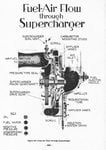
    The supercharger casing seems to be much smaller than that of the Merlin's. It seems to lack a vaned diffuser, though maybe it's just the perspective of the photo.
    Last edited by kool kitty89; 11-24-2008 at 04:51 PM.

  4. #4
    Senior Member
    Join Date
    Mar 2005
    Posts
    479
    Single stage and two speed versions were;

    -45
    -57
    -93
    -97
    -101
    -109
    -111
    -131

  5. #5
    Senior Member
    Join Date
    May 2008
    Location
    Trentham, Victoria, AU
    Posts
    113
    Country
    Australia

    Allison V-1710 superchargers

    Quote Originally Posted by red admiral View Post
    Single stage and two speed versions were;

    -45
    -57
    -93
    -97
    -101
    -109
    -111
    -131
    This claim is at odds with info contained in Dan Whitney's book on the Allison. He says that apart from one or two obscure models of the V-1710, two-speed superchargers were not used on this engine.
    Perhaps there is confusion here between two-SPEED and two-STAGE supercharger units?
    Also, with regard to the original post on this topic, the early versions of the V-1710 had INTERNAL SPUR gear reduction units, not epicyclic.
    Last edited by jerryw; 11-25-2008 at 05:34 PM.

  6. #6
    Senior Member kool kitty89's Avatar
    Join Date
    Aug 2007
    Location
    San Jose, CA
    Posts
    2,415
    Country
    United States
    What do you mean by "internal spur" gearing? Epicyclic gearing was also sometimes referred to as planetary spur gearing.


    Also, from the above cut-away it looks like the V-1710's supercharger had a vaneless diffuser.

  7. #7
    Senior Member
    Join Date
    Mar 2005
    Posts
    479
    Dan Whitney's Vees for Victory is incorrect in this regards. Theres a nice list published by Air Material Command which gives the model designations of USAF engines including details on usage, powers, displacement, supercharger details, prop details etc.

  8. #8
    Senior Member kool kitty89's Avatar
    Join Date
    Aug 2007
    Location
    San Jose, CA
    Posts
    2,415
    Country
    United States
    So were the 2-speed models used for anything operationally? What supercharger gearing did they use?

  9. #9
    Senior Member
    Join Date
    May 2008
    Location
    Trentham, Victoria, AU
    Posts
    113
    Country
    Australia
    Quote Originally Posted by kool kitty89 View Post
    What do you mean by "internal spur" gearing? Epicyclic gearing was also sometimes referred to as planetary spur gearing.


    My understanding is that to have EPICYCLIC gearing, some of the gears involved in the system must, a/ rotate about their own axis and, b/ must also rotate, as a whole, about a common point. The Earth rotates about its own axis AND it also rotates around the sun, hence PLANETARY movement.
    In both the diagrams you provide, conditions a/ and b/ are met, thus they are epicyclic or planetary gearing systems.
    Internal spur gearing is where the pinion on the end of the crankshaft meshes with a surrounding ring gear that has teeth on its INSIDE. Both gears rotate around their own axes but NOT around a common axis.

    P.S. "auxhiullery" is spelt AUXILIARY.


    Also, from the above cut-away it looks like the V-1710's supercharger had a vaneless diffuser.
    The diagrams of the V-1710 supercharger contained in the factory operation and overhaul manuals show the presence of vanes in the diffuser.

    The lower pics show a photo of the arrangement where an internal spur gear is used for the propeller reduction. (Photo is of a Continental engine)
    In the L.S. of the C-model Allison V-1710, the pinion gear on the end of the crankshaft is clearly visible. Note that the centre-line of the prop. shaft is ABOVE the c/l of the crankshaft - in an epicyclic mechanism, the two c/l's would coincide.
    Attached Thumbnails Attached Thumbnails Allison V-1710 Supercharger Impeller-img.jpg   Allison V-1710 Supercharger Impeller-int-spur.bmp  

    Last edited by jerryw; 11-29-2008 at 05:37 PM.

  10. #10
    Senior Member
    Join Date
    May 2008
    Location
    Trentham, Victoria, AU
    Posts
    113
    Country
    Australia
    Quote Originally Posted by red admiral View Post
    Dan Whitney's Vees for Victory is incorrect in this regards. Theres a nice list published by Air Material Command which gives the model designations of USAF engines including details on usage, powers, displacement, supercharger details, prop details etc.
    Yet another unsubstantiated claim from "red admirable". If this "nice list" exists, let's SEE IT!!

  11. #11
    Senior Member kool kitty89's Avatar
    Join Date
    Aug 2007
    Location
    San Jose, CA
    Posts
    2,415
    Country
    United States
    Thanks for the info jerry. The use of that gearing system was to facilitate better streamlining, correct? And the switch to the conventional external spur gearing was due to structural limitations of the earlier configuration? (I've read the V-1710-33's gearbox was only rated for 1,100 hp and there were several accounts of stripped gears -notably from the AVG- due to using higher power settings; the later V-1710-39's reduction gear was rated for 1,600 hp)

  12. #12
    Senior Member
    Join Date
    Mar 2005
    Posts
    479
    Its hardly unsubstantiated when I've told you exactly where to find the information;

    Model Designations of U.S.A.F. Aircraft Engines
    Air Material Command
    Revised January 1, 1950

    Theres a note that this report supersedes AMC No. TSEST-A6 (8th Edition) dated 1946 so you could find the information in that as well (this version includes some postwar engines)

  13. #13
    Senior Member kool kitty89's Avatar
    Join Date
    Aug 2007
    Location
    San Jose, CA
    Posts
    2,415
    Country
    United States
    It's here: ModDesig

  14. #14
    Senior Member ozhawk40's Avatar
    Join Date
    Feb 2007
    Location
    Live on the Oz West Coast - Perth
    Posts
    1,920
    Country
    Australia
    I'm not sure if this is the publication Red Admiral refers, but here is the specs for the v-1710 series which may add to this discussion.

    It's from a USAF publication listing all variants and application.
    Attached Files

  15. #15
    Senior Member ozhawk40's Avatar
    Join Date
    Feb 2007
    Location
    Live on the Oz West Coast - Perth
    Posts
    1,920
    Country
    Australia
    thanks Kool Kitty

    That's the link where I got these files from. A great resource, but I couldn't remenber exactly where!

+ Reply to Thread
Page 1 of 3 1 2 3 LastLast

LinkBacks (?)

  1. Hits: 1
    03-06-2011, 04:53 AM

Bookmarks

Posting Permissions

  • You may not post new threads
  • You may not post replies
  • You may not post attachments
  • You may not edit your posts

1 2 3 4 5 6 7 8 9 10 11 12 13 14 15 16 17 18 19 20 21 22 23 24 25 26 27 28 29 30 31 32 33 34 35 36 37 38 39 40 41 42 43 44 45 46 47 48 49 50 51 52 53 54 55 56 57 58 59 60 61 62 63 64 65 66 67 68 69 70 71 72 73 74 75 76 77 78 79 80 81 82 83 84 85 86