![]() |
| | #1 |
| Junior Member Join Date: Nov 2008
Posts: 18
| Opportunity lost - DB 16 cyl It is historic fact that Damlier Benz worked on a 16 cylinder development of the DB603 line of engines under the DB609 type number. Development of this engine was abandonned in April of 1943. From what little I have been able to find out, it was a conventional V16 design with a crankshaft that was 8 throws long, and the propeller reduction gear at the end of the engine. My guess is that torsional vibration and twisting of such a long heavily loaded carnkshaft was a major difficultly, and that correcting crankshaft problems was beyond the ability of the Damlier Benz engineers and technicians. But what if DB had built the engine like the Chrysler IV-2220?? Use the pistons, rods, valves, etc. from a DB603 to build a 162 mm bore x 180 mm stroke sixteen cylinder engine as essentually two V-8s end to end with the propeller reduction gears in the center of the engine. Now there are two short stiff crankshaft segments, and a the two crank segments could have been isolated from each other with a vibration damper or quill shaft. I estimate that the weight of such an engine with a single stage supercharger would have been around 2700 pounds (1230 kg). This likely would have given the German airforce a reliable alternate to the Jumo 222 on a timely basis. Maybe this could have been the 2500 HP engine that they needed for later versions of the He 219, Ju 388, etc. and the Bomber B projects. That is all I think i know. Piper106 |
| | |
| | #2 |
| Senior Member | too little info to say much about it ... Kris
__________________ ![]() |
| | |
| | #3 |
| Member Join Date: May 2008 Location: Trentham, Victoria, AU
Posts: 84
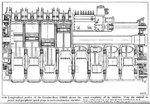
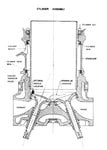
| DB 609 The DB 609 was (yet another) interesting design project produced by the German aviation industry during WW2. It was one of many aimed at producing engines with a quantum power increase compared to the engines the German Air Force started the war with. Below is a couple of line drawings of the DB 609 which was designed to be installed in aircraft either upright or inverted. Points of interest include the use of WET cylinder liners (unusual for DB); SEPARATE cylinder heads; ONE-PIECE crankcase/cylinder blocks (which must have required a very large casting); large diameter ROLLER main bearings (presumably to keep the total length of the engine down);and SIDE-BY-SIDE con-rods. Horsepower figure quoted is 2,660 for a weight of 3,080 lbs (one German source quotes only 2,530 lbs!) so a long way from the 1 hp/lb that some engines of the era obtained. A very big fighter aircraft would have been required to house this engine. In the L.S. drawing below, the prop. drive is missing. This engine was designed for use with contra-props. Does anyone have the drawing with the prop. drive shown? Last edited by jerryw; 11-23-2009 at 05:56 PM. |
| | |
| | #4 |
| Senior Member Join Date: Mar 2005
Posts: 471
| ![]() The main problem is length and weight. Going with the Chrysler double V8 arrangement only increases the length further. |
| | |
| | #5 |
| Senior Member Join Date: Mar 2005 Location: Aquincum, Pannonia Prima
Posts: 958
| Nice drawings, JW and RA - where are they from, if I may ask?
__________________ __________________________________________________ ![]() http://kurfurst.org http://kurfurst.freeforums.org/index.php |
| | |
| | #6 |
| Junior Member Join Date: Nov 2008
Posts: 18
| As far as history; Jane's All the World's Aircraft 1945-46 gives the DB609 weight in both english and metric units. The metric weight is given as 1400 Kg. When you convert 1400 kg = 3080 pounds. Is the 3800 pounds a possible typo that has been repeated over the years??? I respectfully disagree that making a 16 as a twin V8 would have made it significantly longer or heavier, if equal construction techniques are used. You have all the same parts to package, whether the crank is 8 throws long or two 4 throw long pieces. Much of the extreme length of the Chrysler IV-2220 was because it had separate cylinders. Piper106 |
| | |
| | #7 |
| Senior Member Join Date: Mar 2005
Posts: 471
| |
| | |
| | #8 |
| Senior Member | I got this from some website, a list by a guy called Nick Sumner Apart from the well-known and widely used V12 aircraft engines, the DB 601, 603 and 605, and the double engines, DB 606, 610, 613 Daimler Benz projected, designed, tested and built many other engines with model numbers between 604 and 632. These were in development from 1939 to shortly before the end of the Second World War. Of these, 12 projects remained only on the drawing board. Relatively little is known of some of these designs but they can be arranged in five development groups. With two exceptions all are based on the basic patterns of the DB 605 (35.7 l capacity) and DB 603 (44,5 l). These five groups are: A. New developments (DB 604, 609, 630) B. Special equipments (DB 607, 612. 632) C. Double engines ( DB 606, 610, 613 as well as 615, 619, 620) D. Engines with multi-stage superchargers (DB 627, 628, 63l) E. Engines with turbochargers (DB 621, 622, 623, 624, 625, 626, 629) The DB 604 The DB 604 was abandoned in September 1942. It was a 24-cylinder, X-type, liquid-cooled engine with a two-speed supercharger. It was developed in parallel to the Jumo 222 and the BMW 802 and like these, it was considered for the Bomber B program. Bore and stroke were the same (135 x 135 mm) and high revolutions were selected at 3200 rpm. The first experimental engine reached an output of 1725 KW (2350 HP). The marks A and B differed only in the direction of rotation, the engine had a take-off power of 1,835 KW (2500 HP) and was equipped with a mechanical two-stage supercharger for a rated altitude of 5,100 m. Starting from 1939, five DB 604 engines were bench tested and some flight testing was carried out in a Ju 52. A projected development with increased capacity and with a three-stage supercharger was not pursued. The development of the DB 604 was cancelled 1942 on the instructions of the RLM. Cylinders: Bore: 135mm Stroke: 135mm Capacity: 46.5l Compression: 7 : 1 Weight: 1080kg Power: 2660hp at MSL Revolutions: 3200rpm The DB 607 This was a four-stroke diesel engine, whose initial development was at the behest of Lufthansa, later however its usefulness to long-range military aircraft was also realised. The first engine was running in 1939, however the V3 and V4 (1940/41) were only experimental engines. Dimensions were similar to the DB 603. Take-off power was 1100 KW (1,500 HP) and with development should have reached 1285 KW (1750 HP) at 1500 rpm. If this had been successful then with a weight of 860 kg a power to weight ratio of 0,49 kg/HP would have resulted. Sources differ as to when it was cancelled, the earliest states 1941 the latest October 1942. The DB 609 A further new design with the same cylinder dimensions as the DB 603 was the V16 DB 609. The first experimental engine was bench tested in 1942. It was designed in such a way that it could, with minimal modification be installed both upright and inverted. Eight cylinders per block led inevitably to a relatively long engine, but it was only 267 mm longer than a standard DB 603. However this also meant a long crankshaft and this suffered severely from vibration. The weight of the engine was 1,150 kg, and it’s take-off power of 1955 KW (2660 HP) with 2800 rpm meant a power to weight ratio of 0.43 kg/HP which was around 15% lower than a standard DB 603. An increase in output to 2055 KW (2800 HP) and later to 2500 KW (3400 HP) was projected for engines equiped with a supercharger for a rated altitude of 12,000 m. These however were not pursued since the DB 609 was cancelled from the development program in 1943. Cylinders: Bore: 165mm Stroke: 180mm Capacity: 61.8 l Compression: 8.5 to 1 Length: 2935 mm Width: 840 mm Height: 1180 mm Weight: 1400kg Power: 2660hp at MSL, max cruise 1950hp at MSL Revolutions: 2800 rpm There were two other related projects; the DB 619 consisted of two coupled DB 609 engines. It had a capacity Capacity 123.6 litres and a projected output of 5240hp. It was abandoned in April 1943. The DB 629 was a DB 609 with two-stage supercharger and turbo blower for 2650hp. Both were abandoned in April 1943. The DB 627 A development of the DB 603 with a two-stage supercharger and after-cooler. Development abandoned in March 1944. Gearing 0.518 to 1. Length: 2745mm Width: 945mm Height: 1230mm Weight: 1020kg Power: 2000hp at MSL, max cruise 1400hp at MSL Revolutions: 2700rpm Consumption: SFC: 0.462 lb/hp/hr The DB 628 Development of the DB 605, fitted with a two-stage supercharger. Abandoned in March 1944. Gearing 0.594 to 1. Length: 2754mm Width: 903mm Height: 1227mm Weight: 860kg Power: 1475hp at MSL, max cruise 1310hp at MSL Revolutions: 2800rpm Consumption: SFC: 0.474 lb/hp/hr The DB 630 Another development, which did not proceed beyond the drawing board, was the DB 630, a 36 cylinder Double W engine with a capacity of 89 litres and output in the 4,000 HP class (2,940 KW). Dr. Berger calculated the optimal cylinder arrangement angles should be 40° + 40° + 100° and it was designed to use only one crankshaft. Development was abandoned in April 1943. Other Projects DB 614 - A development of the DB 603G, 2000hp. Abandoned June 1942. DB 615 - Consisted of two coupled DB 614 engines. 4000hp. Abandoned in June 1942. Germany. DB 616 – A development of the DB 605. Abandoned in June 1942. DB 617 - A developmenent of the DB 603 for long-range flight. DB 618 - Two coupled DB 617 engines. DB 621 - A development of the DB 605 with a two-stage supercharger. 1620hp. Abandoned in September 1942. DB 622 - Development of the DB 603 with a two-stage mechanical supercharger and a turbosupercharger. 1970hp. Abandoned in January 1943. DB 623 - Development of the DB 603G with twin turbo-superchargers. 2265hp. Abandoned January 1943. DB 624 - Development of the DB 603 with both a two-stage mechanical supercharger and a turbosupercharger. 1900hp. Abandoned in April 1943. DB 625 - A DB 605D with turbo supercharger. 1755. Abandoned DB 626 - A DB 603G with twin turbosuperchargers and induction cooler. 2125hp. Abandoned November 1942. DB 631 - A DB 603G with a three-stage supercharger. 1900hp. Abandoned. DB 632 - Development of the DB 603N, with a drive for contra-rotating propellers. Weight: 1000kg Power: 2400hp at MSL, max cruise 1520hp at MSL Revolutions: 3200 rpm Kris
__________________ ![]() |
| | |
| | #9 |
| Senior Member | Great info Kris.
__________________ Take arrows in your forehead, but never in your back. - Samurai maxim ![]() |
| | |
| | #10 |
| Member Join Date: May 2008 Location: Trentham, Victoria, AU
Posts: 84
| . " Much of the extreme length of the Chrysler IV-2220 was because it had separate cylinders." Piper106 This is not quite right. The Chrysler IV-2220 has separate cylinder HEADS, not separate cylinders. The crankcase casting was a bit like the Junkers Ju 211 with the water jackets and the upper crankcase all in one very large casting. Last edited by jerryw; 11-25-2009 at 05:07 PM. |
| | |
| | #11 |
| Senior Member Join Date: Jan 2009 Location: Michigan, USA
Posts: 1,105
| what if DB had built the engine Newer versions of the DB603 and Jumo213 V-12 engines were achieving 2,000+ hp. These engines were reliable, lightweight and compact. Even late model DB605s were achieving 1,800 hp. IMO that made the concept of V-16 and V-24 monster motors obsolete. |
| | |
| | #12 |
| Senior Member | But those big engines would likewise be developed into engines with also higher power output. Kris
__________________ ![]() |
| | |
| | #13 | |
| Senior Member Join Date: Jan 2009 Location: Michigan, USA
Posts: 1,105
| Quote:
| |
| | |
| | #14 |
| Senior Member | That may seem obvious with 20/20 hindsight. But back in 1943 the jet engine was still an uncertain side show. No jet aircraft was available for production at this time. Also, for bombers the large piston engines were still a necessity, even until the early 50s. Kris
__________________ ![]() |
| | |
![]() |
| Thread Tools | |
| Display Modes | |
| |