![]() |
| | #1 |
| Member Join Date: Mar 2008
Posts: 42
| Paper fuel tanks?? I'm reading the book "To Command The Sky" & I was surprised to read that the U.S. fighters escorting the 8the Airforce bombers used auxiliary fuel tanks made of ----paper! It's kinda hard for me to believe! Thanks everybody

__________________ (img)(/img) |
| | |
| | #2 |
| "Shooter" ![]() |
__________________ ![]() http://www.vg-photo.com For once you have tasted flight you will walk the earth with your eyes turned skywards, for there you have been and there you will long to return. Leonardo Da Vinci |
| | |
| | #3 | |
| "Shooter" ![]() | One more use for them: Quote:
__________________ ![]() http://www.vg-photo.com For once you have tasted flight you will walk the earth with your eyes turned skywards, for there you have been and there you will long to return. Leonardo Da Vinci | |
| | |
| | #4 |
| Senior Member Join Date: Jan 2008
Posts: 853
| they used a thick paper with some form of drop system
__________________ |
| | |
| | #5 |
| Senior Member Join Date: Aug 2007 Location: San Jose, CA
Posts: 2,412
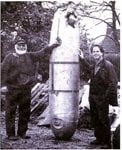
| I beleive the British were the major (only?) useres of such tanks. They were constructed of layers of paper laminated with plastic. They could not hold fuel for extended peroids of time, but worked quite well for the time spent on a mission. (they had to be filled just before the airfraft left for the mission) Such paper tanks would be discarded if retained on landing. (if a plane had to abort the mission) In the case of the P-47's 200 gal paper belly tank (early model P-47's only) it had to be dropped before landing due to the danger of rupturing. (according to the previously posted article, similar procedures were necessary for the Mustang's 108 gal paper tanks) The most common used were the cylindrical 108 US gallon tanks somtimes used by the Mustangs (opposed to the smaller 75 gal teardrop steel tanks). These were also used as ferry tanks on the Hurricane and in combat with the Tempest and Typhoon. In combat, the Hurricane II used 44 imp gal tanks. (I think these may also have been paper) There were also several countries using wooden drop tanks. (Japan, I beleive Russia had some, and Australia had a plywood belly tank in use) Here's a pic from the P-47 loadout thread: http://www.ww2aircraft.net/forum/tec...uts-14154.html (P-47 Loadouts) Last edited by kool kitty89; 12-17-2008 at 09:51 PM. |
| | |
| | #6 |
| Senior Member Join Date: Aug 2008
Posts: 9,030
| Hi KoolKitty. You are right about the construction of the 'paper' drop tanks. They were made from laminations of paper card, with a plastic resin impregnation, and moulded rather like a papier mache 'model'. They were even sometimes referred to as 'papier mache' tanks, and were, to an extent, an early form of what we noe know as fibre glass, with paper rather than extruded glass fibres. However, their use was mainly by the 8th USAAF, and rarely by British forces (RAF or FAA), as the requirement was for use by the longer range escort fighters of that Force. The original cigar-shaped 108 US Gallon tanks were delivered from British sources, and had a 'smooth' exterior, being constructed from mild steel. But, due to the need for this 'precious' metal for more important uses, a paper version was designed, the thinking being that, why waste valuable steel on a 'use once then throw away' product. Tanks of 108 US Gal capacity in steel were still used by the USAAF, but these became more common from American production sources. These could be identified by their finish in Neutral Gray paint. The British - produced paper tanks, distinguishable by their 'ribbed' appearance and silver doped finish, were used on the P47 and P51, as well as the 'tear drop' steel under-wing tanks on the latter, and the early steel belly tank, and later, flatter belly tank on the former. The British 'cigar' shaped belly tank, of a slimmer design, was used on the Spitfire IX on, and was generally of steel construction. Plywood laminate tanks were used also, by the RAF (some Mosquito wing tanksfor instance) and the Luftwaffe. The most common of the latter was the belly tank, used on both the FW190 and Bf109, very similar in shape and appearance to its steel counterpart. By the end of WW2, experiments with glass-fibre tanks had already begun, although protracted use was overtaken by events. Please note that the above refers to those tanks in use in the ETO, by units of the 8th and 9th Air Forces; the use of tanks in other theatres may have, and probably did, differ. Hope this has been of use. Terry. |
| | |
| | #7 |
| Senior Member Join Date: Nov 2008 Location: Calgary
Posts: 372
| Question re Paper Drop Tanks Hi Does anyone know if the 108 gallon tanks were used by the USAAF in Italy in summer 1944? I'm doing a model project of a P51 and have only seen photos with the 75 gal tanks. |
| | |
![]() |
| Thread Tools | |
| Display Modes | |
| |