Aircraft of World War II - Warbird Forums

F4F Wildcat versus P-40E Tomahawk

Polls Discuss F4F Wildcat versus P-40E Tomahawk in the World War II - Aviation forums; My mistake, I was thinking about the CBI and forgot about PH, Australia, Java and New Guinea. I doubt if ...


Go Back   Aircraft of World War II - Warbird Forums > World War II - Aviation > Polls

View Poll Results: Who was better?
P-40 Tomahawk 46 48.42%
F4F-3 Wildcat 35 36.84%
Both 14 14.74%
Voters: 95. You may not vote on this poll

Reply
 
LinkBack Thread Tools Search this Thread Display Modes
Old 06-10-2008, 10:05 AM   #16
Senior Member
 
Join Date: Jan 2007
Location: Montrose, Colorado
Posts: 2,283
Country:
My mistake, I was thinking about the CBI and forgot about PH, Australia, Java and New Guinea. I doubt if the kill total by Welch at PH was accurate, however. The F4F3 had a pretty good record versus the A6M, giving better than it got.
renrich is offline  
Digg this Post!Add Post to del.icio.usBookmark Post in TechnoratiFurl this Post!Spurl this Post!Reddit! Wong this Post!
Reply With Quote
Old 06-11-2008, 11:22 AM   #17
Senior Member
 
claidemore's Avatar
 
Join Date: Jan 2008
Location: British Columbia, Canada
Posts: 267
Country:
A note about names for the P40.

I believe the US referred to all early P40s as simply P40 (or Curtiss 81), and from the P40F variant on, it was officially called Warhawk.

The export planes that went to Britain and the Soviet Union were called Tomahawks and Kittyhawks. B/C were Tomahawks, D/E/K and the rest were Kittyhawks I/II,III,IV etc (P40-K was a Warhawk in US service, Kittyhawk III in British service).

Best way to avoid confusion is to use the actual model designation, P40-E/F/K etc.
__________________
claidemore is offline  
Digg this Post!Add Post to del.icio.usBookmark Post in TechnoratiFurl this Post!Spurl this Post!Reddit! Wong this Post!
Reply With Quote
Old 06-13-2008, 03:26 PM   #18
Senior Member
 
Join Date: Nov 2006
Posts: 316
Country:
Quote:
Originally Posted by claidemore View Post
I believe the US referred to all early P40s as simply P40 (or Curtiss 81), and from the P40F variant on, it was officially called Warhawk.
I agree Tomahawk was virtually not used at all by the US, the early P-40's had no US name. But, even Warhawk was relatively seldom used in the USAAF, the plane was the P-40. Likewise operating units generally called their planes F4F's (or later, FM's) not Wildcats. Primary designation by official name was (and is) a Brit thing. It was only adopted by the US in WWII era (1930's US military a/c seldom had names) and used in publicity/manufacturer oriented things, plus sometimes by USAAF in Europe, again perhaps Brit influence was a partial explanation. AFAIK it was rare in operating units of USAAF in PTO or the USN, or in the US Army (eg. M4 tanks were generally called that in the US Army, not Shermans).

F4F or P-40? Well counting all F4F's, mainly -4's, the F4F was the more effective plane in the early part of the Pacific War when Japanese fighter opposition was toughest. As usual, the causes might be debated, among 'plane', 'pilot' and overall situations, but nonetheless the case. And I don't think it's very meaningful to try correct for non-plane factors and say which *would* have more effective 'all else equal'. If we want factually state the P-40 was faster, etc that's fine, but we don't have an agreed system to convert a given speed advantage into a particular % combat effectiveness advantage... well it's going over old ground, but I still haven't heard a good counterargument to that point.

On strictly plane characteristics though, the F4F's superior altitude performance was actually useful in situations we might compare. For example F4F's defending Guadalcanal v P-40's defending Darwin and Port Moresby (latter RAAF, but at least some of those a/c were actually P-40E's diverted from USAAF in theater, not LL std Kittyhawks). The F4F's were more lethal against both Japanese Navy fighters and bombers and the (Allison) P-40's clunky altitude performance was probably one factor.

Anyway overall the F4F had a distinctly better record (around 1:1 exchange) v the Zero (itself, not counting Japanese Army fighters P-40's faced but F4F's didn't face until 1943) than the P-40 did (1:2 in best episodes, sometimes substantially worse), in the toughest phase of the war.

Joe

Last edited by JoeB : 06-13-2008 at 03:29 PM.
JoeB is offline  
Digg this Post!Add Post to del.icio.usBookmark Post in TechnoratiFurl this Post!Spurl this Post!Reddit! Wong this Post!
Reply With Quote
Old 06-14-2008, 01:55 PM   #19
Senior Member
 
Join Date: Oct 2006
Posts: 1,074
Country:
Hi Pong,

>which could have been the better dogfighter, the 'Ironworks' Wildcat, or the Tomahawk?

Hm, I'd say that depeands on what you mean by "better dogfighter"

Generally, air combat in WW2 was not decided by dogfighting. Just like Boelcke pointed out in WW1, it was decided by attacking a victim over which one held the maximum number of advantages one could achieve.

And even if dogfighting ensued, it was rarely a one-versus-one affair - WW2 doctrine consisted of elementary formations of two, three or four aircraft that were intended to fight as a coherent unit under all circumstances, and the highest priority for a pilot who got separated from his unit was to find a friendly fighter and attach himself to it.

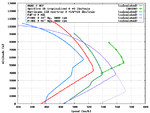
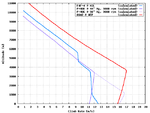
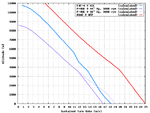
I spent some time preparing a performance comparison of the F4F-4, the P-40E and the A6M2. Here it is - the figures speak for themselves ...

Regards,

Henning (HoHun)
Attached Images
File Type: png F4F_Speed_Comparison.png (8.8 KB, 84 views)
File Type: png F4F_Climb_Comparison.png (7.7 KB, 86 views)
File Type: png F4F_Turn_Comparison.png (8.2 KB, 84 views)
HoHun is offline  
Digg this Post!Add Post to del.icio.usBookmark Post in TechnoratiFurl this Post!Spurl this Post!Reddit! Wong this Post!
Reply With Quote
Old 06-14-2008, 07:44 PM   #20
Senior Member
 
kool kitty89's Avatar
 
Join Date: Aug 2007
Location: San Jose, CA
Posts: 2,273
Country:
What about performance of the P-40E at WEP?
kool kitty89 is offline  
Digg this Post!Add Post to del.icio.usBookmark Post in TechnoratiFurl this Post!Spurl this Post!Reddit! Wong this Post!
Reply With Quote
Old 06-14-2008, 08:49 PM   #21
Member
 
Join Date: May 2008
Posts: 42
Quote:
Originally Posted by HoHun:
I spent some time preparing a performance comparison of the F4F-4, the P-40E and the A6M2. Here it is - the figures speak for themselves ...
Indeed, the figures speak clearly. Nice work.

ponsford is offline  
Digg this Post!Add Post to del.icio.usBookmark Post in TechnoratiFurl this Post!Spurl this Post!Reddit! Wong this Post!
Reply With Quote
Old 06-14-2008, 09:15 PM   #22
Senior Member
 
kool kitty89's Avatar
 
Join Date: Aug 2007
Location: San Jose, CA
Posts: 2,273
Country:
The P-40E obviously had a significant speed advantage at all normal combat altitudes (neither is going to be fighting much above 20,000 ft)

Climb it farly close for both, and turn rate is a bit better for the F4F.

Performance would be a bit better on the lighter F4F-3. (particularly in climb and turn)

But low alt performance of the P-40 would be significantly better with WEP.
(rated for 60" max, with 1,570 hp acheivable at ~5,000 ft with ram)
Above ~5,000 ft (at 3000 rpm) max boost will start to drop gradually up to ~14,000 ft (with ram) where it is down to Mil power. (without ram air, ie in climb, crit alts are ~3,000 ft, and 11,800 ft)

Last edited by kool kitty89 : 06-14-2008 at 09:19 PM.
kool kitty89 is offline  
Digg this Post!Add Post to del.icio.usBookmark Post in TechnoratiFurl this Post!Spurl this Post!Reddit! Wong this Post!
Reply With Quote
Old 06-14-2008, 11:35 PM   #23
Senior Member
 
Join Date: Oct 2006
Posts: 1,074
Country:
Hi Koolkitty,

>What about performance of the P-40E at WEP?

I'm not sure just when higher boost than 44" Hg were cleared ... I've seen data for 57" Hg, but that might be a late-war setting from all I know.

Regards,

Henning (HoHun)
HoHun is offline  
Digg this Post!Add Post to del.icio.usBookmark Post in TechnoratiFurl this Post!Spurl this Post!Reddit! Wong this Post!
Reply With Quote
Old 06-15-2008, 01:55 AM   #24
Senior Member
 
kool kitty89's Avatar
 
Join Date: Aug 2007
Location: San Jose, CA
Posts: 2,273
Country:
57" Hg was for the high blower ratio engines (9.6:1) of the P-40M/N (and P-51A, P-39N/Q) which resulted in detonation at lower boost levels than the 8.8 blower of the other allison powered P-40's.

The 9.6 resulted in a limitation of 57" Hg with 100 octane fuel, which was faily close to the detonation point. Limiting the engines to 1,480 hp, but allowing this to be acheived at 10,400 ft, due to the higher blower ratio. (giving the P-51A a top speed of 415 mph, P-39Q-10 397 mph, and the P-40N 378 mph)
The 8.8 blower was rated for 60" Hg with the same fuel, giving 1,570 hp with detenoation still a good way off, but limited due to structural concerns. Higher boost levels were used in service sometimes, but risked structural failure, as the engine's gearing wasn't rated for more than 1,600 hp. With 66" Hg resulting in 1,770 Hp at 2,000 ft.

(similar to the AVG's Tomahawks overboosting -and overreving- to well over 1,200 hp on the -33 engines, while the engine itsself was generally strong enough and there was no porblems with detonation, the gearing on these early engines was rated for only 1,100 hp, and thus would tend to strip eventually)


See: Perils P40 Archive Data

http://www.raafwarbirds.org.au/targe...39%20abuse.pdf


The two things the Allison people were concerned about with such overboosting was firstly, the risk of structural failure, and likely at some time after WEP was used, in normal operation which would make a very bad situation, particularly if over enemy territory.
The second, more pronounced concern, was that resetting boost to higher levels on the 8.8 blower engines would result in a bad precedent being set which would result in many failures of the new 9.6 blower (-81, -83, -85, -99) engines as it would result in detonation (that being the primary limit to 57" Hg -1,480 hp at 3,000 rpm and 10,400 ft) and failure quickly folling that.


It should also be noted, that early on the P-40D/E's V-1710-39/F3R engine was rated for 56" WEP (before being cleared for 60" allong with the similar -73/F4R of the P-40K). At that rating 1,470 hp could be acheived at ~7,000 ft with ram air. (~5,000 ft w/out)


http://www.raafwarbirds.org.au/targe...fs/1710-39.pdf

http://www.raafwarbirds.org.au/targe...fs/1710-33.pdf

Last edited by kool kitty89 : 06-15-2008 at 02:08 AM.
kool kitty89 is offline  
Digg this Post!Add Post to del.icio.usBookmark Post in TechnoratiFurl this Post!Spurl this Post!Reddit! Wong this Post!
Reply With Quote
Old 06-15-2008, 03:38 AM   #25
Senior Member
 
Join Date: Oct 2006
Posts: 1,074
Country:
Hi Koolkitty,

Thanks for the information! Here are the graphs again, including performance at 56" Hg boost pressure for the P-40E.

(I noticed that the RAAF's revised table from July 1942 apparently did not include 56" Hg, but the USAAF table from December 1942 did - though why it reads "critical altitude - sea level" for that setting is unclear to me.)

Regards,

Henning (HoHun)
Attached Images
File Type: png F4F_Speed_Comparison.png (9.4 KB, 82 views)
File Type: png F4F_Climb_Comparison.png (8.1 KB, 83 views)
File Type: png F4F_Turn_Comparison.png (8.6 KB, 84 views)
HoHun is offline  
Digg this Post!Add Post to del.icio.usBookmark Post in TechnoratiFurl this Post!Spurl this Post!Reddit! Wong this Post!
Reply With Quote
Old 06-15-2008, 11:40 AM   #26
Member
 
Join Date: May 2008
Posts: 42
According to NACA 868, the P-40 enjoyed a significant roll rate advantage over the F4F-3, ranging roughly from 10 to 28 degrees/second depending on speed.
ponsford is offline  
Digg this Post!Add Post to del.icio.usBookmark Post in TechnoratiFurl this Post!Spurl this Post!Reddit! Wong this Post!
Reply With Quote
Old 06-15-2008, 04:55 PM   #27
Senior Member
 
Join Date: Oct 2006
Posts: 1,074
Country:
Hi Ponsford,

>According to NACA 868, the P-40 enjoyed a significant roll rate advantage over the F4F-3, ranging roughly from 10 to 28 degrees/second depending on speed.

Thanks for the information! It seems to be hard to find anything at all that the F4F-4 can do better than the P-40E, except maybe flying from a boat

Regards,

Henning (HoHun)
HoHun is offline  
Digg this Post!Add Post to del.icio.usBookmark Post in TechnoratiFurl this Post!Spurl this Post!Reddit! Wong this Post!
Reply With Quote
Old 06-16-2008, 03:41 AM   #28
Senior Member
 
kool kitty89's Avatar
 
Join Date: Aug 2007
Location: San Jose, CA
Posts: 2,273
Country:
And take more engine damage.
kool kitty89 is offline  
Digg this Post!Add Post to del.icio.usBookmark Post in TechnoratiFurl this Post!Spurl this Post!Reddit! Wong this Post!
Reply With Quote
Old 06-16-2008, 04:24 PM   #29
Senior Member
 
Join Date: Oct 2006
Posts: 1,074
Country:
Hi Koolkitty,

>And take more engine damage.

Often claimed, never proven

But I've tackled questions like the B-17 vs. B-24 survivability issue or the Me 109 vs. Fw 190 landing accident question with WW2 data, so I feel there might be meaningful data on the engine survivability issue too if we look hard enough. I've suggested one possible source in the current engine survivability thread - maybe some RAF expert can help us out over there?

http://www.ww2aircraft.net/forum/eng...ity-13581.html (Engine Survivability)

>And take more engine damage.

Back on topic ... I'd say that if we accept the radial's greater durability, it still is the question if this can be turned into a decisive advantage. If the performance of the F4F-4 and the P-40E was close, durability could tilt the scales, but with the measure of superiority enjoyed by the P-40, I don't think it would have too much impact on the final result.

Regards,

Henning (HoHun)
HoHun is offline  
Digg this Post!Add Post to del.icio.usBookmark Post in TechnoratiFurl this Post!Spurl this Post!Reddit! Wong this Post!
Reply With Quote
Old 06-16-2008, 06:09 PM   #30
Senior Member
 
drgondog's Avatar
 
Join Date: Jun 2006
Location: oregon
Posts: 2,497
Country:
From my perspective engine 'durability' has two components - abusing it in WEP, and small caliber fire near the deck while flying CAS or strafing.

In the latter case there is more to the equation than engine durability - one has to also account for coolant system vulnerability for in-line engines.
drgondog is offline  
Digg this Post!Add Post to del.icio.usBookmark Post in TechnoratiFurl this Post!Spurl this Post!Reddit! Wong this Post!
Reply With Quote
Reply


Thread Tools Search this Thread
Search this Thread:

Advanced Search
Display Modes

Posting Rules
You may not post new threads
You may not post replies
You may not post attachments
You may not edit your posts

vB code is On
Smilies are On
[IMG] code is On
HTML code is Off
Trackbacks are On
Pingbacks are On
Refbacks are On


All times are GMT -5. The time now is 03:22 AM.


Powered by vBulletin
Copyright ©2000 - 2008, Jelsoft Enterprises Ltd.
SEO by vBSEO 3.1.0
   

AVIATION TOP 100 - www.avitop.com Avitop.com


1 2 3 4 5 6 7 8 9 10 11 12 13 14 15 16 17 18 19 20 21 22 23 24 25 26 27 28 29 30 31 32 33 34 35 36 37 38 39 40 41 42 43 44 45 46 47 48 49 50 51 52 53 54 55 56 57 58 59 60 61 62 63 64 65 66 67 68 69 70 71 72 73 74 75 76 77 78 79 80 81 82 83 84 85 86 87 88 89 90 91 92 93