![]() |
| |||||||
| Weapons Systems Tech. Technology behind the weapons and systems within aircraft. |
![]() |
| | LinkBack | Thread Tools | Display Modes |
| | #31 |
| Senior Member | No se como se arman los PDF solamente se usarlos. De todas maneras te lo envio por privado si queres. Breda in remote controlled G1 and Z2 turrets in Piaggio P-108 bomber ![]() ![]() Waist emplacement in the same bomber. ![]() Characteristicas Breda S.A.F.A.T 12,7 mm Caliber: 12,7x81 mm semirimmed. Operation: Short recoil with muzzle booster. Refrigeration: air Weight: 26,5 kg Charging; manually charged in in flexible mounting plus CR-32, 42 and Re-2000/2001 fittings. The others pneumatically charged. Rate of fire: 700 rpm Muzzle velocity: 765 mps. |
| | |
| | #32 |
| Member Join Date: Oct 2006
Posts: 46
| Te paso mi e-mail gadget@telefonica.net Gracias. Te hago un intercambio con otro manual de reconocimiento de la época. |
| | |
| | #33 |
| Senior Member | Bien, te lo estoy enviando. Tambien tengo algunos videos caseros que...no mejor no, olvida eso ultimo. Scotti M1933 cal 12,7mm Alfredo Scotti had also one of its gas operated guns modified to shoot the heavy machinegun caliber. It was adopted in a more limited manner than the Breda .50, mostly for turret defensive emplacements in several types of bombers, recce and transports. The rate of fire was slightly higher than its predecessor. Probably the best characteristics was the lesser weight. The open bolt action favoured refrigeration and avoided cook-off of the ammunition after long burst, but again denied the adaptation of a synchronization mechanism. Scotti also proposed a wing variant with remote charging but it did not entered in service in Service with the Regia Aeronautica probably because at that time the italians were interested in a 20 mm weapon. Ventral turret, Savoia SM 84 bomber. ![]() - Lancia type 1 dorsal turret above Fiat RS 14 - Operator of a Lancia type 1 turret depicted inside the CANT Z 1007 bomber. the aim was obtained with a periscopic articulated gunsight Last edited by CharlesBronson; 10-29-2008 at 06:20 PM. |
| | |
| | #34 |
| Junior Member Join Date: Nov 2006
Posts: 21
| Hi Charles I’ve a question for you about Scotti guns: You wrote Scotti guns couldn’t be synchronized, due to their open bolt operating principle. But, in spite of the fact that Breda Safat guns were “open bolt” weapons too, they could be synchronized. Both 7,7mm and 12,7mm Breda-Safat operated in the same way: when the burst was interrupted the bolt remained in its open position, but: a) the “spent” cartridge” was already been ejected out of the weapon during the previous backward bolt movement; b) the “new” cartridge was already in the barrel (already in axis with the barrel , just waiting to be pushed into its firing chamber and to be fired) since, again, during the previous bolt backward movement, it had been picked up from the feed. So the questions are: was the forward movement of Scotti bolt simply slower (bigger inertia?) or less predictable than the one of Breda Safat? Had the Scotti gun to operate like the Lewis gun that had to catch a new cartridge from the feed during its forward movement (differently from Safat)? Both factors? As far as I know, the longer and the less predictable (that in turns, due to the need to consider worst cases, means long) the time from the start of the firing sequence to the moment the projectile reaches the prop blades, the less is the possibility for a weapon to be synchronized. Priming systems, cartridge propellant burning time (mainly for some cannon cartridges), low average bolt speeds (big bolt mass, that is inertia), low bullet muzzle velocities, big distances between gun muzzle and propeller blades, were all unfavourable factors for a gun to be synchronized. Coming back to Scotti vs Breda comparison, we can exclude the influence of the cartridge type (both weapons used the same cartridges) and other factors like the positioning of the gun on the aircraft, since Breda and Scotti sizes were comparable. Since it is not clear to me the actual Scotti mechanism, which was, according to your information, the detail preventing Scotti gun, to be synchronized with aircraft props? Thanks in advance for your answer. Last edited by bruno_; 10-29-2008 at 05:42 PM. |
| | |
| | #35 |
| Senior Member Join Date: Jan 2008 Location: logan ohio
Posts: 279
| Very cool stuff , I always like there airplanes ,even know alot of them were out of date , do you know if they carried anything heavier, like a 50 cal or 20 mm???? |
| | |
| | #36 | ||
| Senior Member | Quote:
They did use a 20mm, the Mauser MG 151/20. Quote:
Last edited by CharlesBronson; 10-29-2008 at 06:42 PM. | ||
| | |
| | #37 |
| Senior Member Join Date: Jan 2007 Location: Helsinki
Posts: 1,361
| Charles Excellent material! Thanks a lot! Juha |
| | |
| | #38 |
| Senior Member | You are welcome. Side fuselage Scottis, P-108. ![]() Characteristics Scotti M1933: Caliber: 12,7x81 semirimmed Action: gas operated , rotating bolt lock. Refrigeration: air Feeding: desintegrable metallic belt Charging; manually charged Lenght: 1170mm Rate of fire: 730-750 rounds per minute Muzzle velocity: 760 mps. Weight: 21 kg. Last edited by CharlesBronson; 10-29-2008 at 07:15 PM. |
| | |
| | #39 |
| Member Join Date: Nov 2006
Posts: 30
| Bruno, you syncro-hoolic, you never give up! |
| | |
| | #40 |
| Junior Member Join Date: Nov 2006
Posts: 21
| |
| | |
| | #41 |
| Senior Member | For the maniac. To be effectively synchronised, a gun required a short "lock time"; the delay between the gun receiving the message to fire and the cartridge actually firing. This had to be as short as possible, in order to provide the precision needed to avoid hitting the propeller. A lot of MGs and cannon (the Scotti included) fired from an open bolt; the starting position for the gun was with the chamber empty and the bolt held back. When the gun received the message to fire, the bolt was released, began to move forwards, picked up a cartridge, loaded it into the chamber, locked up the action and, only then, fired. This took far too long. There were a few open-bolt guns which retained a separate control of the firing pin (the MG 17 was one) which did enable them to be synchronised. The Breda S.A.F.A.T used a copy or the Browning short recoil mechanism...the Browning Short recoil system used in the M2/M3 caliber.50 and the M1917 & M1919 cal 30 is a closed bolt short recoil mechanism. I dont have any Idea what is your source for the Breda shooting from an open bolt but is simply WRONG. Hai capito bene ? Last edited by CharlesBronson; 10-30-2008 at 07:25 PM. |

| | |
| | #42 |
| Junior Member Join Date: Nov 2006
Posts: 21
| Hi Charles, the sources of my information are the official manuals of the Breda. Therefore if there it is explained what I reported in my post, we should conclude Breda were open bolt machine guns. As to the short "lock time" issue, as I've also said, this is one of some factors indicating the possibility for a gun to be synchronized. Most of the time is THE factor, but it is not the only one. By way of example, MK 108 30mm cannon had its unsolved synch. problems in the uneven rate of cartdrige propellant burning time. |
| | |
| | #43 |
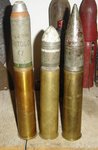
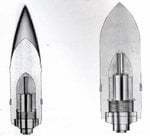
| Senior Member | 12,7x81SR ammunition. The ammo employed in the italia heavy machineguns was originally designed by Vickers in 1920s, after the fauilure of the "class B" Mg chambered for this round, the cartrigde was slightly modified ( from rimless to semi rimmed) and offered for export. Both italy and Japan eventually used it in WW2. From left to right: a) Ball b) FMJ Tracer c) Armor piercing with hardened steel core ![]() d) Incendiary e) AP-Incendiary without tracer, both bullets had a blue tip. ![]() There was also a fully explosive bullet with impact fuze, despite the fact many experts considered the 20mm as the minimum practical diameter for a HE shell the italians didnt agreed, and used a generous quantity of explosives in the fighters ammunition belt. This type of projectile was indicated by a yellow band. ![]() Muzzle velocity of the 12,7x81mm ammo varied between 750 and 771mps, projectile weight between 32 to 38,5 grams. Reloading a Macchi MC 200. |
| | |
| | #44 |
| Senior Member Join Date: Aug 2007 Location: San Jose, CA
Posts: 2,412
| On the synchronization issue, I've also seen several refrences to the .303 Browning machine gun (version of the M1919) saying that it fired from an open bolt due to problems with "cook-off" when using the .303 British round. (with the more heat sensitive cordite) But the .303 Browning was used in Synchronized mountings in several aircraft, namely the Gladiator. ANd here's an article on the .50 Vickers: Untitled Document (from which the Italian 12.7mm ammo was derived) Last edited by kool kitty89; 11-04-2008 at 05:14 AM. |
| | |
| | #45 |
| Senior Member | Hmm... maybe it was for wing mounting only. Where is Tony W when you really need him ? |
| | |
![]() |
| Thread Tools | |
| Display Modes | |
| |