| WW1 Bombers| World War I Discuss WW1 Bombers in the Other Eras forums; This is my first post so I hope this is the right place for this topic. A while back I ... |
|
03-10-2007, 12:55 PM
|
#1 | | Junior Member
Join Date: Mar 2007 Location: Surf City USA
Posts: 2
Country: | WW1 Bombers This is my first post so I hope this is the right place for this topic. A while back I saw the movie "Flyboys" about WW1 fighter pilots. During the bombing raids I did not notice any bombs being carried under the wings of the planes. Was this just a movie error or did planes of this vintage have bomb bays as did later aircraft in WWII? It had been my opinion that all bombs during WW1 were either dropped from the cockpit or were attached under the wings. |
| |
03-10-2007, 01:13 PM
|
#2 | | IP/Mech THE GREAT GAZOO
Join Date: Apr 2005 Location: Colorado, USA
Posts: 13,013
Country: | It depended on the bomber. It seems both allied and axis bombers of WW1 carried their bombs at the lower wing close to the fuselage. Here's a great site about WW1... Welcome to The Aerodrome - Aces and Aircraft of World War I
__________________ "IF ITS RED OR DUSTY, DON'T TOUCH IT" |
| |
03-11-2007, 07:23 AM
|
#3 | | Banned
Join Date: Mar 2007
Posts: 180
Country: | oopps EDIT, wrong first 4 engine bomber link for the Brits Handley Page V/1500
We also have a few relics of the even larger, 38m (126ft) span, Handley Page V/1500. This Rolls-Royce Eagle powered, long-range bomber of 1918 was the first British bomber with four engines, but was short-lived.
At the time of the Armistice, three V/1500s were operational, with No.166 Squadron at Bircham Newton in Norfolk, and were standing by to bomb Berlin, from the United Kingdom. This was possible due to their 2,092km (1,300 mile) range, and this just 15 years after the Wright Brothers first managed a few hundred feet! As ever, War had proved a great incentive for aeronautical development.
The last RAF V/1500 served at Martlesham Heath until mid 1921
or this beast
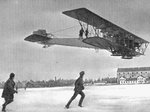
The S-6 with a 100 hp Argus engine flew in November 1911. In 1912, Igor Sikorsky became Chief Engineer for the aircraft factory of the Russian Baltic Railroad Car Factory in Petrograd. His S-6-B won a small order from the Russian Army, and the factory governing society approved construction of a large, four-engined airplane. With a wingspan of 89 ft. and a gross weight around 9,000 lb., Mr. Sikorsky's S-21 was simply The Grand. When it first flew on May 13, 1913, Igor Sikorsky became the world's first four-engine pilot. The bigger S-22 was dubbed the II'ya Muromets and in December 1913 began flying passengers. A bomber version flew in 1914 and went to war with the Imperial Russian Air Force in 1915.
wiki
The Il'ya Muromets aircraft was the worlds first four-engine bomber and was used to form the worlds first dedicated strategic bombing unit. The plane was named after a hero from Russian mythology Ilya Muromets.[1] Sikorsky Ilya Muromets - Wikipedia, the free encyclopedia Our History
Last edited by Jackson : 03-11-2007 at 07:44 AM.
Reason: messed up on everything
|
| |
03-11-2007, 01:59 PM
|
#4 | | Junior Member
Join Date: Mar 2007 Location: Surf City USA
Posts: 2
Country: | WWI Bombers So there were no bombers with bomb bays in WWI?? All bombs were carried under the wings? This raises the next question about who invented the bomb bay door and on which aircraft was it first used? Probably too much to cover here. |
| |
03-27-2007, 10:53 PM
|
#5 | | Senior Member
Join Date: Oct 2004 Location: Queensland
Posts: 1,256
Country: | I do know that some WWI aircraft had a hole that could be opened and a cradle from which a bomb could be released. I suppose a lot of this depends on the individual pilot. The pilot could have made the alteration to the aircraft which could be construed as bomb-bay doors. But I don't really think it was a widespread design feature by all means. |
| |
06-07-2008, 02:57 AM
|
#6 | | Junior Member
Join Date: Jun 2008 Location: Russia
Posts: 9
Country: |
Last edited by NightFlightAs : 06-07-2008 at 03:15 AM.
|
| |
06-07-2008, 05:00 AM
|
#7 | | Junior Member
Join Date: Jun 2008 Location: Russia
Posts: 9
Country: | Sikorsky Ilya Muromets  |
| |
06-07-2008, 05:47 AM
|
#8 | | Senior Member
Join Date: Dec 2003 Location: UK
Posts: 3,505
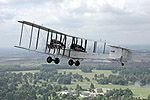
Country: | The Vickers Vimy was one of the more successful bombers of WW1 and reliable enough to make the first trans Atlantic crossing by a plane
This weekend a replica is flying at the Biggin Hill airshow |
| |
06-07-2008, 08:01 AM
|
#9 | | Junior Member
Join Date: Jun 2008 Location: Russia
Posts: 9
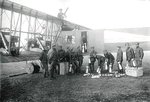
Country: | Handley Page 0/400  |
| |
06-08-2008, 04:22 AM
|
#10 | | Senior Member
Join Date: May 2007
Posts: 1,408
Country: | Quote:
Originally Posted by NightFlightAs Handley Page 0/400 | Hi 'NightFlightAs',
Do you have more on the 0/400 photo? If you view the "original image" you can just make out two American flags on the noseand I'm wondering if it's the Langley, one of eight(?) 0/400s produced by the Standard Aircraft Corporation in New Jersey. Anyone know if it was one of the three used in Mitchell's air-power demonstrations?... http://www.mind42.com/wiki/Billy_Mitchell Quote: |
"By noon, Ostfriesland had settled two more feet by the stern and one foot by the bow. At this point, 2,000 lb bombs were loaded and a flight of three Handley-Page O/400 and eight NBS-1 bombers led by Capt. Walter Lawson dropped six in quick succession, aiming for the water near the ship. There were no direct hits but three of the bombs landed close enough to rip hull plates as well as cause the ship to roll over. The ship sank in 21 minutes, with a seventh bomb dropped on the foam rising up from the sinking ship. Nearby the site, observing, were various foreign and domestic officials aboard the USS Henderson. One man present was a representative of the Japanese navy: Captain Osami Nagano. Nagano was quoted in a local paper as saying there was "much to be learned here." Years later, Nagano helped plan the Japanese attack on Pearl Harbor."
|
The end of the Langley?... HANDLEY PAGE BOMBER 3  |
| |
06-09-2008, 01:50 AM
|
#11 | | Junior Member
Join Date: Jun 2008 Location: Russia
Posts: 9
Country: |
Last edited by NightFlightAs : 06-09-2008 at 03:38 AM.
|
| |
06-10-2008, 05:13 AM
|
#12 | | Senior Member
Join Date: Oct 2004 Location: Queensland
Posts: 1,256
Country: | So what were the common bomb-bay methods used during WW1? Can anyone tell me that? Healz. |
| |
06-10-2008, 06:40 AM
|
#13 | | IP/Mech THE GREAT GAZOO
Join Date: Apr 2005 Location: Colorado, USA
Posts: 13,013
Country: | Quote:
Originally Posted by HealzDevo So what were the common bomb-bay methods used during WW1? Can anyone tell me that? Healz. | Bomb racks on the exterior belly of the aircraft.
__________________ "IF ITS RED OR DUSTY, DON'T TOUCH IT" |
| |
06-10-2008, 08:56 AM
|
#14 | | Junior Member
Join Date: Jun 2008 Location: Russia
Posts: 9
Country: | Quote:
Originally Posted by HealzDevo So what were the common bomb-bay methods used during WW1? Can anyone tell me that? Healz. | At allies precisely I do not know, and at Russian... Quote:
...Sikorsky has improved the car tactically - instead of one heavy bomb the plane began to bear cartridges about 8 100 kg or 14 50 kg bombs. It the first has applied system of cassette bombing allowed to strike the massed blows to congestions of armies, tanks, artillery positions...
In 1916 has appeared "IM-P1", bearing an automatic gun, a large-caliber defensive machine gun, 16 bombs, everyone in weight on 50кг, 6 rockets of calibre 127мм, for bombing began to apply cartridges with the vertical suspension bracket, equipped with an electrotripper device, and two dynamo-jet of a gun Kurchevsky, - to steam of heavy bombers was on force to stop approach of the opponent or to clear away a way to the armies...
| |
| |
06-10-2008, 08:10 PM
|
#15 | | Senior Member
Join Date: May 2007
Posts: 1,408
Country: | Quote:
Originally Posted by djd This raises the next question about who invented the bomb bay door and on which aircraft was it first used? | More than likely "djd" is no longer with us any more, but his original question has been driving me nuts! Google isn't helping, but I've come to the conclusion that the Zeppelin Staaken RVI of 1917 (see photos above) must be a likely contender for the title. It had nine bomb bays with doors, each holding two 220lb bombs. The release mechanism was situated in the nose cockpit.
Some Handley-Page, Avro and Sopwith bombers, had internal compartments for bomb storage, either vertically or horizontally mounted, (but I don't know if they had doors), but as Joe has pointed out, the vast majority were externally mounted.  |
| | | Thread Tools | Search this Thread | | | | | Display Modes | Linear Mode |
Posting Rules
| You may not post new threads You may not post replies You may not post attachments You may not edit your posts HTML code is Off | | | All times are GMT -5. The time now is 05:33 PM. |  | |