Aircraft of World War II - Warbird Forums

Battle of Midway.

WW2 General Discuss Battle of Midway. in the World War II - General forums; This remarkable photo shows all fifteen of Torpedo Eight's TBDs as they depart for their attack on Kido Butai ...


Go Back   Aircraft of World War II - Warbird Forums > World War II - General > WW2 General

Reply
 
LinkBack Thread Tools Search this Thread Display Modes
Old 05-30-2007, 03:38 PM   #31
Senior Member
 
Lucky13's Avatar
 
Join Date: Aug 2006
Location: Glasgow, Scotland
Posts: 7,384
Country:

This remarkable photo shows all fifteen of Torpedo Eight's TBDs as they depart for their attack on Kido Butai on 4 June 1942.


SBD "Dauntless" dive bombers from USS Hornet (CV-8.) approaching the burning Japanese heavy cruiser Mikuma to make the third set of attacks on her, during the early afternoon of 6 June 1942.
Mikuma had been hit earlier by strikes from Hornet and USS Enterprise (CV-6), leaving her dead in the water and fatally damaged.


A Douglas SBD-3 "Dauntless" scout bomber warming up on USS Yorktown, in the late morning of 4 June 1942.
It is Number 17 of "Scouting" Squadron Five (the temporarily redesignated Bombing Squadron Five), piloted by Ensign Leif Larsen, but was apparently not one of ten "VS"-5 planes launched on a scouting mission shortly before noon on 4 June. Another of the squadron's SBDs succeeded in locating Hiryu, the only Japanese aircraft carrier of the Midway striking force that was still operational.
The next plane, at right, is "VS"-5's Number 4, which did fly the scouting mission, piloted by Lieutenant John Nielsen.


A Douglas SBD-3 "Dauntless" scout bomber (Bureau # 4542), of USS Enterprise's Bombing Squadron Six (VB-6), is parked on board USS Yorktown (CV-5) after landing at about 1140 hrs on 4 June 1942. This plane, damaged during the attack on the Japanese aircraft carrier Kaga that morning, landed on Yorktown as it was low on fuel. It was later lost with the carrier. Its crew included Ensign George H. Goldsmith, pilot, and Radioman 1st Class James W. Patterson, Jr.
Note damage to the horizontal tail and dual stripes painted on the fin.


A Douglas SBD-3 "Dauntless" scout bomber (Bureau # 4542), of USS Enterprise's Bombing Squadron Six (VB-6), on USS Yorktown (CV-5) after landing at about 1140 hrs on 4 June 1942. This plane, damaged during the attack on the Japanese aircraft carrier Kaga that morning, landed on Yorktown as it was low on fuel. It was later lost with the carrier.
Its crew, Ensign George H. Goldsmith, pilot, and Radioman 1st Class James W. Patterson, Jr., are still in the cockpit. Note damage to the horizontal tail.


A Grumman F4F-4 "Wildcat" fighter (Bureau # 5244) takes off from USS Yorktown (CV-5) on combat air patrol, during the morning of 4 June 1942.
This plane is Number 13 of Fighting Squadron Three (VF-3), flown by the squadron Executive Officer, Lieutenant (Junior Grade) William N. Leonard.
Photographed by Photographer Second Class William G. Roy, from the ship's forecastle. Note .50 caliber machinegun at right and mattresses hung on the lifeline for splinter-protection.
__________________

JAN
"I´m going back to the front to relax"
"THE BLACK CATS FLIES TONIGHT"
"Find your enemy and shoot him down - everything else is unimportant!"
"When you're out of F-8's... You're out of fighters!"

Last edited by Lucky13 : 06-03-2007 at 07:49 AM.
Lucky13 is offline  
Digg this Post!Add Post to del.icio.usBookmark Post in TechnoratiFurl this Post!Spurl this Post!Reddit! Wong this Post!
Reply With Quote
Old 05-30-2007, 05:18 PM   #32
Senior Member
 
syscom3's Avatar
 
Join Date: Jun 2005
Location: Orange County, CA
Posts: 8,473
65 years later, Midway is for the birds

65 years later, Midway is for the birds
By Jackie Main
Article Launched: 05/29/2007 01:00:00 AM PDT


Iwo Jima ... Omaha Beach ... the Battle of the Bulge. These are some of the great and famous battles of World War II. But military historians say the most significant of that war's battles was fought 65 years ago this week - not between vast and bloodied armies but over four days between American and Japanese airplanes flying off carriers near a tiny Pacific atoll of only two square miles called Midway.

The American victory, almost exactly a year and a half after the Japanese seized domination of the Pacific by devastating the American fleet at Pearl Harbor, enabled the United States to control the Pacific sea routes.

Some historians say Midway was the most important battle, not only of World War II, but of the entire military history of the United States. Fought June 3-June 6, 1942, it was certainly the turning point of the last world war.

Recently, I was privileged to be among 12 rarely permitted visitors who were allowed by the United States Navy to pay a two-day overnight visit to this remote island, at the northeast tip of the Hawaiian Archipelago, 1,250 miles northwest of Honolulu. Normally, the island is closed to overnight visitors except VIPs, like Laura Bush and her entourage, who shortly before our April trip were personally given the same thorough tour as we were by Barry Christensen, the Midway Atoll National Wildlife Refugee manager who is helping put together an eco-tourism plan for the protected area.

With him on this atoll, which once held 5,000 residents, was a population only 60 people - who live in historic quarters that used to house Navy pilots and are now home to wildlife experts, scientists and support staff who go sleep to the sounds of beak-clacking, moaning, gull-like sounds and bird cage odors (if their windows are open).

But there is hardly a lack of life on Midway - except now Midway is strictly for the birds. At peak season in spring, almost 2 million make their home here, including some rare species hardly found anywhere els! e in the world.

I was there with a special delegation from the Traveler's Century Club, an organization of people who have visited more than 100 nations. My former boss at newspapers in Southern California, Post columnist Lowell Blankfort, is a member. Remembering my passion for birds and for photography, he offered me his place providing I offer my pictures and story first to the Post.

***

Midway, which after World War II briefly became a postal air station linking the Far East and the United States, and still is an emergency stop for planes flying the Pacific to and from the United States, is home to 75 percent of the world's Laysan albatross-more than a half million nesting pairs. Among the world's Laysan duck population of about 100, Midway has 34.

Other memorable birds include the magnificent frigate with the male's puffy chest when in full plumage, fairy tern, red-footed and masked boobies, Christmas shearwater, black-footed albatross, Pacific golden plover and short-tailed albatross (sometimes called the golden gooney). Descendants of canaries brought to Midway by early settlers also are here, along with predatory myna birds which threaten white terns, sooty terns and black noddies by feasting on their eggs.

In April, a big bird season, no piece of ground seemed untouched by some sort of bird - in the road, on the sidewalks, on the grass and plane runway, Fuzzy Laysan albatross chicks were everywhere.

We were warned about stepping off pathways because the Bonin petrel makes its nest under the ground, which can collapse if stepped on. But the birds aren't the only wildlife. Along the coast are Hawaiian spinner dolphins, endangered green sea turtles and Hawaiian monk seals. Planes defer to the birds.

Commercial flights are totally banned from Midway and special planes, like our Air Services Hawaii turbo-prop, only are allowed to fly at night, lest in daylight their windshields and engines clog up with bird fodder, obscuring pilot vision, endangering the plane and putting in danger stray birds out for some exercise in the skies.

Our group stayed in two-room suites with a bath in refurbished officer bachelor quarters built in 1957-58 for pilots and crew who made sure the Soviets did not sneak through the north Pacific and attack the United States.

We ate in the cafe where we chowed down great American and Thai food prepared by the mostly Thai crew yumm.

Oh, yes. When, upon returning home, I happen to mention Midway I usually get a puzzled look or something like "I've been there, just passing through years ago when in the Navy."

I remind them that some famous historians have claimed it the site of the most important battle in the history of the United States (and some say the world). In World War II, after the U.S. broke the Japanese code, the battle at Midway allowed America and its allies to reverse their course, prevail and the rest is history.

Midway is worth visiting for its immense historical significance, artifacts and memorials-a former home to a population of more than 5,000 people-now a haven of wildlife, migrating birds and sea life.
__________________
"Pilot to copilot..... what are those mountain goats doing up here in the clouds?"
syscom3 is offline  
Digg this Post!Add Post to del.icio.usBookmark Post in TechnoratiFurl this Post!Spurl this Post!Reddit! Wong this Post!
Reply With Quote
Old 05-31-2007, 02:40 AM   #33
Senior Member
 
Lucky13's Avatar
 
Join Date: Aug 2006
Location: Glasgow, Scotland
Posts: 7,384
Country:

USS Yorktown (CV-5) is hit on the port side, amidships, by a Japanese Type 91 aerial torpedo during the mid-afternoon attack by planes from the carrier Hiryu, 4 June 1942. Photographed from USS Pensacola (CA-24).
Yorktown is heeling to port and is seen at a different aspect than in other views taken by Pensacola, indicating that this is the second of the two torpedo hits she received. Note very heavy anti-aircraft fire.


Japanese Type 97 shipboard attack aircraft from the carrier Hiryu amid heavy anti-aircraft fire, during the torpedo attack on USS Yorktown (CV-5) in the mid-afternoon, 4 June 1942. At least three planes are visible, the nearest clearly having already dropped its torpedo. The other two are lower and closer to the center, apparently withdrawing. Smoke on the horizon in right center is from a crashed plane. It is possible that the object very close to the horizon, in center, is another attacking aircraft.


USS Yorktown (CV-5) under attack by Japanese dive bombers from the carrier Hiryu, shortly after noon on 4 June 1942, as seen from USS Astoria (CA-34). One Aichi Type 99 carrier bomber is falling ahead of the ship, with its tail shot off. A bomb has just hit a few hundred feet astern.


Two Type 97 shipboard attack aircraft from the Japanese carrier Hiryu fly past USS Yorktown (CV-5), after dropping their torpedoes during the mid-afternoon attack, 4 June 1942. Note heavy anti-aircraft fire. Photographed from USS Pensacola (CA-24). The destroyer at left, just beyond Yorktown's bow, is probably USS Morris (DD-417).


Two Type 97 shipboard attack aircraft from the Japanese carrier Hiryu fly past USS Yorktown (CV-5), amid heavy anti-aircraft fire, after dropping their torpedoes during the mid-afternoon attack, 4 June 1942. Yorktown appears to be heeling slightly to port, and may have already been hit by one torpedo.
Photographed from USS Pensacola (CA-24). The destroyer at left, just beyond Yorktown's bow, is probably USS Morris (DD-417).


USS Yorktown (CV-5) dead in the water and listing heavily, shortly after being hit by two Japanese Type 91 aerial torpedoes during the afternoon of 4 June 1942. This view was taken prior to the ship's abandonment. Section of catwalk jutting above the flight deck, port side amidships, is directly above the place where the torpedoes struck the ship's hull.


View from above the signal station of USS Yorktown (CV-5), 4 June 1942, during the mid-afternoon Japanese aerial torpedo attack. This view looks forward and to port, with the port leg of the tripod foremast at right. Barrels and gun training limit rails of the .50 caliber machinegun battery atop the island are in center, with the flight deck beyond. At the flight deck edge are the port forward 20mm and 5"/38 gun galleries, with gunsmoke visible outboard of them.


A Japanese Type 97 shipboard attack aircraft (upper right) approaches USS Yorktown (CV-5) during the mid-afternoon torpedo attack by planes from the carrier Hiryu, 4 June 1942. Photographed from above Yorktown's signal station, immediately aft of her tripod foremast, looking forward and to starboard. Note mast leg with radar wave guide at left and signal halliards across the field of view. A .50 caliber machine gun, one of several mounted atop the island, is at bottom, with gun training limit rails above it.


A Japanese Type 97 shipboard attack aircraft flies near USS Yorktown (CV-5) during the mid-afternoon torpedo attack by planes from the carrier Hiryu, 4 June 1942. This plane, which has already dropped its torpedo, is trailing a thin stream of grey smoke from its port wing. Photographed from one of Yorktown's gun positions, with the shield and barrel of a 20mm gun visible at right.


Scene on the flight deck of USS Yorktown (CV-5) shortly after she was hit by two Japanese aerial torpedoes, 4 June 1942. Men are balancing themselves on the listing deck as they prepare to abandon ship. This view looks aft from alongside the island. F4F-4 "Wildcat" fighter visible in the background is Fighting Squadron Three's Plane # 6 (Bureau # 5165), which had been flown by Ensign Brainard T. Macomber during the morning attacks on the Japanese carrier fleet. Insufficient fuel prevented it from being launched to defend Yorktown from the afternoon torpedo plane attack.


Looking forward on the flight deck of USS Yorktown (CV-5) shortly after she was hit by two Japanese aerial torpedoes, 4 June 1942. Men are preparing to abandon ship. Island's port side is at right, with the curved supporting structure for the Primary Flight Control booth at top. Knotted lines in the foreground were apparently used to evacuate the island's upper platforms.


Looking to port, amidships, on the flight deck of USS Yorktown (CV-5) shortly after she was hit by two Japanese aerial torpedoes, 4 June 1942.
View shows the damaged port side catwalk at between about Frames 83 & 90, which was broken and bent upwards by the explosion of an aerial torpedo on the hull below. Arresting gear wire visible is that located at about Frame 91.5. This appears to be a partial double-exposure, with the second image, at bottom, showing the tail of an F4F aircraft.


USS Yorktown (CV-5) dead in the water after being hit by Japanese bombs on 4 June 1942. The ship was hit shortly after noon. This view was taken about an hour later, with fires still burning in her uptakes but other immediate repairs well advanced. F4F-4 fighters that had been parked at the forward end of the flight deck during the attack have been respotted aft, in take off position. Two SBD-3 scout bombers can be seen through the open sides of her after hangar bay.


Scene on board USS Yorktown (CV-5), shortly after she was hit by three Japanese bombs on 4 June 1942. Dense smoke is from fires in her uptakes, caused by a bomb that punctured them and knocked out her boilers.
Taken by Photographer 2rd Class William G. Roy from the starboard side of the flight deck, just in front of the forward 5"/38 gun gallery. Man with hammer at right is probably covering a bomb entry hole in the forward elevator. Note arresting gear cables and forward palisade elements on the flight deck; CXAM radar antenna, large national ensign and YE homing beacon antenna atop the foremast; 5"/38, .50 caliber and 1.1" guns manned and ready at left.


USS Astoria (CA-34) steams by USS Yorktown (CV-5), shortly after the carrier had been hit by three Japanese bombs on 4 June 1942. Dense smoke is from fires in Yorktown's uptakes. Taken by Photographer 2rd Class William G. Roy from the starboard side of the flight deck, just in front of the forward 5"/38 gun gallery. Both guns are manned and ready. Projecting bars beyond the gun barrels are aircraft parking outriggers. Note open sights on the guns and splinter shield plates, fastened together with bolts.


Repairing bomb damage on board USS Yorktown (CV-5), shortly after the carrier was hit by Japanese bombs on 4 June 1942. This hole, about twelve feet in diameter, was caused by a 250 Kilogram bomb that exploded on contact with the flight deck. Its explosion killed and injured many men on nearby guns and set fires on the hangar deck. Two of the dead are under a cover in the top center, by a battery of .50 caliber machine guns.
Photograph looks aft and slightly to starboard from the rear edge of the midships aircraft elevator. The hole was quickly repaired with a timber and steel plate cover, allowing resumption of flight deck activities. This hole, minus the repair, was clearly visible when Yorktown's wreck was examined in May 1998, and looked much as it does in this view.
__________________

JAN
"I´m going back to the front to relax"
"THE BLACK CATS FLIES TONIGHT"
"Find your enemy and shoot him down - everything else is unimportant!"
"When you're out of F-8's... You're out of fighters!"

Last edited by Lucky13 : 06-03-2007 at 07:49 AM.
Lucky13 is offline  
Digg this Post!Add Post to del.icio.usBookmark Post in TechnoratiFurl this Post!Spurl this Post!Reddit! Wong this Post!
Reply With Quote
Old 05-31-2007, 02:54 AM   #34
Senior Member
 
Lucky13's Avatar
 
Join Date: Aug 2006
Location: Glasgow, Scotland
Posts: 7,384
Country:

Corpsmen treating casualties on board USS Yorktown (CV-5), shortly after the carrier had been hit by Japanese bombs on 4 June 1942. The dead and wounded were members of the crew of 1.1" machine gun mount # 4, in the center background. They were struck by fragments from a bomb that exploded on the flight deck just aft of the midships elevator. This view looks directly to starboard from the front of the midships elevator. The aircraft crane is at left, with 1.1" gun mount # 3 visible in the upper left corner.. Note bearded Chief Petty Officer walking by, flight deck clothing worn by some of those present and fire extinguisher in the lower left.


Scene in the hangar of USS Yorktown (CV-5), 4 June 1942, shortly after fires there from Japanese bomb hits had been extinguished. This rather fuzzy time exposure looks directly aft, with the sloping inner uptake sides at left. One bomb, which detonated on the flight deck just aft of the midships aircraft elevator, set fires in the area seen in the left distance. Note fire hoses on deck, and spare TBD-1 "Devastator" torpedo plane (with obsolete markings) hung under the hangar overhead.


Firefighters at work on board USS Yorktown (CV-5), after the ship was hit by three Japanese bombs shortly after noon on 4 June 1942. This view was probably taken in the hangar as crewmen were extinguishing fires set by a bomb that detonated on the flight deck just aft of the midships elevator.


Bomb fragment damage in the hangar of USS Yorktown (CV-5), 4 June 1942.
This damage was caused by a bomb that detonated on the flight deck just aft of the midships elevator, sending fragments into the hangar and setting fires that were quickly extinguished. Note water on the deck; also ordnance carts and chain fall mechanism stowed in the area.


Scene in the hangar of USS Yorktown (CV-5) during salvage operations on 6 June 1942. A Douglas TBD-1 "Devastator" torpedo plane is being prepared for jettisoning, as part of efforts to lighten the listing ship. Photographed by Photographer 2nd Class William G. Roy. This view looks to port, out the forward hangar bay opening, with the sea visible beyond.


USS Hammann (DD-412) sinking with stern high, after being torpedoed by Japanese submarine I-168 in the afternoon of 6 June 1942.
Photographed from the starboard forecastle deck of USS Yorktown (CV-5) by Photographer 2nd Class William G. Roy. Angular structure in right foreground is the front of Yorktown's forward starboard 5-inch gun gallery.
Note knotted lines hanging down from the carrier's flight deck, remaining from her initial abandonment on 4 June.


USS Hammann (DD-412) disappears beneath the waves, after being torpedoed by Japanese submarine I-168 in the afternoon of 6 June 1942.
Photographed from the starboard forecastle deck of USS Yorktown (CV-5) by Photographer 2nd Class William G. Roy.


An SBD-3 scout bomber, probably flown by the Bombing Squadron Three (VB-3) Commanding Officer, Lieutenant Commander Maxwell F. Leslie, ditches alongside USS Astoria (CA-34) at about 1348 hrs on 4 June 1942. This was one of two VB-3 planes that ditched near Astoria after they were unable to land on the damaged USS Yorktown (CV-5). Photographed from atop Astoria's after superstructure. Note her port aircraft crane, and an SOC floatplane on her port catapult.


A Bombing Squadron Three (VB-3) SBD-3 scout bomber, probably flown by Lieutenant (Junior Grade) Paul A. Holmberg, ditches near USS Astoria (CA-34) at about 1342 hrs on 4 June 1942. This was one of two VB-3 planes that ditched near Astoria after they were unable to land on the damaged USS Yorktown (CV-5). A PBY is flying nearby, in right center.
__________________

JAN
"I´m going back to the front to relax"
"THE BLACK CATS FLIES TONIGHT"
"Find your enemy and shoot him down - everything else is unimportant!"
"When you're out of F-8's... You're out of fighters!"

Last edited by Lucky13 : 06-03-2007 at 07:50 AM.
Lucky13 is offline  
Digg this Post!Add Post to del.icio.usBookmark Post in TechnoratiFurl this Post!Spurl this Post!Reddit! Wong this Post!
Reply With Quote
Old 05-31-2007, 11:31 AM   #35
Senior Member
 
syscom3's Avatar
 
Join Date: Jun 2005
Location: Orange County, CA
Posts: 8,473
Great Pics!!!!!!!!!!!!!!!!!!!!!!!!!!!!!!!!!!!!
__________________
"Pilot to copilot..... what are those mountain goats doing up here in the clouds?"
syscom3 is offline  
Digg this Post!Add Post to del.icio.usBookmark Post in TechnoratiFurl this Post!Spurl this Post!Reddit! Wong this Post!
Reply With Quote
Old 05-31-2007, 01:15 PM   #36
Senior Member
 
R Leonard's Avatar
 
Join Date: Dec 2004
Location: Virginia
Posts: 423
Country:
The vast majority of the on-board shots taken on Yorktown were taken by Bill Roy, one of the ship's company photgraphers mates. His diligence in preserving his equipment and film in two abandonments of Yorktown made these view possible. Bill is still alive and with us.

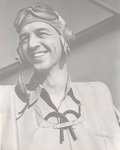
Thanks for posting his picture of my father's plane taking off for morning CAP duty. Below is a shot of him taken aboard Hornet around 8 June by that ship's company photographers. What you don't know is that the F4F used in this shot aond other shots, as well as some film later incorporated into John Ford's documentary was the same F4F over and over. They took a VF-8 F4F, slapped a rising sun victory flag under the cockpit and shot every pilot with one credit. Then, slapped on a second rising sun and shot all those with two; a third rising sun and those with three, and so on. I have a picture of my father after the battle (actually I've quite a few pictures of quite a few VF-3-42 pilots, before and after the battle) sitting in the cockpit of this particular airplane with four rising suns dancing down the side. He was credited with two enemy planes near Tulagi on 4 May 42, one at Coral Sea, and one at Midway. But that was not the plane (b/n 5244/white 13) he flew during the Battle of Midway, it was the photo prop plane from VF-8.

Below the airplane photo are photos some of the surviving VF-3 paperwork. These are recaps of VF-3 aircraft, scores, pilot status, etc. I have the originals, err, actually carbon copies (hey old timers, remember carbon paper in the pre-zerox days) of the originals.

Regards,

Rich
Attached Images
File Type: jpg After Midway.jpg (96.8 KB, 97 views)
File Type: jpg 4xJun15074x150.jpg (264.3 KB, 95 views)
File Type: jpg 4xJun15075x150.jpg (268.3 KB, 94 views)
File Type: jpg 4xJun15076x150.jpg (250.6 KB, 91 views)
__________________
hmmm ... I wonder what this switch does ...
R Leonard is offline  
Digg this Post!Add Post to del.icio.usBookmark Post in TechnoratiFurl this Post!Spurl this Post!Reddit! Wong this Post!
Reply With Quote
Old 05-31-2007, 01:25 PM   #37
Senior Member
 
Lucky13's Avatar
 
Join Date: Aug 2006
Location: Glasgow, Scotland
Posts: 7,384
Country:
Great stuff Rich! Please keep it coming....
__________________

JAN
"I´m going back to the front to relax"
"THE BLACK CATS FLIES TONIGHT"
"Find your enemy and shoot him down - everything else is unimportant!"
"When you're out of F-8's... You're out of fighters!"
Lucky13 is offline  
Digg this Post!Add Post to del.icio.usBookmark Post in TechnoratiFurl this Post!Spurl this Post!Reddit! Wong this Post!
Reply With Quote
Old 06-01-2007, 10:17 AM   #38
Senior Member
 
R Leonard's Avatar
 
Join Date: Dec 2004
Location: Virginia
Posts: 423
Country:
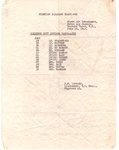
This is the tactical organization of VF-3 drawn up as of 31 May 1942 after the Exec, Lt Cdr Don Lovelace, was killed in a flight deck crash. Each section is assigned a color and that color along with the nominal side number was the official radio call sign for that individual and plane. The document shows, for example, my father as leader of the 3rd Division in 3-F-13, having moved up to Exec to replace Lovelace. His call sign was Blue-13. The reality was that the ship would communicate only with the division leader using his call sign. Within and between divisions communications were usually by first names. There were a few exceptions to that. Thach told Tom Cheek, for example, in 3-F-5 that he (Thach) would call him “Sam” as his fellow Machinist pilot, DC Barnes, was already called “Tom”. RAM Dibb, of course was called “Ram”. Years later, in the Pentagon, Cdr Tom Cheek would run into Admiral Thach in a hallway and was greeted with a “Well, Sam, how have you been.” Tom once remarked, “I guess I was ‘Sam’ forever.”

As another note, although each pilot was assigned a particular plane, one actually took what was available in the launch spot. That’s why you see in the histories that Thach flew 3-F-23 in his morning strike escort mission; that plane was first in line and ready to go. Of course, later, when he also went to add his greetings to the incoming Japanese torpedo planes, he was in his assigned mount, 3-F-1; one, because it was ready and, two, because my father, as Exec/Flt Officer, ordered 3-F-23 struck for battle damage repairs. Of twenty-five VF-3/42 pilots flying at Midway only four, Thach (in 3-F-1 b/n 5171 in the afternoon), Leonard (3-F-13 b/n 5244), DC Barnes (3-F-17 b/n 5142), and Bass (3-F-22 b/n 5050) actually flew their assigned aircraft. Also, for all you purists, I use the convention “3-F-x” to identify specific aircraft because I like to, in actuality, only the plane number itself was painted on the airplane, thus the number one would have seen on the side of Thach’s plane in the morning strike was plain white 23; my father’s was plain white 13; the “3-F” part was eliminated early in the war for security reasons.

Anyway, my father snatched this document (a mimeograph) from the VF-3/42 ready room and shoved it in the pocket of his flight jacket before taking off from the ship to greet the incoming Japanese torpedo planes. It is, perhaps, the only original, surviving, pre-battle, document from VF-3 at Midway. As far as I know, there is only one surviving, battle time period related, document for VF-3, an aircraft operations and maintenance report (the ubiquitous “yellow sheet”) for b/n 5165, 3-F-6, flown in the dawn CAP by John Bain and, then, in the morning strike escort by Brainerd Macomber. I believe the document is retained the crew chief for this plane. 3-F-6 was struck for battle damage repair and was lost when Yorktown sank.

Rich
Attached Images
File Type: jpg 4x5 B4 Midway battle tactical org VF-3 150.jpg (411.9 KB, 91 views)
__________________
hmmm ... I wonder what this switch does ...
R Leonard is offline  
Digg this Post!Add Post to del.icio.usBookmark Post in TechnoratiFurl this Post!Spurl this Post!Reddit! Wong this Post!
Reply With Quote
Old 06-01-2007, 10:23 AM   #39
Senior Member
 
R Leonard's Avatar
 
Join Date: Dec 2004
Location: Virginia
Posts: 423
Country:
more Midway stuff

This is one of the maps issued to Yorktown fliers prior to the Battle of Midway showing Midway and surrounding atolls.

R
Attached Images
File Type: jpg 4x5 Midway Map Issued for operation 150.jpg (341.9 KB, 92 views)
__________________
hmmm ... I wonder what this switch does ...
R Leonard is offline  
Digg this Post!Add Post to del.icio.usBookmark Post in TechnoratiFurl this Post!Spurl this Post!Reddit! Wong this Post!
Reply With Quote
Old 06-01-2007, 11:20 AM   #40
Senior Member
 
syscom3's Avatar
 
Join Date: Jun 2005
Location: Orange County, CA
Posts: 8,473
Thanks Leonard!
__________________
"Pilot to copilot..... what are those mountain goats doing up here in the clouds?"
syscom3 is offline  
Digg this Post!Add Post to del.icio.usBookmark Post in TechnoratiFurl this Post!Spurl this Post!Reddit! Wong this Post!
Reply With Quote
Old 06-01-2007, 04:51 PM   #41
Senior Member
 
Lucky13's Avatar
 
Join Date: Aug 2006
Location: Glasgow, Scotland
Posts: 7,384
Country:
Very, very much appreciated Rich, thanks a bunch!

__________________

JAN
"I´m going back to the front to relax"
"THE BLACK CATS FLIES TONIGHT"
"Find your enemy and shoot him down - everything else is unimportant!"
"When you're out of F-8's... You're out of fighters!"
Lucky13 is offline  
Digg this Post!Add Post to del.icio.usBookmark Post in TechnoratiFurl this Post!Spurl this Post!Reddit! Wong this Post!
Reply With Quote
Old 06-01-2007, 05:06 PM   #42
Senior Member
 
Lucky13's Avatar
 
Join Date: Aug 2006
Location: Glasgow, Scotland
Posts: 7,384
Country:
Is this young fellow your father Rich?

LEONARD, WILLIAM NICHOLAS, LT(jg), USN

Leonard, William Nicholas- Pilot
Born: 12 January 1916
Died: Currently Living in Virginia Beach, VA
Enlisted: 1934
USNA Class: 1938
Rank: LT(jg)
Squadron: Fighting Three (VF-3)
Carrier: Yorktown
Assigned A/C: F4F-4, F-13, BuNo 5146


An Army Brat, William N. Leonard is a 1938 graduate of the U.S. Naval Academy. Upon graduation he served on the USS Honolulu (CL-48.) and USS Arkansas (BB-33) for the, then, mandatory two years fleet service before attending flight school. He went to Pensacola in June, 1940 and was designated Naval Aviator # 6953 in January, 1941. His first assignment was to VS-41 on the USS Ranger (CV-4), flying SBU-1's. The squadron was redesigned VF-42 and transitioned to the F4F-3 beginning in March 1941 and completing the process in early may. Following deployments on the Ranger and the USS Wasp (CV-7), VF-42 was assigned to the USS Yorktown (CV-5) in June, 1941 to replace the nominal Yorktown fighter squadron, VF-5, which was to make the transition from F3F biplanes to F4F’s. VF-42 stayed on the Yorktown through the Neutrality Patrols period and remained with the ship when she departed for the Pacific on December 16, 1941.
VF-42 was the fighter squadron on the Yorktown through the Battle of the Coral Sea. Upon the ship’s return to Pearl Harbor at the end of May, 1942, Leonard, then a Lieutenant (jg), was the senior of the sixteen VF-42 pilots sent to Kaneohe NAS to join up with the eleven pilots of Lieutenant Commander John S. ("Jimmie") Thach’s VF-3 for the Midway deployment. When VF-3, flying F4F-4's, flew out to the Yorktown on May 29th, Thach was commanding, LCDR Don Lovelace was Executive Officer, and Leonard was Flight Officer. Lovelace was killed that day in a tragic flight deck crash. Leonard, as the next senior pilot, was assigned the additional duty of Executive Officer. Servicing the squadron were the crewmen from VF-42 who had remained on the ship. Following the sinking of the Yorktown, the majority of the VF-3 pilots ended up on the USS Hornet (CV-8.) in a composite squadron commanded by LCDR Thach, made up from the Yorktown pilots and the remaining VF-8 pilots. Returning to Pearl Harbor on June 13th, the planes of this squadron were launched; the VF-8 pilots flew to Ewa MCAS as did Leonard and the VF-42 contingent of VF-3. Thach and the remaining VF-3 pilots landed at Kaneohe NAS. Shortly thereafter, Fighting 42 was decommissioned; most flying personnel were sent back to the mainland and most crewmen were reassigned to other squadrons in the theater.

In August, 1942, Leonard, who had been promoted to Lieutenant in June, was assigned to VF-11 and deployed with that squadron as to Guadalcanal in April 1943. VF-11, in F4F-4's, operated out of the Fighter 1 auxiliary field near Henderson Field until July 1943. VF-11 was one of the last squadrons to fly the Grumman F4F in combat operations. It was during this tour that Leonard scored his 5th and 6th confirmed victories. Leonard flew some 170 combat missions during the war.

After that tour, Leonard was assigned to the Commander Fleet Air, West Coast (CFWC) staff, working on fighter doctrine and training new fighter pilots until November 1944. During this period he flew the noted "Aleutian" A6M2-21 Zero fighter (b/n 4593) and the Ryan XFR-1. He was then assigned to Task Force 38 as assistant operations officer on the staff of Vice Admiral John S. McCain, whose operations officer was Commander Thach. He was in this position when the war ended, through November, 1945.

As his next assignment, Leonard, now a Commander, was assigned to NATC at the Patuxent Naval Air Station. In this assignment he flew more than 20 different types of aircraft, including the P-59, P-80, P-51, RAF Mosquito, F6F, F7F, F8F, F4U, F2G, XF15-C, FH, FJ, XBT2D, AM, TBM, SB2C, PV, PBJ, and PB4Y. In January 1946, in a P-59B, he became the 73rd naval aviator to qualify in jets.

In 1948, he was in command of VF-17A (soon thereafter designated VF-171) when it became the first Navy jet squadron and the first jet squadron to qualify for carrier operations. During his tour as CO of VF-171 he presented testimony to Congress in the B-36 hearings regarding the Navy’s ability to perform intercepts at altitudes greater than 50,000 feet using F2H Banshees.

Other operational assignments included Commander, Air Group 17; Executive Officer, VX-3 (all-weather operations); Commander, VX-5 (special weapons delivery); Executive Officer, USS Bonhomme Richard (CV-31); Captain, USS Salamonie (AO-26); Captain, USS Ranger (CVA-61); Commander, Carrier Division 14 (USS Wasp, CVS-18.); and Commander, Naval Safety Center. During a tour in OPNAV (OP-55) in the mid 1950's, Leonard directed the team responsible for developing the military requirements/specifications that led to the A-6 series all-weather attack airplane. CARDIV14, during Leonard’s time as its Commander, was the primary recovery group for the Gemini series of manned space expeditions.

Even with the loss of information on flights recorded in his first logbook (it went down with the Yorktown), in all, Leonard logged some 4087 flight hours, including 2761 hours in propeller driven aircraft and 1326 hours in jets,, approximately 2600 hours in VF/VA types and 150 hours in VT types, and 330 carrier landings. He has flown some 82 different aircraft or major model variants.

He retired in July 1971 as a Rear Admiral and lives in Virginia Beach, VA. RADM Leonard was awarded the Navy Cross for action in the Battle of the Coral Sea and a second Navy Cross for action at the Battle of Midway. His other awards include: the Legion of Merit, with Combat ‘V’ and star for 2nd award; the Distinguished Flying Cross; the Bronze Star, with Combat ‘V’; the Air Medal, with gold stars for 5 awards; the Joint Service Commendation Medal; a Presidential Unit Citation; the Navy Unit Commendation, with star for 2nd award; the American Defense Medal, with ‘A’ for Atlantic Neutrality Patrol service; the American Campaign Medal; the Asia-Pacific Campaign Medal, with 5 stars; the World War II Victory Medal; the Occupation Medal; the National Defense Ribbon; and the Philippines Liberation Medal, with 2 stars.
__________________

JAN
"I´m going back to the front to relax"
"THE BLACK CATS FLIES TONIGHT"
"Find your enemy and shoot him down - everything else is unimportant!"
"When you're out of F-8's... You're out of fighters!"
Lucky13 is offline  
Digg this Post!Add Post to del.icio.usBookmark Post in TechnoratiFurl this Post!Spurl this Post!Reddit! Wong this Post!
Reply With Quote
Old 06-01-2007, 09:06 PM   #43
Senior Member
 
R Leonard's Avatar
 
Join Date: Dec 2004
Location: Virginia
Posts: 423
Country:
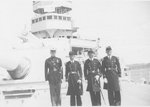
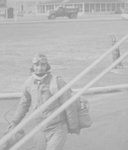
Yep, that’s the guy. He left Va Beach and moved in with me in early 2001. He passed away in August 2005. Here’s a couple of before and after . . . first, on the deck of USS Arkansas in late 1939. Gents in the photo are, left to right are 2d Lieut Merrill M Day, Ensign Bradley Sullivan, Ensign William N Leonard, and, someone else you may have heard of, Ensign George L Street. Day ended up a Colonel in the Marines, retiring in 1964 and passing in 2005. He commanded the 3d Marine Regt in 1955. On Sullivan, I can find no information. Street went to submarines, retired a Captain in 1966 and passed in 2000; From Richmond, VA, Street was USNA class of 1937, a year ahead of my father. He married a Norfolk girl, as she was known in my family “the lovely Mary Martha,” who was my mother’s best friend. My parents met for the first time at their wedding where both were in the wedding party. Street was awarded the Medal of Honor for action as commander of USS Tirante during WWII. Next photo is at Pensacola while my father was in flight training in the fall of 1940. The two diagonal objects in the foreground are wing supports for a trainer. Third photo jumps ahead 30 years and he is a Rear Admiral.
Attached Images
File Type: jpg 4x5 USS Arkansas 1939 150.jpg (99.2 KB, 88 views)
File Type: jpg 4x5 WNL TrnRon 3 P-cola fall 1940 150.jpg (132.4 KB, 90 views)
File Type: jpg 4x5 WNL RAdm 150.jpg (174.4 KB, 88 views)
__________________
hmmm ... I wonder what this switch does ...
R Leonard is offline  
Digg this Post!Add Post to del.icio.usBookmark Post in TechnoratiFurl this Post!Spurl this Post!Reddit! Wong this Post!
Reply With Quote
Old 06-01-2007, 09:18 PM   #44
Senior Member
 
R Leonard's Avatar
 
Join Date: Dec 2004
Location: Virginia
Posts: 423
Country:
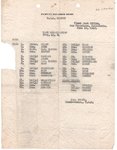
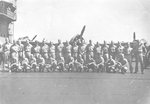
After Midway, most of the remaining VF-3/42 pilots and their planes went over to USS Hornet to replace that ship’s VF-8 losses (ten of the VF-8 fighters ditched in the open sea due to, charitably, navigation errors. Thach commanded the new organization, called VF-3-42-8, and he retained my father as Exec even though there were more senior VF-8 pilots available. The below document is the division and section organization for the combined squadrons. Below that is a photo showing the pilots of VF-3-42-8. They are, front row, kneeling, left to right: AE Dietrich (VF-8), ED Mattson (VF-42), JP Adams (VF-42), MI Cook (VF-8), RS Merritt (VF-8), LC French (VF-8), G Formanek (VF-8), CB Starkes (VF-8), DC Sheedy (VF-3), ET Stover (VF-8), RZ Hughes (VF-8), HA Bass (VF-3). Back row, standing, left to right: MK Bright (VF-3), DC Barnes (VF-3), JC Smith (VF-8), DB Freeman (VF-8), HA Fairbanks (VF-8), RAM Dibb (VF-3), WW Ford (VF-8), BL Harwood (VF-8), JS Thach (VF-3), HA Carey (VF-8), JF Sutherland (VF-8), WW Barnes (VF-42), AJ Brassfield (VF-42), GF Markham (VF-42), JB Bain (VF-42), RG Crommelin (VF-42), WN Leonard (VF-42), WA Haas (VF-42).
Attached Images
File Type: jpg 4x5 Midway Task Org VF-3 -42 -8 150.jpg (329.8 KB, 92 views)
File Type: jpg 4x5 VF-3-42-8 aboard CV-8 150.jpg (216.4 KB, 90 views)
__________________
hmmm ... I wonder what this switch does ...
R Leonard is offline  
Digg this Post!Add Post to del.icio.usBookmark Post in TechnoratiFurl this Post!Spurl this Post!Reddit! Wong this Post!
Reply With Quote
Old 06-01-2007, 09:21 PM   #45
Senior Member
 
syscom3's Avatar
 
Join Date: Jun 2005
Location: Orange County, CA
Posts: 8,473
Rich, how did your dad get into naval aviation.

I remember hearing Ken Walsh speak (some years ago) and he said that during the depression years, to get into naval aviation you needed a lot of smarts, drive, determination and luck.
__________________
"Pilot to copilot..... what are those mountain goats doing up here in the clouds?&qu